Shit, why not?

I have now officially jumped into the Pacific Ocean naked. I don’t have a bucket list in life, but if I did, that would definitely be on it.

After leaving the bar tonight, some friends and I decided to close out the night with a walk to the beach. We are staying in a vacation home just a minute walk from the beach. At night, the walk is quiet and peaceful. There is no better way to end a night.. except perhaps with a beautiful sunrise.

Towards the end of our time on the beach, a friend turns to me and says, “Hey Alex, what do you think about jumping in naked?”

I immediately shoot back: “Shit, why not? Lets do this.” And then I start taking off my clothes as a sign of commitment.

One other friend commits to it, and in a few minutes we are down to our boxers.

3… 2… 1.. go! I drop our boxers and run for the waves. My feet slosh through the wet sand as I run towards a small wave coming up. I take a few steps into the water, collect myself, and then jump into the wave.

Splash!! I land jump past the wave, and hit the water, immediately getting getting my whole body wet. Luckily, the water is warm.

I look around and my two friends are in the water also. We share some laughs and then enjoy the moment. It feels so good to be in the water. We let a few waves drag us back and forth, stand up, and take it all in. The shoreline, waves, palm trees, and night sky.. they are all perfect.

A picture would be perfect for commemorating the moment. Except for the fact that we are naked, and a picture would be a horrible idea. We high five, and then walk back to our clothes.

“Shit, why not?”

Almost every time I find myself saying this, something awesome happens.

It always begins the same way. I hear a thought or challenge that sounds a bit absurd. At first, it feels slightly wrong, or even scary. And then I realize that there are almost no negative consequences. Furthermore, it passes my 80-year deathbed test. That is, I know that when I am on my deathbed, I will be glad that I did it.

When these circumstances pop up, there is only one answer.

That is why I found myself naked in the warm waters of Hawaii tonight. It is also why I quit my job to give the startup thing a try. There are no real downsides, and when I am on my deathbed, I will be glad I did it. So, “shit, why not?”

P.S. This is post number #87 in a 100 day blogging challenge. See you tomorrow!

Follow me on Twitter @alexshye.

Or, check out my current project Soulmix.

The island spirit

oahu-beaches-hanauma-bay-hawaii

I’m currently in vacation mode on a week-long trip to Hawaii, and its been a blast so far.

Getting away is always a good idea, but there is something special about Hawaii. Every time I visit (this is the fourth time), I come away amazed with the culture. Perhaps it is the sun, but I’m fairly sure that it is more than that. I hear it called the Aloha spirit and whatever it is, it seems to be an awesome thing.

People here seem genuinely happier and friendlier than I am used to. They seem to be less preoccupied with the shallow worldly things, and more connected with themselves, with others, and with nature. I say “seem” because that is what it is. I don’t actually know the culture, but from all observations, it seems to be true.

In any case, it is a big change from hustle in Silicon Valley. Innovation is great, but I think it is important to remember that focus should still primarily be on the important things in one’s life: family, friends, fellow human beings, and the world around us.

P.S. This is post number #86 in a 100 day blogging challenge. See you tomorrow!

Follow me on Twitter @alexshye.

Or, check out my current project Soulmix.

Minimizing cognitive load in design

brain

Yesterday, I wrote on the three things I believe to be important in design.

I’d like to delve a little more into minimizing cognitive load. It sounds like a simple statement, but actually means a lot.

Minimizing cognitive load means that you respect the user’s time and attention. They are using your product to get something done, and you want to enable them to do it with as little extra mental processing as possible.

Minimizing cognitive load means reducing extraneous clutter. Clutter makes a page difficult to process. The user must filter through several bits of information before finding what really matters to them.

Similar to clutter, minimizing cognitive load means reducing distractions. The unfortunate part is that for most websites on the internet, ads count as clutter. They provide little value and act as something the user must dodge.

Minimizing cognitive load involves an understanding of the user’s attention and focus. At any given point, what are they trying to do? How do you make it as easy as possible for them to accomplish this? This requires a great deal of empathy for the user.

Minimizing cognitive load involves an understanding of the user’s habits and behaviors. Are there common behaviors performed by the user? What are the most important things your user does? What patterns of behaviors do your users have? How do you design in order to make these behaviors as streamlined as possible for your user?

Minimizing cognitive load tends to imply simplicity. Distilling a product to its core concepts makes it easier for the user to figure out what is going on. However, don’t over simplify. A product which is over simplified can be confusing and difficult to figure out.

Can you think of anything else? The more I think about design, the more I believe that enabling the user while minimizing cognitive load is one of the most difficult parts of design. If you know of any good resources or tips, I would love to hear them.

P.S. This is post number #84 in a 100 day blogging challenge. See you tomorrow!

Follow me on Twitter @alexshye.

Or, check out my current project Soulmix.

Good design

Apple Macbook Air

I’m not artist or designer, but I have spent enough time studying good products on the web (as well as studying why my past products have sucked) to have some initial thoughts on it.

From my limited experience, design can be boiled down to three main points.

  1. Good design is useful. It enables the user to easily do what they want to do.
  2. Good design minimizes cognitive load. It respects the user’s time and attention.
  3. Good design is beautiful, without sacrificing utility or increasing cognitive load.

Only three things, but it is difficult to accomplish all three. If you product is useful, minimizes cognitive load, and is beautiful, you have done one hell of a job.

What does good design mean to you?

P.S. This is post number #83 in a 100 day blogging challenge. See you tomorrow!

Follow me on Twitter @alexshye.

Or, check out my current project Soulmix.
Be good (the startup version)

Yesterday, I wrote on a big lesson that consistently pops up in my life: be good. The lesson is simple: if you want something, the only thing that matters is to be good.

Most recently, I have been learning this lesson with respect to startups.

When I quit my job in April 2012, I had no idea what I was doing. I only knew that I wanted to create an impact in the world, and that I probably had to figure it out on my own.

The first thing I did was consume everything I could find on the web and in the bookstore. I devoured books and blog posts. I watched as many videos as I could find from founders I respected. I browsed Hacker News daily, reading a good fraction of all the posts on the front page. At the same time, I started doing a lot. I picked up web programming. I started blogging. I continually networked as best I could, taking coffee meeting after coffee meeting.

In the first year, I met a lot of people, and learned a great deal about the VC and tech world. However, I hadn’t built anything worth anything. I had built and scrapped three prototype products. So where was my startup? At ground zero.

After I scrapped my third code base, I remembered that lesson that I always seem to come back to: be good.

Since then, I’ve browsed Hacker News a lot less. I’ve drastically cut back on coffee meetings. Instead, I spend almost all of my time building and iterating on product.

Why?

A startup is defined by it’s product. Build a great product, and you’ve built the beginnings of a great startup. Fail to build a great product, and there is no startup.

You can have the greatest network in the world, but without a good product, you are just simply good at schmoozing and connecting with people.

You can figure out a way to raise millions of dollars, but without a good product, you aren’t a startup. You are just a bank account.

You can churn out thousands of lines of code, but if it doesn’t turn into a good product, those lines of code are going to be thrown away.

You can build your Twitter and blog following, but without a good product, you are a talking head.

You can read all of Hacker News, Techcrunch, etc. but without a good product, you are just a listener.. most likely listening to a bunch of talking heads.

You can learn all you want about growth hacking, but without a good product, you have nothing to grow.

Only one thing matters in building a startup: being good at building product.

And how do you build a great product?

I wish I could answer that one. I only know that the start of that answer again is to be good. I don’t think there are any tricks. Great products don’t just pop out of thin air. They are created by people who are good at building product that people want.*

Knowing this, there is only one thing to do: focus on understanding great consumer web/mobile products. I’m not good yet, but hopefully if I keep focusing and working, I’ll get there one day.

* One may say there is some luck involved, and I would agree. But it isn’t all luck, and the best way to maximize your luck is to be good, and be persistent.

* You may ask why I am blogging. First, I am rounding out this 100-day challenge. Second, and more importantly, I have learned that blogging everyday forces me to reflect and think about the big picture on a regular basis. This forcing function has actually been great. So even if I write horribly with typos and grammatical errors all over the place, the writing is really good for me. I’m not sure what I’ll do when the blogging challenge is over, but I may keep writing everyday.

P.S. This is post number #82 in a 100 day blogging challenge. See you tomorrow!

Follow me on Twitter @alexshye.

Or, check out my current project Soulmix.
Be good

I like the idea of using this blog to note big lessons that I have learned in life. I have already written about the most important lesson I’ve ever learned (just do it!), as well as another important lesson on how the world is gray.

There is another big lesson that consistently pops up in my life: be good.

There are so many things some we may strive for in life. We want to be happy. We want to attract the opposite sex. We want that girlfriend/boyfriend, and that great wife/husband. We want that awesome job. We want that next promotion. We want to be socially aware. We want to be great leaders. We want to be powerful speakers. We want to be charismatic.  We want to have a close group of friends. We want to truly connect with others.

There are many ways we can go about striving to attain each of these things. People will give you advice. Experts will publish online, and magazines and books. You will hear tips, tricks, and lifehacks. These are all fine, but there is only one thing that matters: be good.

What does it mean to be good? Simple. Be genuinely good at whatever it is that you want. If you aren’t good, then the only thing that matters is to get good. Tips, tricks, hacks, and advice can be good, but can also be a distraction. They only matter if they help you get good at what you want.

Here are a few examples

Happiness.

Everyone wants to be happy, but many expect it to happiness to happen to them. That isn’t the way life works.

If you want to be happy, you have to get good at being happy. It means actively recognizing and finding reasons to be happy. It means creating happiness, and exchanging it with others.

You are only happy when you get good at being happy.

Career.

We all want great jobs. We want that promotion. That great title. That startup exit. Or that position of respect and influence.

To get there, you will hear all kinds of advice. Dress this way. Network this way. Communicate with your boss like this. Manage your team like this. Build your product like this. Follow these steps to gain leverage in your organization.

What always gets lost in the mix is the most important thing: be good.

That is all that matters. So many people are looking to be promoted to that specific job title so that they can have influence. They have it the wrong way around. You gain a position of power when you have influence.. when you are good.

Whatever our job is, you will almost always be best served by focusing on your craft. Be good. And when you are good, figure out how to get better.

Personal relationships.

People spend an amazing amount of time thinking about how to attract a partner. They will expend an incredible amount of energy, change how they dress, how them act, how they talk, etc. As an example, just take a read through The Game, a fascinating book on the world of pickup artists.

Again, only one thing matters: be good. In this case, simply be a good person. Have a set of values. Stick to them. Genuinely care about others. Respect others and respect yourself.

If you want that great girl, be a great guy. If you aren’t a great guy, she will find out. And vice versa. You can’t trick someone into thinking you are someone else.. at least not in the long term. If you are smart about it, your best bet is to just focus on being awesome.. and then that awesome person will like you.

See the pattern here?

I could go on and on.

I often go through the same pattern. First, I find myself wanting something. I find myself thinking about it, reading material, and trying tips and tricks. After investing some time in it, I realize that only one thing matters: be good.

It happens time and time again across many aspects of life.

I’m now in the process of trying to imprint this lesson into my head. Writing it down helps.

Is there something you want to be or achieve? Be good. That is all there is to it.

P.S. This is post number #81 in a 100 day blogging challenge. See you tomorrow!

Follow me on Twitter @alexshye.

Or, check out my current project Soulmix.
Startups, money, and happiness

money-happiness

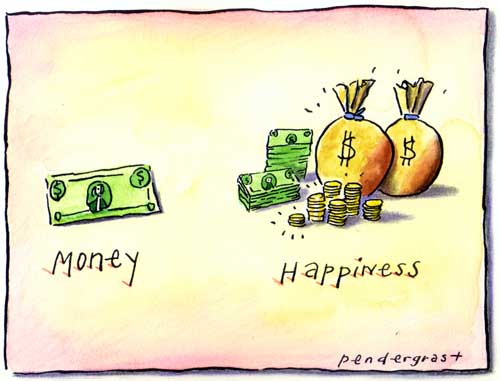
A commonly cited Princeton study on money and happiness claims that money correlates to happiness until you reach a 75K/year salary. Past that, money doesn’t make you much happier.

You can argue about locations, standards of living, etc. but I think it is easy to agree that money provides decreasing marginal utility. That is, the amount of happiness you gain per dollar decreases as you make make more money.

People often think about the marginal utility of money with respect to an annual salary, but there is another interesting way to look at it: the marginal utility of money earned in a lifetime. This becomes particularly interesting for people making the decision between their tech job, and their desire to give the entrepreneur/startup thing a try.

Let us use an example of Jeff, a fictional dude that has 30 years of work in him. He has the choice to either work at a company for 30 years, or to give up 5 years of salary to give a startup a try. If we assume Jeff makes the same amount each year (which obviously isn’t true, but please just go along with it for now), Jeff gives up 16.67% of his lifetime income if he goes the startup route.

Is this a good tradeoff?

I’m going to argue that going the startup route is the right decision (granted that deep down, he really wants to try it).

Jeff only needs a certain amount of money in his lifetime before reaching of point of diminishing returns with respect to happiness. At that point, the only way to significantly increase happiness is to significantly increase the total money earned.

If Jeff’s cushy tech job pays anywhere near 6 figures (as many in tech jobs do), he is way above the 75K/year number in the Princeton study. If he gives the startup thing a try, he doesn’t stand to lose much lifetime happiness when reducing his lifetime income by 16.67%.

However, by trying a startup, Jeff gains the chance to significantly increase his happiness in two ways.

First, he gets the chance to chase a dream. The impact to happiness here is hard to measure, but it can be significant. In the short term, there are benefits to having purpose and hope while chasing your dream. In the long term, there are also big benefits. Whether he succeeds or fails, when Jeff is on his death bed, he will be proud that he gave the startup thing a try.

Second, should the startup actually make it big, he has the chance to significantly increase his lifetime earnings. By “significant”, I mean 2x, 5x, 10x , or possibly more. At these multiples, the increase of lifetime earnings can significantly impact your life happiness, and change your life style.

Yes, this example is rough, but it should be enough to get the picture. I believe that for a knowledgable and skilled person who wants to try a startup and optimize for life happiness, the rational decision is to take the plunge and go for it.

Obviously, I would say this because I’ve done it. What do you think? Does it make sense?

P.S. This is post number #80 in a 100 day blogging challenge. See you tomorrow!

Follow me on Twitter @alexshye.

Or, check out my current project Soulmix.

The problem with righteous entrepreneurship

Recently, there have been a lot of press on the troubles of VC firm Kleiner Perkins. They were once legendary in their pick of tech companies, as early investors in Amazon, AOL, EA, Google, Intuit, Netscape, Sun Microsystems, Tandem, etc. More recently, they went all-in with cleantech, and did not come out smelling so great.

Linked to the article from Gigaom is another good article this, and on the problem with righteous investing. VCs play a large role in innovation by picking and choosing the right startups to fund. However, this choice is critical. VCs can’t just pick a lofty mission, and dump money into it. As I’ve been learning (and wrote about in a prior post), the market always wins. Lofty visions are great, but there must be a market, and the market must want your product.

However, VCs are only one side of the story. The other side is the entrepreneurs. And the same law applies: lofty visions are awesome, but at some point the vision meets reality, and the reality of the market wins.

This is critical for entrepreneurs to think about. Passion matters in entrepreneurship. Most people don’t leave perfectly good jobs (with perfectly good paychecks) unless they have a passion for something. The most passionate are often driven by the largest missions, and there are many great missions out there: world peace, feeding the poor, educating the world, etc. Clean tech may be one of these (although I’d bet that timing was the real issue). These missions sound great, but can be huge traps. Maybe they would be great as a non-profit, but as a startup? Tread lightly.

This has been one of my biggest lessons so far in my time as an entrepreneur. Look at yourself and make sure you aren’t being a righteous entrepreneur. Passion is great, but the market always wins.

P.S. This is post number #79 in a 100 day blogging challenge. See you tomorrow!

Follow me on Twitter @alexshye.

Or, check out my current project Soulmix.
The rising income inequality isn’t going to stop

income-inequality

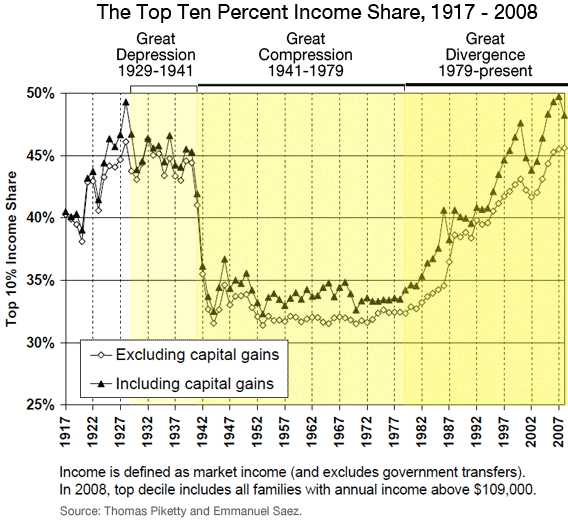
You hear a lot these days about the rising income inequality, and the strains it causes in our society. People talk about curbing this trend, but I’m not sure it is possible.

As a rough approximation, let us assume that income is proportional to the amount of value a person produces in the market. Thus, we can talk about productivity as a proxy for income. The rising income inequality means that the most productive individuals in society are distancing themselves from the least productive individuals.

This makes intuitive sense. With each scientific discovery, and with each technological innovation, we enable the most knowledgeable and most productive individuals in our society to become even more productive. However, those without the knowledge, skills, and/or motivation will still exist. As innovation continues, the distance between the most productive and the least productive will increase. And if innovation accelerates, this gap will accelerate.

I can’t see how a innovative society can avoid a rising income inequality. There are two options that I see. The first is the stop innovation by changing policy, increasing taxes for businesses, etc. The second is to figure out how to raise the productivity of the least-productive individuals in society. IMHO, the first shouldn’t be an option. The second is a tough challenge, and I don’t think we can rely on the market/capitalism. Instead, we need government programs, improved education, etc. There must be a way, but with the growing income inequality, we obviously haven’t figured it out yet.

(photo credit: slate.com)

P.S. This is post number #76 in a 100 day blogging challenge. See you tomorrow!

Follow me on Twitter @alexshye.

Or, check out my current project Soulmix.

Are startup valuations and payouts too high?

Since I have jumped into the startup game, I’ve consistently heard people comment on the high startup valuations/acquisitions and the high payouts that successful founders and early employees get in liquidity events.

These comments/complaints sound something like:

  • Snapchat just turned down 3 billion. Is it really worth that?
  • Pinterest and Dropbox have valuations of 4+ billions. That’s crazy!
  • Twitter just raised close to 2 billion on a 14 billion valuation.. built on top of a table storing 140 character tweets!
  • Tumblr? 1 billion? Damn, that is a lot of money.

There are also similar comments about the money people end up with:

  • Snapchat just turned down 3 billion? Even with modest founder equity percentages, the founders would have banked. Is it fair that they make so much?
  • Instagram had twelve people and sold for a billion? That is a boatload of money for 10+ people.
  • etc., etc., etc.

People seem to have a hard time with these kinds of numbers. Are these high numbers alright? And are the high payouts for founders and early employees fair?

I believe that for the most part, the high valuations and payouts and 100% warranted. I’m no economist, finance wizard, or even that good with numbers, but I don’t think it is difficult to come to this conclusion.

High startup valuations.

As a quick exercise, check out the market caps of the Fortune 500 companies (and these are for 2012). You see that? Apple is at 568 billion! Microsoft is at 269 billion. Those are some big big numbers.

People squawk about startups valued at a few billion. Seriously? They don’t believe that a startup could speculatively be valued at 1% of Apple? At some point, the breakout unicorn startups will be surely be worth a few percent of Apple. And possibly more in the future if they do a great job.

Individual don’t usually deal with huge numbers in their bank accounts, but businesses do. You shouldn’t be stunned with you see billions in the business world. It is a regular thing for the real large successful companies out there.

 High founder and early employee payouts.

The real insight here is this: a person’s pay should be related to the value they bring to the market.

It can be easy for employees of large corporations to lose sight of this. Why? Because they go to work everyday, and collect a nice paycheck regardless of the value they bring to the market. The employee doesn’t directly bring value to the market. Instead, the business does. The business is a money making machine, and it pays employees to keep this money making machine sustainable.

Founders and early employees have a different job than employees. Their job is to figure out how to create value for the market, and then turn this value into a money making machine. Their job is to create the beast which, if successful, may one day have a market cap in the 10’s or 100’s of billions!

When you think this way, it surprising that founders and early employees of successful companies are well compensated? Not really.

A common dialogue.

I have many friends in the tech industry, and I have already repeated this conversation several times. In turns out, I have many friends in research, so it makes this conversation even easier. It goes something like this:

Friend: Dude, Snapchat just turned down 3 billion cash! The founders could have easily walked away with 100’s of millions cash, if not more. Isn’t that crazy?

Me: Well, it really isn’t that crazy. You’re a good software developer at Google/Facebook/etc. I bet your yearly compensation is somewhere between 150K and 200K right? Possibly more?

Friend: Yes.. that is in the right ball park.

Me: And I bet your boss makes more right? As does you’re boss’s boss. They must make 200K-1M a year depending on how big they are right?

Friend: Yes… probably.

Me: OK, well tell me: what happened to your project this last year or two?

Friend: Well we’ve been working on something, but the project just got cancelled and we’ve been put on something else. (Again, having friends in research makes this argument really easy.)

Me: Hmm.. OK. So you and your bosses are banking a cool fraction of a million per year without creating value in the world. Do you know what the Snapchat kids did? They have 30+ million active users and are sending 400+ million messages a day. It is quite a feat. That is real value, and it is real world impact. Are you telling me that they don’t deserve a payout that is orders of magnitude more than you and your boss?

Friend: Ummm….

Me: Oh yeah, and if you want another way to think about it, Paul Graham has this really good essay on how to make wealth. You should check it out.

P.S. This is post number #75 in a 100 day blogging challenge. See you tomorrow!

Follow me on Twitter @alexshye.

Or, check out my current project Soulmix.