
The rising income inequality isn’t going to stop

income-inequality

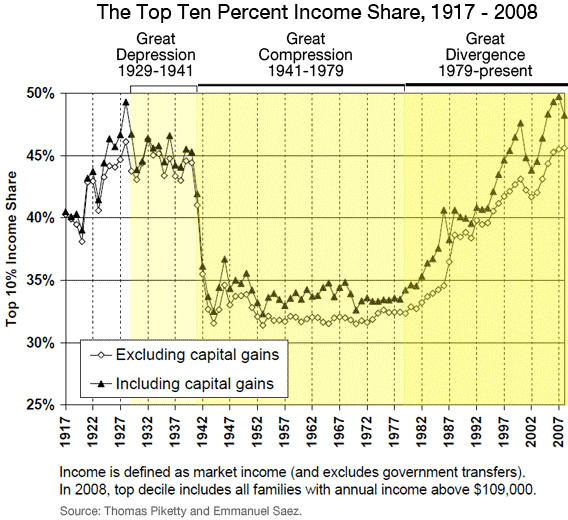
You hear a lot these days about the rising income inequality, and the strains it causes in our society. People talk about curbing this trend, but I’m not sure it is possible.

As a rough approximation, let us assume that income is proportional to the amount of value a person produces in the market. Thus, we can talk about productivity as a proxy for income. The rising income inequality means that the most productive individuals in society are distancing themselves from the least productive individuals.

This makes intuitive sense. With each scientific discovery, and with each technological innovation, we enable the most knowledgeable and most productive individuals in our society to become even more productive. However, those without the knowledge, skills, and/or motivation will still exist. As innovation continues, the distance between the most productive and the least productive will increase. And if innovation accelerates, this gap will accelerate.

I can’t see how a innovative society can avoid a rising income inequality. There are two options that I see. The first is the stop innovation by changing policy, increasing taxes for businesses, etc. The second is to figure out how to raise the productivity of the least-productive individuals in society. IMHO, the first shouldn’t be an option. The second is a tough challenge, and I don’t think we can rely on the market/capitalism. Instead, we need government programs, improved education, etc. There must be a way, but with the growing income inequality, we obviously haven’t figured it out yet.

(photo credit: slate.com)

P.S. This is post number #76 in a 100 day blogging challenge. See you tomorrow!

Follow me on Twitter @alexshye.

Or, check out my current project Soulmix.

Are startup valuations and payouts too high?

Since I have jumped into the startup game, I’ve consistently heard people comment on the high startup valuations/acquisitions and the high payouts that successful founders and early employees get in liquidity events.

These comments/complaints sound something like:

  • Snapchat just turned down 3 billion. Is it really worth that?
  • Pinterest and Dropbox have valuations of 4+ billions. That’s crazy!
  • Twitter just raised close to 2 billion on a 14 billion valuation.. built on top of a table storing 140 character tweets!
  • Tumblr? 1 billion? Damn, that is a lot of money.

There are also similar comments about the money people end up with:

  • Snapchat just turned down 3 billion? Even with modest founder equity percentages, the founders would have banked. Is it fair that they make so much?
  • Instagram had twelve people and sold for a billion? That is a boatload of money for 10+ people.
  • etc., etc., etc.

People seem to have a hard time with these kinds of numbers. Are these high numbers alright? And are the high payouts for founders and early employees fair?

I believe that for the most part, the high valuations and payouts and 100% warranted. I’m no economist, finance wizard, or even that good with numbers, but I don’t think it is difficult to come to this conclusion.

High startup valuations.

As a quick exercise, check out the market caps of the Fortune 500 companies (and these are for 2012). You see that? Apple is at 568 billion! Microsoft is at 269 billion. Those are some big big numbers.

People squawk about startups valued at a few billion. Seriously? They don’t believe that a startup could speculatively be valued at 1% of Apple? At some point, the breakout unicorn startups will be surely be worth a few percent of Apple. And possibly more in the future if they do a great job.

Individual don’t usually deal with huge numbers in their bank accounts, but businesses do. You shouldn’t be stunned with you see billions in the business world. It is a regular thing for the real large successful companies out there.

 High founder and early employee payouts.

The real insight here is this: a person’s pay should be related to the value they bring to the market.

It can be easy for employees of large corporations to lose sight of this. Why? Because they go to work everyday, and collect a nice paycheck regardless of the value they bring to the market. The employee doesn’t directly bring value to the market. Instead, the business does. The business is a money making machine, and it pays employees to keep this money making machine sustainable.

Founders and early employees have a different job than employees. Their job is to figure out how to create value for the market, and then turn this value into a money making machine. Their job is to create the beast which, if successful, may one day have a market cap in the 10’s or 100’s of billions!

When you think this way, it surprising that founders and early employees of successful companies are well compensated? Not really.

A common dialogue.

I have many friends in the tech industry, and I have already repeated this conversation several times. In turns out, I have many friends in research, so it makes this conversation even easier. It goes something like this:

Friend: Dude, Snapchat just turned down 3 billion cash! The founders could have easily walked away with 100’s of millions cash, if not more. Isn’t that crazy?

Me: Well, it really isn’t that crazy. You’re a good software developer at Google/Facebook/etc. I bet your yearly compensation is somewhere between 150K and 200K right? Possibly more?

Friend: Yes.. that is in the right ball park.

Me: And I bet your boss makes more right? As does you’re boss’s boss. They must make 200K-1M a year depending on how big they are right?

Friend: Yes… probably.

Me: OK, well tell me: what happened to your project this last year or two?

Friend: Well we’ve been working on something, but the project just got cancelled and we’ve been put on something else. (Again, having friends in research makes this argument really easy.)

Me: Hmm.. OK. So you and your bosses are banking a cool fraction of a million per year without creating value in the world. Do you know what the Snapchat kids did? They have 30+ million active users and are sending 400+ million messages a day. It is quite a feat. That is real value, and it is real world impact. Are you telling me that they don’t deserve a payout that is orders of magnitude more than you and your boss?

Friend: Ummm….

Me: Oh yeah, and if you want another way to think about it, Paul Graham has this really good essay on how to make wealth. You should check it out.

P.S. This is post number #75 in a 100 day blogging challenge. See you tomorrow!

Follow me on Twitter @alexshye.

Or, check out my current project Soulmix.
Exploring the new

In my car, I keep a pile of mp3 CDs containing various mix tapes. The mixes range from 70’s funk/soul, to 80’s big hair band rock, to 90’s old school hip hop and current house and trance music. 90% of the time, I toggle through different mix tapes when I drive. There is so much good music that has already been made that I don’t ever get bored of it all.

But every so often, I get this itch, and think to myself, “hmmm, something good must have come out”. I switch off the CD player, flip on the radio on, and then spend a few days toggling through various radio stations.

Every time I do explore the radio, something interesting happens.

At first, everything sounds so new.. and so weird. I notice how musical styles have changed. And, I notice that new artists have come onto the scene. If I’m being honest, most of it sounds pretty bad. And most of it is bad! Compared to the great 70’s, 80’s, 90’s, and 00’s, there is a lot of bad music on the radio.

I don’t know why, but I always persist with my radio exploration anyways. I think it is because I am inherently a hopeful person. I want to believe something great has been created, and I want to be delighted.

And, if I stick with it long enough (usually it is just a few days), invariably, the same thing always happens. First, I start to gain a taste for some of the new styles. Second, I always stumble across a few artists or songs that I really love. Third, and most importantly, I almost always love these new songs/artists for a new reason. A while ago, it was an obsession with John Legend. I loved how he created a modern version of the best soul music from the 70’s. Later on, it was Lil Wayne. His music was so different and out there, but his flow and his word combinations were just ridiculously awesome. Lately, I’ve grown an appreciation for Macklemore and Lady Gaga, both because they mix pop music with very important social messages.

The pattern always repeats itself. I get an itch, explore, find a lot of crap, and then find a few awesome things.

Yesterday, I kicked off the pattern again. This time, as I switched the radio on, I began to listen, and came across a bunch of crap. And then, I had an epiphany.

I knew I would come across something good at some point. And I was glad that I knew this. Exploration is the only way to discover anything new. It is the only way to keep up with the times. To some degree, it the best way to stay mentally young.

How many times have you heard the following:

  • Aww, the radio is full of shit. Back in my day, the music was way better.
  • Kids these days have crappy video games. Back in my day, we were way better off.
  • All these new apps are shit. 140 characters? Disappearing pictures? We solve real technical problems and solve real challenges.

This is what old people say. They have formed some connections in their brains, and are done with it. They have a mental model that seems complete, and they are willing to just go with it.

If you tell them to explore, they will tell you that the new stuff is full of shit. And they will be right. Most of it is. But some of it isn’t. Some of it is brilliant.. just in a different way. And these old folks who are mentally inflexible will never realize it.

So, as I switched on this radio yesterday and listened to bad music, I had this epiphany and smiled to myself. I thought of all the great artists I have discovered. I thought about how quitting my job 18 months ago to explore the new world of web/mobile technology is the best thing I’ve ever done for my career.

I know I will grow old of age, but I don’t want to grow old in the mind. I hope that I will always explore and wade through the new shit to discover the new gems and understand why they are so brilliant.

P.S. This is post number #74 in a 100 day blogging challenge. See you tomorrow!

Follow me on Twitter @alexshye.

Or, check out my current project Soulmix.

The importance of the market when building a startup

This 100-day blogging challenge is getting difficult. Now, one or two days a week, I hit a writer’s block and just can’t come up with a topic to write about. This is a big reason why I have begun publishing notes on other content. I figure if I share notes on some of the best content I have found, it may be useful to others.

Well today I’m having writers block again. I’ve been thinking about the importance of the market in building a startup, but frankly, I don’t have anything original or interesting to add to prior blog posts that I have read.

So, I’ll just leave you with the best blog post I have ever come across on this topic by Marc Andreeson of Andreeson Horowitz. Some of the best parts paraphrase Andy Rachleff, formerly of Benchmark Capital.

When discussing startups, people tend to argue about the relative importance of the team, product, and market. Marc makes a strong case that the most important factor is the market. He then describes product-market fit (PMF), which is arguably the most important step a startup can take on the road to success.

IMHO, the most important bit is here:

The #1 company-killer is lack of market.

Andy puts it this way:


– When a great team meets a lousy market, market wins

– When a lousy team meets a great market, market wins.

– When a great team meets a great market, something special happens.


You can obviously screw up a great market — and that has been done, and not infrequently — but assuming the team is baseline competent and the product is fundamentally acceptable, a great market will tend to equal success and a poor market will tend to equal failure. Market matters most.

And neither a stellar team nor a fantastic product will redeem a bad market.

And here:

The only thing that matters is getting to product/market fit.

Product/market fit means being in a good market with a product that can satisfy that market.


You can always feel when product/market fit isn’t happening. The customers aren’t quite getting value out of the product, word of mouth isn’t spreading, usage isn’t growing that fast, press reviews are kind of “blah”, the sales cycle takes too long, and lots of deals never close.


And you can always feel product/market fit when it’s happening. The customers are buying the product just as fast as you can make it — or usage is growing just as fast as you can add more servers. Money from customers is piling up in your company checking account. You’re hiring sales and customer support staff as fast as you can. Reporters are calling because they’ve heard about your hot new thing and they want to talk to you about it. You start getting entrepreneur of the year awards from Harvard Business School. Investment bankers are staking out your house. You could eat free for a year at Buck’s.

Again, you can find the entire article here, and I highly recommend it. If you have even more time, the Pmarchive contain a bunch of old posts from Marc Andreeson. They are some of the best reading you can find on building startups.

P.S. This is post number #73 in a 100 day blogging challenge. See you tomorrow!

Follow me on Twitter @alexshye.

Or, check out my current project Soulmix.

How are you going to change someone’s life?

change-your-life

Founders and entrepreneurs come up with different ways of generating and framing startup ideas. Some say to make stuff people want. Some say to make something that you want. Other may say to find a person’s pain point which you can solve/remove/relieve.

Recently, I’ve been thinking about another interesting way to frame this:

How are you going to change someone’s life?

This may be what matters the most. At the end of the day, your product must come in contact with a person, and it must drastically change their lives for the better.

  • Are you enabling people to do something they could never do before?
  • Do you help people save money? Even better, do you help them make money?
  • Time is money. Do you help people save time?
  • Do you help people improve their reputations?
  • Do you help them find/express themselves?
  • Can you help someone get famous?
  • Can you help them connect with people who matter? Or help them get laid?
  • Can you help someone get promoted?

I’ve started thinking that this is the best way to think about and frame your startup idea.

A common mistake people make (especially technical people like myself) is to get overly intellectual about a product. People will talk about features. They will talk about technical constraints and  focus on the mechanics of a product. These are all interesting, but what really matters is the impact of the product.

Facebook isn’t a social networking site. It helps you people connected with friends.

Twitter isn’t a micro-blogging platform. It helps people connect with the world.

Pinterest isn’t a curation platform. It helps people discover things they love.

Yelp isn’t a review site. It helps people decide where to eat/visit/go.

Google isn’t a search engine. It helps people find the information they need.

Focus on the user. If you can change a life, you may have a good idea on your hands.

P.S. This is post number #72 in a 100 day blogging challenge. See you tomorrow!

Follow me on Twitter @alexshye.

Or, check out my current project Soulmix.

Notes from the PandoMonthly with Mark Suster

For the past few weeks, I have been burning through PandoMonthly fireside chats and keeping notes on them. Since the talks are so long, I hope the notes will be useful in helping you determine if you want to watch the full interview.

marksuster5

Today I’ll be writing on the PandoMonthly with Mark Suster, a prior entrepreneur, a VC at Upfront Ventures, and a blogger at Both Sides of the Table. The interview is a bit under 2.5 hours, and has a ton of great advice in it.

Here are some paraphrased notes of my favorites points during the interview.

  • CEO as chief psychologist: You have sales working with marketing working with engineers, and they have different viewpoints. Everyone ends up fighting with everyone else. CEO’s job is to handle this. If the CEO wants everyone to love them, you can’t make the right decisions, and handle these problems correctly.
  • Deflationary economics: Almost every great success story on Internet is built on massively deflationary prices. Drive costs down, drive margins down, create large overall market doing so, and it is impossible for the big incumbents to beat you.
  • Finds it a shame he sold company: There were many currently successful companies built on the ideas that his company was working on. He was tired, employees were tired, etc. They ended up selling the company, and didn’t see it through, but could have had a great future.
  • Why big VC blogs in NY, Boulder, LA:  Necessity of mother of all invention. Fred Wilson (NYC), Brad Felt (Boulder), and Mark Suster (LA) weren’t plugged into Silicon Valley ecosystem. They needed to work harder to get out there. It ended up being a great investment.
  • Commercializing academic work is tough. Very difficult, especially in California. The UC system has a unified policy is they want 2% royalties on sales. That makes most of their startups untenable. If a professor is involved, it makes it worse. The tip is to not touch university resources or professors. Universities should embrace equity like Stanford.
  • Internet of everything.  Mark isn’t a big fan of wearable. He is a big fan of things talking to each other: objects all talking to each other, broadcasting, and communicating. This will be powerful for logistics, manufacturing, transportation, etc..
  • Consumer vs. enterprise. Marc Andreeson recently said that Andreeson-Horowitz generally wants to do enterprise A round, and consumer B round. Consumer is hard. Enterprise and unsexy stuff has less competition, you know users, and monetization more clear. In enterprise, you can listen to consumers. With consumer, you can’t because its always angry consumer that is loudest.
  • Keep communication simple about startup and vision. Be more like George Bush, less like Al Gore. Al Gore speaks too intelligently. Keep message simple so that everyone will easily understand it.

If you’ve got the time, check out the full interview here:

P.S. This is post number #71 in a 100 day blogging challenge. See you tomorrow!

Follow me on Twitter @alexshye.

Or, check out my current project Soulmix.

Living online documents

pages

I haven’t been treating this blog as an “actual” blog.

As a reader, I view blogs as a place for regularly published posts which are read and then immediately forgotten. As a writer, I view blogs as a place to publish a piece of writing and then move on to the next piece.

I can’t think of my blog this way.

Instead, I think of each post as an unfinished piece of work that acts a stake in the ground for an idea that may be worth thinking about. In the future, I may come back to fix up typos, grammatical errors, add/remove sentences, or even add/remove entire ideas.

This means that each post is a living online document. I wish that there was some way for the public to view it as such. Instead, people just see the new posts within their email or RSS readers. To my subscribers, I’m sorry about this. It is unfortunate because all of the ideas are half-baked and may contain some horrible typos/errors. I hope you still find the ideas interesting, and perhaps find your way back to some of the posts in the future (after the 100-day challenge when I can revisit posts).

This points to an interesting thought about online publishing. Most content online does not change. News articles don’t change. Most people don’t change their blog posts. Facebook and Twitter posts don’t change. And at the same time, content is growing at and exponential rate. The Internet is becoming a firehose of half-baked articles that could be better, but never will be.

The current Internet rewards quantity. Yet, over time, it is the evergreen quality posts that really matter. One could expect writers to publish fully formed evergreen content, but this is very difficult. What makes sense is to revisit ideas, iterate on them, and then iterate on the writing.

Is there some way to support and encourage living online documents? If someone could figure how to make living documents engaging, IMHO, the Internet would become a much better place.

P.S. This is post number #70 in a 100 day blogging challenge. See you tomorrow!

Follow me on Twitter @alexshye.

Or, check out my current project Soulmix.

Will we see more successful startups with single founders?

cofounders

Historically, most tech startups have multiple founders, especially the ones that have made it big. Think Steve & Woz, Larry & Sergey, Bill & Paul, Hewlett & Packard, Brian & Joe & Nathan (AirBnb), Drew & Arash (Dropbox), Jack & Noah & Ev & Biz (Twitter), Ben & Evan & Paul (Pinterest), etc.

It has become so ingrained in Silicon Valley wisdom that life as a single founder is very difficult. Because of this, it people seem to take founding teams more seriously. As an example, it seems that accelerators highly prefer cofounding teams. The partners of accelerators often say so. And from experience, I know teams of smart people with no product that have gotten YC/500/Techstars/etc. interviews (or into the programs), but very very few single founders that have gotten interviews in the same position.

To some degree, it makes sense. A startup is hard enough that it is extremely difficult for one person to get something off of the ground. And even if a single person gets something off the ground, can they build a team while growing and scaling?

Things may be tough for a single founder, but times are changing quickly.

  • Services such as  AWS, Heroku, MixPanel, MailChimp, etc. make development simple. More and more startups are popping up to improve the toolchain and sell shovels to the startup folks. It is never been easier to get a product up and running.
  • The world is becoming increasingly connected with the growing social and interest graphs. This means that for many consumer apps, distribution has never been easier.
  • Crowdfunding is starting to gain traction, as well as Angellist. It has never been easier to contact investors, as well as close a round (from what I’ve heard).
  • Accelerators are picking up and learning how to improve the chances for startup success. At the same time, founders/investors are becoming increasingly open with advice on blog posts, Hacker News, USV.com, etc. It has never been easier to gain a basic education in startups, marketing, positioning, distribution, etc.

All of these trends are continuing, and they may even be accelerating. This means that as time goes by, the amount of work necessary to build a startup decreases quickly.

It would go against common wisdom, but if the trends continue, it intuitively makes sense that we should see more single founders build large successful startups.

What do you think? As I am working alone at the moment, I surely hope this is the case.

P.S. This is post number #69 in a 100 day blogging challenge. See you tomorrow!

Follow me on Twitter @alexshye.

Or, check out my current project Soulmix.

Where ideas meet reality

tree-root

I was talking to a fellow founder today about the lessons we have learned. It is always interesting to go back and reflect on lessons learned.

Over the last 18 months, I have learned a whole lot about building a consumer product. The biggest lesson I have learned is this:

There are interesting ideas, and then there is the reality of what people want.

The reality of what people want always wins out. An idea is only good if it touches this reality. If there is a gap between your interesting idea and reality, the idea is a bad idea.

I’ve often found myself lured by the trap of interesting ideas. I don’t know if all entrepreneurs have this problem, but I surely have. I think a big part of it stems from my experience in academia where novelty is rewarded with publications.

In the real world, novelty means almost nothing.

What matters is:

  1. Whether there is a market for your product,
  2. Whether your product satisfies this market,
  3. Whether you can build this product, and
  4. Whether you can get it into the market.

And by market, I mean people. There have to be actual people out there that need your product because it dramatically changes their lives for the better.

P.S. This is post number #68 in a 100 day blogging challenge. See you tomorrow!

Follow me on Twitter @alexshye.

Or, check out my current project Soulmix.

Overvalued personal traits

halo-effect

One of the most frustrating things about human psychology is our tendency to overvalue a wide array of visible external traits.

The obvious one here is with beauty and attractiveness. When someone is attractive, we tend to assume that they also possess a number of other positive traits. Psychologists refer to this as the halo effect. This isn’t hard to believe. Just look out at the world. Look at the beautiful people in advertisements, and ask yourself, why do these beautiful people have to do with the product?

Attractiveness is overvalued within our society, even though it really has no correlation with the other positive traits.

This is just one example. There are many more.

We assume that those who are taller are more powerful, even if they aren’t

We assume that people well groomed are more respectable, even though being well groomed has no correlation to one’s integrity.

We assume that the loud ones will make good leaders, even though loudness has nothing to do with leading people.

We assume great public speakers, or charismatic people are fit for important jobs, even though they may have nothing to do with doing the important job.

We assume that decisiveness matters, even though the only thing that matters is the ability to make good decisions.

These false assumptions strongly affect the world that we live in. All of these overvalued personal traits shouldn’t matter, and yet they do. Attractive people get treated better than unattractive people. At work, the loudest are often heard the most. The charismatic interviewer tends to get the job. Our leaders tend to be tall, good-looking, well-groomed, and exceptional at public speaking.

And these false assumptions about external traits mask the important internal traits. Does someone has a strong set of values? Do they stick to their values? Are they trustworthy? Can they think through a problem? Can they think out of the box? Do they genuinely respect others? You can’t immediately tell whether someone has these positive traits, but they are the traits that really matter.

What can we do about these overvalued traits?

  1. First make sure you have the traits that matter. Be a good person. Hone your craft and up your skill level. At the same time, be aware of the overvalued traits that you can take advantage of. Some are natural, but some can be improved.
  2. If you find yourself dazzled by someones overvalued traits, be especially careful to look beyond it. If you don’t do this, you may be stuck with a bad boss, coworker, employee, friend, or significant other.

P.S. This is post number #67 in a 100 day blogging challenge. See you tomorrow!

Follow me on Twitter @alexshye.

Or, check out my current project Soulmix.