Blog updates: new domain and look!

I started this blog April 2012 with the intention of learning more about the web. I figured the web is a media for sharing and being open, so why not start a blog? The initial goals were to share my story as a first-time entrepreneur, and learn more about how publishing and web traffic works.

At the beginning, I had a tough time publishing. It isn’t easy hitting the publish button! Once the button is hit, my thoughts are no longer just my own. They are out there for the world. And what if there’s a typo? What is something is wrong? In the early days, I had a really tough time just hitting that publish button.

However, in the last 3 months with the 100-post challenge, I’ve started to gain my stride. I learned how to fit blogging into my routine, and learned that I could actually hit the publish button on a daily basis.

Awesome!

In celebration, I think it is time to make this blog more of a “real” blog. I’ve been pretty busy pivoting Soulmix lately (which I’ll probably write about soon), but I’ve updated two obvious things:

  1. A real domain: I have been sitting on this domain for a few months, but wasn’t sure if I wanted to commit the domain to the blog. Well, now it is done. This blog is now officially at alexshye.com 🙂
  2. A more real theme: I started out with the default WordPress theme. I thought it looked decent and it didn’t require any work, which is a good thing. But now that this blog is more “real”, it is time to get off the default. So here is another WordPress theme. I found it because a friend was using it, and I really like the simplicity of it.

So, here we go!

For the foreseeable future, I’m still committed to hitting the publish button on a daily basis.

I hope you’ll enjoy it. As always if you have any thoughts on the blog, I’d love to hear from you in the comments.

See you tomorrow 🙂

What content people want

Paul Graham of Y Combinator has a motto: “make something people want”.

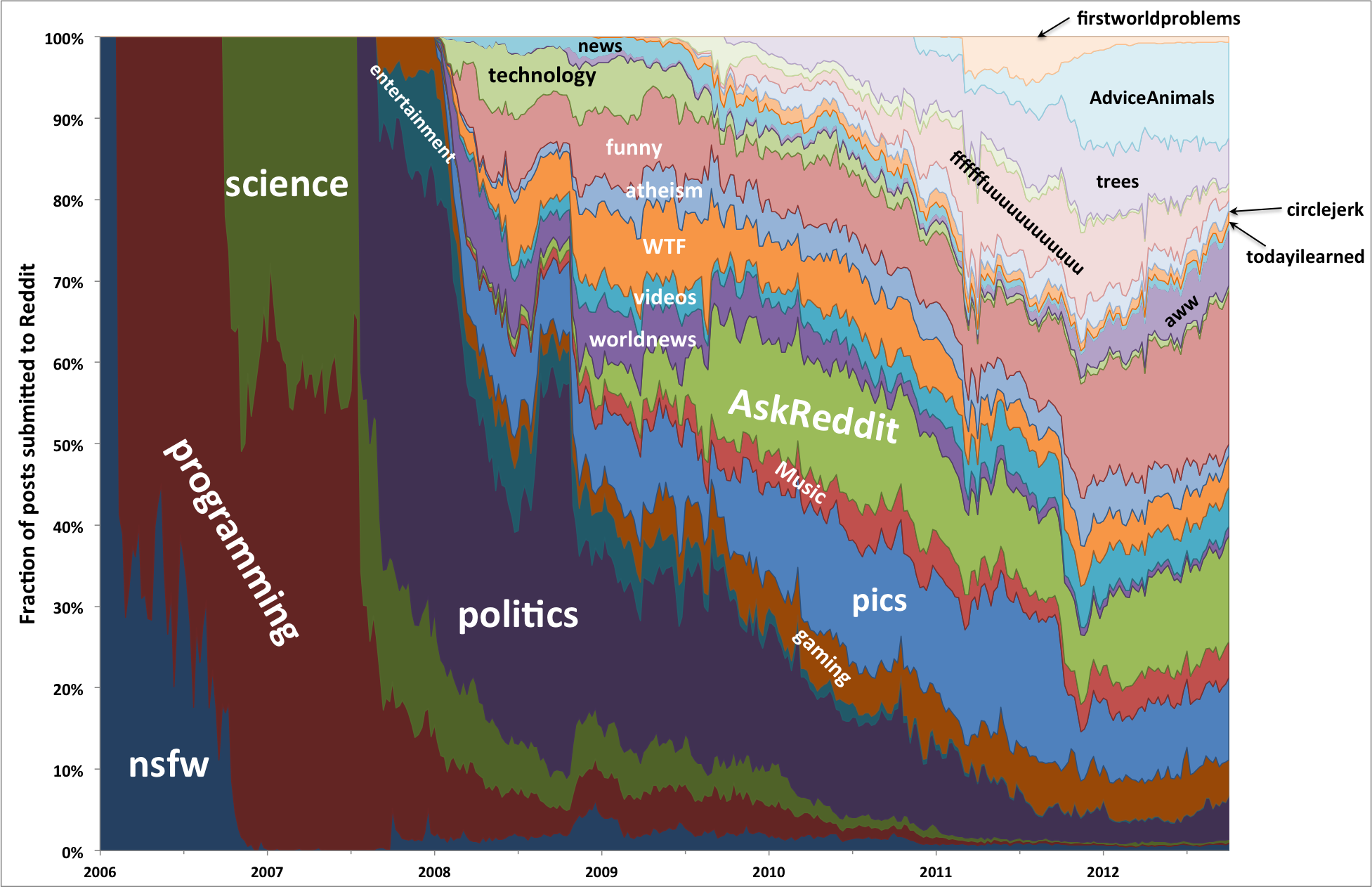
If you believe in the motto (which makes a lot of sense), and you are working on a content-related startup, Randal Olson has recently posted a gift for you. In a blog post, he shows the number of posts on Reddit across different subreddits.

A picture of the large timeline is below:

Credit: Randal Olson

Credit: Randal Olson

In this graph, you can see that Reddit gained traction within a particular niche which was most programming related (apparently this niche loves NSFW content also). In the first year or two, it covered other topics that programmers/hackers may find interesting, such as politics and science. In 2008, Reddit went mainstream, allowing users to create whatever subreddits they liked. And as a result, Reddit as a whole changed dramatically. Today’s Reddit is dominated by images, memes, videos, advice, and funnies.

Some look at it and cry out “Reddit has gone mainstream!”, or even worse, “Reddit has gone downhill with stupid memes and garbage”. That is one way to look at it. Another way to see this is to understand that the users have spoken. This is the Reddit they want. More specifically, this is the content they want.

If you are building a content-related startup, this information is gold.

If you are building a general content-related startup, you better allow users to share some combination of images, memes, videos, advice, and/or funnies.

If you are building a niche content-related startup, make sure to take a good look at this graph. The right side of this graph is what users want. If you are going to target it niche, it shows you which niches you might want to start thinking about.

P.S. On a related note, last year, I wrote a blog post on the unbundling of Reddit. It is still continuing today, and if you are building a startup that unbundles a niche of Reddit, this tells you where the big niches are.


Fred Wilson’s litmus test for startups

I just wanted to quickly share an image that I found on Quora today.

Semil Shah describes using Fred Wilson’s litmus test for looking examining startups. I’m a huge fan of simple concepts that get to the core of a problem, and will probably use this framework for thinking about my own startup as well as other startups.

Fred-Wilson-startup-testSimple equation: Person/team + idea + product + timing + market = Great.


Reflecting on 2013

jupiter-beach_sunrise

I’ve been asked a few times about my reflections on 2013, and I suppose it is high time for a reflection post.

When reflecting on long periods of time, I think it is critical to keep the big things in mind. Over the course of the year, many things have gone right, and many have gone wrong, but I mainly want to talk about the most important things in my life. For me (and for most people), it is family, relationships, and work.

Family.

After high school, I moved away for 10+ years. First it was Champaign-Urbana, IL, and then Boulder, CO, and then Chicago, IL. There were internships along the way in New York and Boston. And so I got used to seeing my family only a few times a year.

In the past 3 years, I’ve moved back near home, and it has been great. I see my parents at least a few times a month, and sometimes a few times a week. As a result, we’ve connected much more than I’ve been used to, and it has been awesome. An added benefit is that my family has been super supportive of my decision to give up the safe corporate gig and spend some time working in the startup world. My brother is in LA, but I’ve been able to make 2-3 trips down to visit him for about a week at a time.

I couldn’t ask for much more here. If anything, I’d like to visit my brother a bit more and will work on that this year.

Relationships.

I’ve had a steady girlfriend over this past year, and it has been very good. Through the relationship, I’ve learned a lot about myself, and what I want out of a relationship. More importantly, I’ve learned how important it is to commit time out of each day to spend time together and nurture the relationship.

I’ve been slowly building a new network in the startup community and that has also been great. It is good to meet like-minded people who in the same boat as I am. Before I quit my job in 2012, I knew almost nobody in the startup community. I’m nowhere near connected now, but I feel like I have some people to talk to and ask for advice when necessary.

Things haven’t all been great. Looking back, I realize that many of my relationships with past friends have weakened. Part of it is because one only has so much time in the day, and I’ve been building new relationships in the startup community. Part of it is because entrepreneur-life is just so different: I don’t feel that many of my friends understand what I am going through on a day-to-day basis. Part of it is laziness on my part. And part of it is that many of them have just started having children and their lifestyles have completely changed. Still, looking back, I’m not too happy about this, and should find a way to maintain my old friendships better.

Work.

This year, work has been awesome. The best part of being an entrepreneur is that I’m creating stuff that I want to create for the world. I shouldn’t even call it work. I should just call it “stuff I want to see happen in the world”.

2013 was full of learning. I’ve tried a lot, thought about a lot, and failed a lot. I wouldn’t really call it failure though. I’ve just built a lot of stuff that I’m not sure will work. Throughout the process, I’m gaining an education all over the map: from back-end implementation, to front-end design, UI/UX, user acquisition, online ads, positioning, marketing, blogging, etc. As the lessons build up, I’m starting to feel more capable. I feel like my gut instinct is better. I have opinions on what may work and what won’t. I think these opinions are closer to being right.

Overall.

2013 was just a great year. I feel so happy to be able to look back and say that.

The main negative from last year was that I didn’t maintain some friendships as well as I think I could have. In 2014, I’m going to put some effort into changing this.

Besides that, I hope to keep spending quality time with family, and visit my brother a bit more in LA. And, I plan to just keep chugging away at work. I have learned so much about startups in this last year that I know I need to keep at it. Who knows how much there is to learn in 2014?

Looking forward to an awesome 2014. I have the feeling that 2014 will be an epic year.

The 140-day tweet challenge

With the 100-day blogging challenge is now over, it seems like a good time to focus on building a new habit.

This last weekend, a friend and I were talking about how Twitter has been awesome for us. We use it to discover content, keep our finger on the pulse of the startup world, and connect with interesting people out there in the Twitter-sphere. However, we both mainly consume content. We don’t create much new content, and both expressed a desire to do so. And right then during the conversation, it clicked: why not do a tweet challenge?

So with that, I’d like to announce my new challenge: the 140-day tweet challenge.

The rules are simple:

  1. I will post to Twitter at least once day.
  2. The tweet must be text from me to the world. This means it isn’t a link share, an image share, a quote, or a tweet at someone else.
  3. I’ll number each day in the first tweet of the day which satisfies rule #2.

The only real restriction is rule #2. It may be restricting, but I think it is important. I already make a habit of retweeting links and quotes that I like. However, retweeting means that I am simply re-broadcasting other thoughts on the web. Rule #2 ensures that I am sharing my own personal thoughts on Twitter also.

Blogging has been great, but not all thoughts warrant a blog post. If I can blog on a daily basis, surely I can micro-blog on a daily basis also, right?

So now it is on!

You can follow my tweets (as well as tweet at me) on Twitter @alexshye 🙂

Reflecting on 100 posts in 100 days

fountain_pen1

This is a big blog post for me: it is #100 a 100-day blogging challenge!

I started this challenge exactly 100 days ago, and have hit the publish button everyday since then. Along the way, I have had a great experience. I have built the blogging habit, learned about myself, and learned a few lessons on startups and entrepreneurship. I’d like to wrap up the challenge with a reflection on the process, how things went, and my plans moving forward.

Building the blogging habit.

I wrote earlier on building my blogging habit (#35).

Much of what I wrote in the earlier post remains the same. The only important part of it all has been to commit to publishing every day. That means that I have to hit the publish button before I go to sleep. If I haven’t published, I don’t sleep. It is now almost 3am California time and I can’t wait to publish this because then I get to sleep.

One thing that has helped me blog every day is to remove process and preparation. Before this blogging challenge, I used to brainstorm ideas to write about, create outlines, write, re-write, and re-write again. All of this process and preparation creates dependencies that requires much time and thought. When trying to blog every day as a side project, all of that time is just overhead. Instead, I removed all state from writing. I simply sit down, come up with a topic, write a bit about it, and then hit publish.

Is this the optimal way to write?

I’m pretty sure it isn’t, and I’ll get back to this later. But, I am sure it is the only way that I could publish every day.

The biggest benefit to writing every day.

I outlined most of my reasons for blogging in a prior post on why I write. In the post, I describe why I don’t write, and why I do write. For your reference, I’ve listed the reasons that I write below:

  • I write to understand life.
  • I write to share my thoughts.
  • I write to understand entrepreneurship
  • I write to figure out product
  • I write to make creating and shipping a way of life.
  • I write to motivate myself.

There is a common theme among these: writing forces me to create time to think.

We are all busy in some shape or form. Each day comes with its own challenges and problems, and it can be easy to lose perspective. Writing has forced me to back out at the end of each day, and think about the big picture. This is how I come up with my daily blog topic. I think about life. I think about the life I want. I think about what matters to me. I think about my work, and how things are going. I think about product. I think about strategy. I take the multiple moving parts within my life and work, and then synthesize them to determine how things are going. Along the way, I usually come with with a few interesting thoughts, which benefits my life, and leads me to my blog topic for the day.

External benefits of blogging every day.

I most blog for internal purposes, but there are clearly external benefits to blogging every day.

First, it gives me an online presence. I have met people offline who have stumbled across my blog posts and recognize me from them. I am not Internet-famous by any means, but it is cool to be recognized from my online work (although I suppose if I actually became Internet-famous one day, it wouldn’t be cool anymore).

Second, consistent writing has helped in increasing this blog’s following. I haven’t promoted this blog much, but there is a noticeable difference in traffic. Before the 100 day challenge, I had ~100 email subscribers. As of today, I there are just under ~1000 email subscribers. This isn’t a huge numbers, and I don’t know how many of them are fake WordPress/email accounts, but the increase in subscribers is a benefit, and something that I have definitely noticed through the last few months.

Is publishing every day optimal?

In the last 100 days, I’ve learned that blogging every day is definitely doable as long as you are OK with sacrificing one thing: quality.

I occasionally go back to old blog posts, and within a minute, I’ll find a typo or a grammatical error. Those are bad, but it can get much worse. Sometimes I find my old arguments pointless or potentially wrong. Sometimes I remember points that I should have added. These are all quality problems.

If I look at my blog, I’m fairly sure that none of my best posts are in the last 100 posts. Before the challenge, I rarely blogged, but I put more thought into each blog post.

If the goal is to produce quality material, publishing every day is not optimal. However, if the goal is to produce and ship a new creation each day, publishing every day is optimal. It really depends on the goal, and I need to figure out what I want in the long term.

An alternative is to write every day without committing to the publishing every day. It would provide me the benefit of writing everyday while allowing me the time to hone each work of writing. The downsides are that (1) I’m fairly sure I wouldn’t iterate through as many thoughts, and (2) without a strict target, I might get lazy. It may be possible to make word count a strict target, but I don’t believe that is a good target. Much of revising and improving writing involves reducing word count. It may be possible to use time as a strict target, but time doesn’t always equal productivity. I need to think a bit more about this, but it could be a good option.

Where to go from here.

To be honest, I’m not sure. But I would like to be. So here is a first cut at it:

  • I would definitely like to keep writing everyday. I’m not completely sold on publishing every day, but for the time being, I think I’ll try continuing the habit.
  • I’ll lose the signature below each post. During the 100-day challenge, I wanted a signature to keep track of the number for each blog post. I figured that along the way, I’d add my Twitter as well as the project I’m currently working on. Now that the 100-day challenge is over, I’ll lose the signature
  • I plan to write more about my startup journey. Looking back, I realize I’ve written a lot about life and startups in general, but haven’t written much on my specific journey. The biggest reason for this is that it is difficult. I find myself with more questions than answers. And I find myself failing and being wrong a lot. It is hard to write when you feel you are flailing about. However, it may also be interesting to the world, and help future founders who come across this blog.
  • I will probably be more promotional. I don’t like the idea of promoting and marketing, but the fact of the matter is that it is important. Beyond that, it will be tough to write specifically about my startup journey without writing about the startup. And on the Internet, any mention of something is promotion.

Overall, I’m glad that I did the 100-day blogging challenge. Thanks to David Spinks for kicking this thing off. I’ve learned a lot about myself and startups along the way, and it has given me good momentum that I don’t want to let up on just yet.

I hope to keep writing, and I hope that this blog will get better over time. If you have any thoughts or feedback on anything, especially from the last 100 days, I would love to hear from you in the comments!

Curation as the third frontier of the web

One of my recent big interests has been related to our relationship with content on the web. I’ve written a few posts on this about the importance of old content, and on finding the best content on the web. I’ve been beginning to believe that curation will play a huge role in our relationship with content.

Today I stumbled across a great blog post that helped me crystallize more of my thinking on this topic by Patrice Lamothe (founder of Pearltrees) called The Web’s Third Frontier.

The most interesting part to me was a section on the founding principles of the world wide web:

The founding principles

These principles are simply the initial objectives that Tim Berners-Lee and Robert Caillau stated for their project. Eliminating technical jargon, these objectives can be broken down into three general, universally applicable propositions:

1-    Allow anyone to access any type of document

2-    Allow everyone to disseminate their own documents

3-    Allow everyone to organize the entire collection of documents

When I came across this, things began to make sense.

  1. Information access: The Internet allows anyone immediate access any type of document via a URL.
  2. Information dissemination: Blogs enabled simple creation of content, and timely dissemination has been enabled via mailing lists and RSS readers.
  3. Information organization: This is where we are stuck with limited options.

This is a huge insight. Access and dissemination have been solved. Organization hasn’t been solved, and it could be a game changer on the Internet.

As far as organization goes, we are limited to (1) the time-based nature of blogs and news sites, or (2) the retrieval process from automated search.

Curation provides a much-needed third option, and it sounds good in theory, but has been difficult to implement in practice. Outside of Pinterest, which is mainly about images, there hasn’t been another huge winner in this space (and many have tried!).

What will to take to crack the curation space? I can’t say I have an answer, but am starting to come up with some interesting thoughts. If you have any thoughts or opinions on current and/or future curation solutions, I would love to hear from you!

P.S. This is post number #99 in a 100 day blogging challenge. See you tomorrow!

Follow me on Twitter @alexshye.

Or, check out my current project Soulmix.

What time frame do you optimize for?

Infinity-Time1

To optimize productivity for today, I would probably continue working on exactly what I was working on yesterday.

To optimize productivity for the next few years, I would probably continue working in exactly the same area I’ve been working on for the last few years.

To optimize productivity for 10+ years, things change. I may be better off leaving my current area of expertise, and building expertise somewhere else.

To optimize for play today, I would forget about productivity and have as much fun as possible.

To optimize for play in the next few years, I would probably work in my area of expertise to maximize my pay/hour, and use that money to buy awesome life experiences.

To optimize for play in the next 10+ years, I’m not sure what I would do. My guess is that purely playing for the sake of playing would get old. I would want some sense of purpose.

To optimize my life for the now, I would probably optimize for fun.

To optimize my life in the next few years, I would probably do a mix fun, family, and purpose.

To optimize my life for 10+ years, I would probably emphasize family and purpose.

What is interesting is that as the time period changes, my actions to optimize anything also changes. It means that for any given area in life, it is important to know what time frame you are optimizing for. If your actions match the time frame you are optimizing for, you are probably in decent shape. At the very least, you are living the life you intend to life at the moment. If your actions don’t match the time frame you would like to optimize for, then something is off, and it is worth considering whether your actions or the time frame you are optimizing for is off.

I find myself performing this thought experiment from time to time and it has significantly impacted how I view my actions. Personally, I shoot to optimize for the short-term (today) a small fraction of the time (let’s say 20%), and I shoot to optimize for the long-long-term (10+ or 20+ years) most of the time. Optimizing for the now allows me to do some crazy awesome stuff and enjoy the moment. Optimizing for the long-long-term allows me to view my life as a whole, and do what I feel is right for an entire life. I’m not convinced it is worth optimizing for the medium time frames.

Have you done this thought experiment? What time frames do you optimize for, and what have you found to work best for you?

P.S. This is post number #98 in a 100 day blogging challenge. See you tomorrow!

Follow me on Twitter @alexshye.

Or, check out my current project Soulmix.


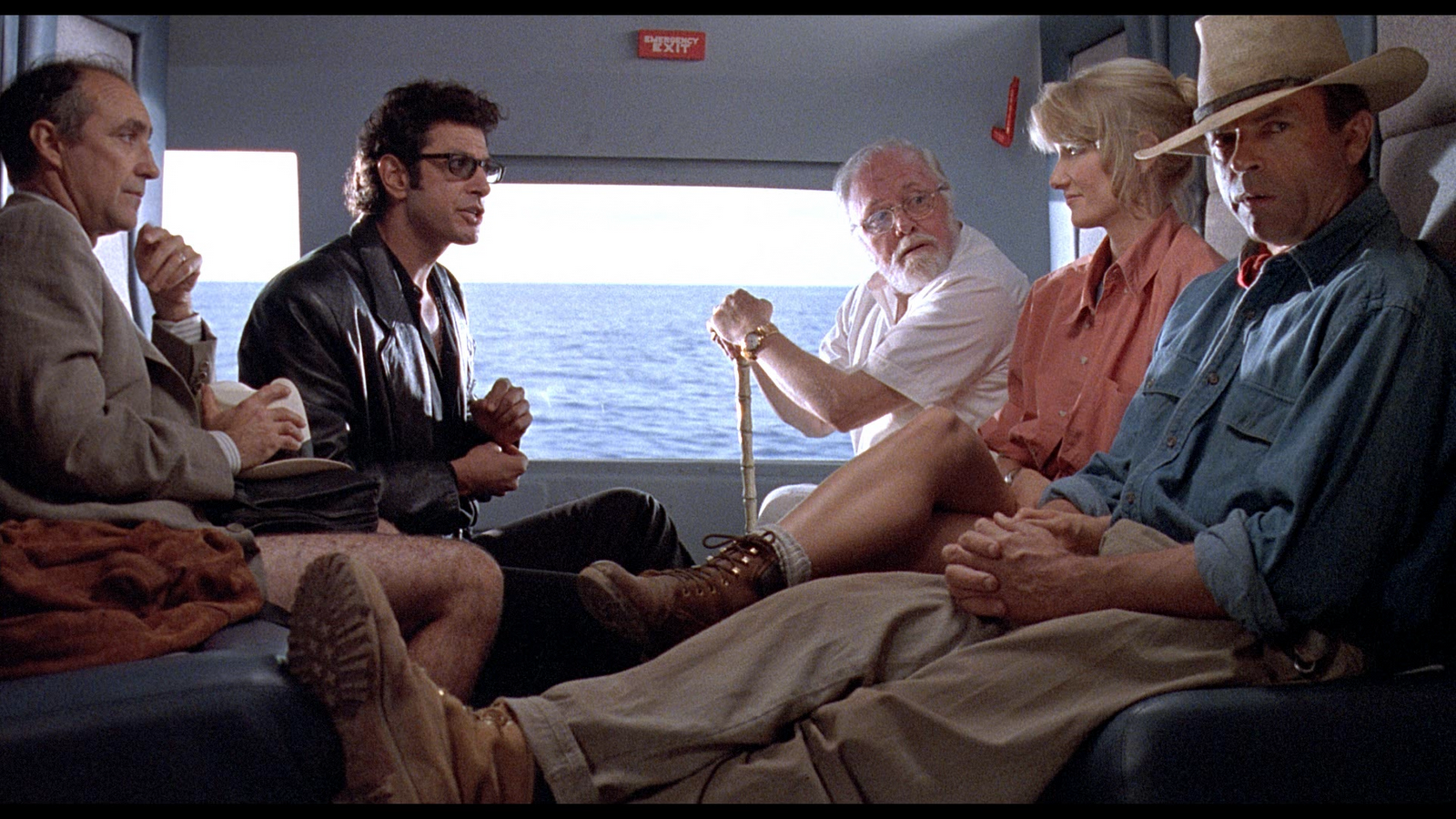
Jurassic Awesome

jurassic-park-helicopter-ride

I strongly believe in the importance of the old. Much of my favorite music is from the 70’s. Many of the best blog posts I’ve read on the web are old blog posts. Old stuff can be great. It shouldn’t just sit around occupying the dark corners of bookshelves (or of the web).

Because of this, I am always happy when something awesome from the past pops up.

Last week in Hawaii, some friends and I visited a valley used as scenery in Jurassic Park. The day before, we watched the movie. Released nearly 20 years ago, the movie is still brilliant. It seems dated, but not 20-years dated. And the soundtrack is still as beautiful as I remember it 20 years ago. I fell in love with the theme song back when it was released, and just this past week, I have fallen in love with it again.

Since then, I’ve bee playing the theme song non-stop. It is old, but damn, it is better than 99% of the stuff I could be listening to. I think I’ll keep it going for a little while longer, and then put it aside. I just hope that I will re-discover it again the near future, and fall in love with it all over again.

For those looking for a bit of nostalgia plus and extra does of ridiculous-ness, I have stumbled across 10 hours of the Jurassic Park Theme, embedded below for your aural pleasure 🙂

http://www.youtube.com/watch?v=cIWLIUwe1tE

P.S. This is post number #97 in a 100 day blogging challenge. See you tomorrow!

Follow me on Twitter @alexshye.

Or, check out my current project Soulmix.

Looking back on 2014

looking-back

Today is January 1st, 2014, the perfect time for New Year’s resolutions.

Personally, I’m not a plan of resolutions.

A resolution is something that you don’t do, but would like to talk about doing. That is why you hear everyone talk about them (and maybe even stick to them) for a few weeks, and then they fall off of the wagon.

A big problem with resolutions is that they look forward. Looking forward is difficult. The future is cloudy and fraught with uncertainties. How can we guarantee anything? In the face of uncertainty, at the very least, we can make a wish and hope that things pan out. That is how resolutions are. Resolutions are like making a wish.

It is always easier to look back. Once we have reached a point, we can simply turn around and see the path we took to reach that point. There is no uncertainty. There is just cause and effect.

We can use this observation to improve our resolutions. Instead of looking forward, let us take a look back on 2014.

If you were to look back on 2014, what would it be like? What would you like to be proud of in 2014? What would your personal life be like? What about career, or social life? How will you have grown in 2014?

Once you know the answers to these questions, there aren’t any more uncertainties. You can look back and figure out what you need to do.

If you need to pick up something new, do it.

If you need to quit something, do it.

If you need to stay on the same path, do it.

Sound good?

P.S. This is post number #96 in a 100 day blogging challenge. See you tomorrow!

Follow me on Twitter @alexshye.

Or, check out my current project Soulmix.