The personal development stigma

I’m a huge personal development nerd.

My bookshelves are lined with self-help, psychology, leadership, and management books. My favorite conversations involve personal challenges, current issues, and life goals. For the past year, I’ve been trying to work at the intersection of personal development and technology.

Unfortunately, I also feel weird about it.

I’m not particularly proud that I’ve read all my personal development books. It definitely isn’t something that I openly talk about. In general, I get this strange feeling when publicly talking about personal development.

Why is this?

The self help stigma.

There is something uncool about personal development.

If I have to guess, it is because it implies that something is wrong with you.

Bring up your own personal development in company, and you get this strange nod. Internally, they are thinking: why do you need to improve? Is there something wrong with you?

If you bring up personal development with respect to someone else, you risk implying that they aren’t good enough. In general, only close friends talk about the stuff. And even then, not often. (…at least in my personal experience)

The self-help industry doesn’t help.

In fact, it makes it much much worse.

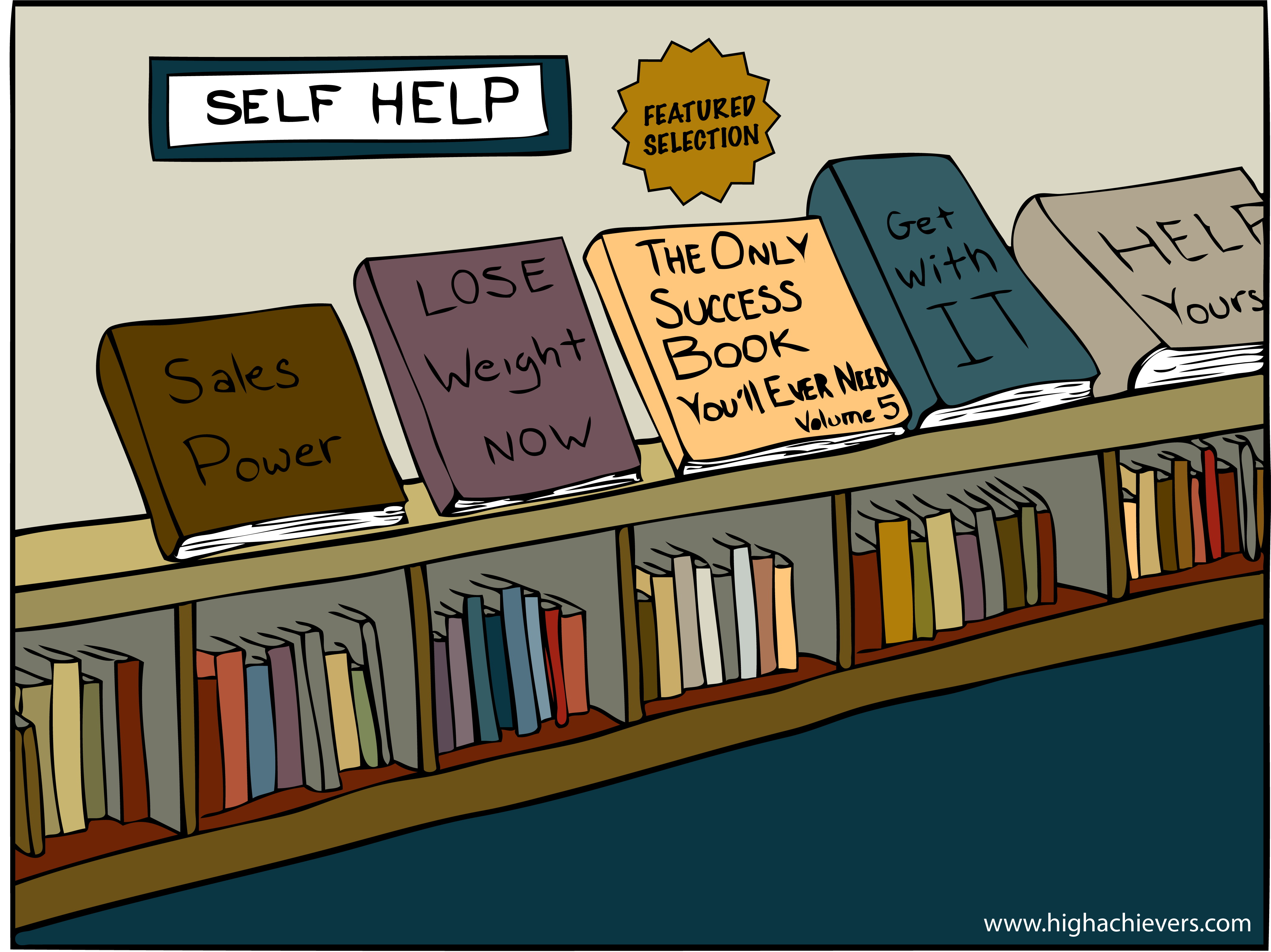
Walk through the bookstore, or browse any self-help on the Internet, and you’ll come up with ridiculous sounding stuff.

  • 3 steps to get your man back!
  • 30 days to a flat belly!
  • How to think your way to your dreams!
  • 10 steps to that promotion!

Does anyone actually believe it? They must.. people must be buying that stuff right?

Personally, I think it sound cheesy. Not only that, it is wrong.

Unfortunately, the reason this is on the shelves, and all over the Internet, is because it works! The industry has become expert marketers and they know what you want to hear: “What you want amazing results in 2 days? Just buy this book!“.

The industry has optimized to grab your attention and convince you to purchase stuff.

I find this very unfortunate. There is so much good stuff to think about with personal development, and the industry ruins its own public perception in the name of profits.

Your turn.

Do you sometimes feel strange about personal development?

Does the industry itself bug you?

I’d love to hear your thoughts!

P.S. This is post number #36 in a 100 day blogging challenge. See you tomorrow!

Follow me on Twitter @alexshye.

Check out my current project Soulmix.

My blogging habit

write-night

This will be post #35 of the 100 day blogging challenge, and here I am, still at it.

Over time, I’ve refined my blogging algorithm and have seemed to settle in on a good one. Here is what works for me:

  1. Stop working about an hour before I intend to sleep. Since I sleep late this tends to be anywhere between 12 midnight, and 3am. Today, it is was 2:30am.
  2. I give myself about 15 minutes to come up with an idea. Usually I choose something that was on my mind during the day. I have old drafts in WordPress, but rarely use them. I just don’t happen to be inspired to complete them. If 15 minutes is up, I choose the best topic I’ve come up with.
  3. Start writing, and publish it before I go to bed.

This has been surprisingly effective, and I think it may be sustainable.

They keys here are really the two forcing functions. I must pick a topic in 15 minutes, and I must hit the publish button before I go to bed. I can take as long as I want to write, but at some point, I am sleepy and it is time to publish.

The result is that every morning, I wake up and think two things:

  1. “Oh man, I could have made last night’s post so much better”, and then
  2. “I can’t believe that I’m still blogging!”.

The first thought kind of sucks, but hey, no one said blog posts have to be perfect. On the plus side, it leaves room for future blog posts.

The second thought is awesome, and it makes me feel better about the first one.

Now it’s 3:03am and it’s time to sleep. I don’t even need to wait until tomorrow morning. This one could have been way better.

Still, for you aspiring bloggers, I hope you picked up something useful (pro tip: its the two forcing functions!).

P.S. This is post number #35 in a 100 day blogging challenge. See you tomorrow!

Follow me on Twitter @alexshye.

Check out my current project Soulmix.

Consumer web: focus on two concepts

Following the last post on how life is simple, it has been starting to dawn on me that consumer web design is also simple.

I don’t mean it is simple to think of something and get traction. I just mean simple in design.

This is for good reason.

When a new user reaches a website, everything is new. If you do a good job with design, and if the user is interested, they might learn a few concepts.

Sites with one concept seem to be rare. You should hope to get across at least two concepts. The two concepts needed usually turn out to be (1) a data format, and (2) an interaction with respect to the data.

Here are some examples of early products:

  • Twitter: tweets, and follows
  • Reddit: posts, upvotes
  • WordPress: blog posts, follows
  • Tumblr: blog posts, and reblogs (follows could be a third)
  • Myspace/Facebook: profiles, and friending (the wall messages is a third)
  • Pinterest: Pins and repins (with board, and maybe follows)
  • Yelp: Places and comments
  • Instagram: Picture art, and share
  • Snapchat: Picture art, and temporary share

Pay attention to your product’s data format and main interaction. It seems that these concepts define what your product will fundamentally become. If you can’t get the site off the ground with these concepts, you may not have a good product. If you find yourself white-boarding or coding something with more concepts, you might want to reconsider.

A good number of startups in the short list above seem to have something that could be considered a third concept. If you have one, it should add a lot to your product. For example, people love to curate boards on Pinterest. Writing on Facebook walls were pretty popular back in the days.

Also, from the inconclusive list above, it seems like each combination of concepts ultimately becomes dominated by the one startup that executes it well. By dominating, I mean that this startup is usually serves the general user well and covers many (if not all) niches.

Be sure to clearly define your few concepts. If they are the same as another startup (particularly one who is winning already), be careful. You probably don’t want to clone it unless you have a good idea of how you are going to be different. It could be execution. Facebook beat Myspace because of how its execution influenced the community. It could be tweaking the product. As Andrew Chen says, it may be good to clone 80% of a startup as long as you tweak 20% of the product. One way is to tweak one of the concepts in a fundamental way so that your product changes. This would be the best. A second is to cater to a particular niche and add product features for that niche. If you do this, you can still succeed, but you most likely will never get as big as the main startup that dominates your combination of concepts.

In general, this is good news for consumer web product designers. Keep it simple, and focus on your two (or three) fundamental concepts.

How do you think about consumer web products? Simplifying consumer products has helped me begin reasoning about different products. I would love to hear your thoughts.

P.S. This is post number #34 in a 100 day blogging challenge. See you tomorrow!

Follow me on Twitter @alexshye.

Do you like to ponder life? You might like Soulmix.

Life is simple

While reflecting on past blog posts related to personal development, I’ve recently come to a conclusion about life: perhaps things are simpler than we think they are.

Yes. Life is relatively simple, and the big decisions are simple to make. They are just hard to carry out. It just happens there is a lot that can make things complicated: emotions, people, relationships, sunk costs, etc.

Here are some examples:

The most important lesson I’ve ever learned? If you want something, just do it.

Want to create a new habit? Commit to it and change your wants to wills.

Want to achieve a goal? Again, commit to it.

Feel different and don’t know what to do? Own it, embrace it, and make it you.

It goes on.

Want to talk to a girl? Just do it. She may reject you, but you can try.

Is your gut telling you to break up with your girlfriend? It is probably right. Just do it.

Does your current career path feel wrong? It probably is. It won’t be easy, but if you work hard at it, you can be effective at something else you enjoy more.

This realization is gives you incredible freedom.

Have a problem?

Stop thinking about all the complexities. At the end of the day, there is a simple answer that is right.

What is the answer? Deep down in your gut, you probably already know.

Just do it.

Have you realized this at all? Do you have your own additions from your experience? I would love to hear about them 🙂

(Photo credit: sidestone.com)

P.S. This is post number #33 in a 100 day blogging challenge. See you tomorrow!

Follow me on Twitter @alexshye.

Do you like to ponder life? You might like Soulmix.

The next generation of academic publishing

books-sidestone.com

(Note: my academia-related posts are strongly colored by my experience studying computer engineering. Other fields will/may differ.)

Since leaving the publication treadmill of academia, I’ve spent a lot of time thinking about academic publishing, and what it could/should be.

The publishing process.

Similar to most large entities, the academic publishing and dissemination process is amazingly slow. Here was the process for me during grad school:

  1. Do research and write up a manuscript (anywhere from 1 month to years)
  2. Submit to a conference
  3. Wait 2-3 months for review
  4. Get a review and write rebuttals
  5. Wait a few weeks
  6. Get an acceptance or rejection. If it is a rejection, wait a few months until the next conferences and go back to step 2.
  7. If the paper is accepted, work on the camera-ready and submit a few weeks later.
  8. Wait another 3 months and then go to the conference. At this point, it is officially published put in print and is published.

The entire process is around 7 months. That is a long time.. and that’s if you are lucky and get an accept the first time around!

Many papers go back to step 2 several times, meaning that it can be years before a piece of research is actually disseminated into the world. The rejections can be fairly random too. I have a friend who got a paper rejected 5 times (or was it more?), and then it won Best Paper at the conference it was accepted to.

In computer science, we are lucky to publish primarily in conferences. Journals are even worse. Best case, the turnaround is often a year or more.

Little to no change in the publication process over time.

Innovation is speeding up. As we continue to build on top of prior work, we find ourselves able to accomplish more with less time.

If it publishing isn’t already a bottleneck, it will be soon. As a sample point, I once published a paper that took one month to gather data and write up, and then 7 more months to publish.

What has been done in the last 5-10 years to speed this up? From what I can tell in computer science, nothing.

The major changes I have seen are that ACM and IEEE will put PDFs up online. And to help speed up dissemination of research, people will sometimes publish PDFs to their websites before the conference with a “To appear in…” before the conference title.

To channel Barack Obama, that is not change I can believe it.

A look at online publishing.

As a comparison, what has gone on in online publishing in the last 10-15 years?

It used to be that you had to rely on a publisher to get something out into the world. With the rise of the Internet, blogging platforms (Blogger, WordPress, etc.) were created which enabled anyone to publish to the web.

What about distribution? Well, email lists have existed for a while. And more recently, the big social networks popped up (Facebook, Twitter, etc.) which are great for connecting, but double as distribution platforms. The more likes or retweets a piece of content got, the further it spread into the web-o-sphere.

What about peer review? Peer review is basically a curation process. Social curation platforms such as Reddit and Digg have worked fairly well. If one isn’t a fan of social curation, personal curation platforms such as Pinterest can also be used.

There have been so many tools created for publishing, distributing, and curating content online. And innovation just keeps on happening.

Why can’t academics leverage any online tools?

One possibility.

If I were running a research group right now, I could imagine publishing and sharing without conferences and publications.

My students would each have a blog. They would use it to (1) publish philosophical thoughts on a research area to engage in online discussion, and (2) publish research findings that they want to share with the research community.

My research group would have a blog. Important posts from my students would get cross-posted to the group blog. In addition, I may write to the group blog.

We would all have Twitter accounts, and share blog posts via tweets. We would follow academics who we were interested in, and retweet posts that we liked. We would engage in short conversations over Twitter, and more meaningful conversations via blog comments or our own blog posts.

Peer review would be done with a curation platform. Similar to how conferences have a program committee, a committee of respected individuals could be in charge of curating a number of high quality posts every month. This could be manual, but could also be automatic. For example, if a certain number of committee members retweet a post, it gets automatically put into a collection of great posts.

The archival journals would be official curated collections of posts, and the citations to specific posts would be URLs.

This is just one way to do it. You could imagine many other ways. It wouldn’t be exactly the same as the current system, but it would serve the same purpose.

Benefits.

The benefits would be near-instant publication and distribution. Academics wouldn’t need to sit around and twiddle their thumbs for an accept or reject. They could immediately publish their thoughts and move on. At the same time, they could engage in near real-time communication and conversation about important research topics.

The result would have to be faster turn-around for research, which would speed up innovation. This sounds like a good for the world.

So, who will do this?

I would, except that I’m not in academia anymore. Maybe one day 🙂

Most people who are jaded with academic publishing have left academia. And that is problem for academia.

Would a current academic dare hop off the publication treadmill and then put their reputation on the line to experiment with creating a new publication treadmill? The problem is that professors and grad students are rated based upon their performance on the existing publication treadmill. It would be extraordinarily risky for a younger academic. If they cared about getting tenure (or graduating if they are grad students), they wouldn’t risk it.

It would have to be an older academic. The problem is that they have made their careers on the existing publication treadmill. Why change it?

So who will get things started?

It will take a brazen academic that respects the pure purpose of academia (to teach and discover knowledge), but does not respect the current incarnation of the academic system. But, what university would hire such a person?

(Photo credit: sidestone.com)

P.S. This is post number #32 in a 100 day blogging challenge. See you tomorrow!

Follow me on Twitter @alexshye.

Check out my current project: Soulmix.

The currency of happiness: or, how to accumulate happiness

They say money can’t buy happiness, and most would agree that this is true.

If money isn’t the currency of happiness, what is?

I was contemplating this today, and it occurred to me that perhaps the currency of happiness is… well, happiness.

This makes happiness itself is a currency. Like money, it is exchanged, as well as created.

Exchanging happiness.

It is well known in psychology that humans tend to mirror each other. When two people interact, and one person presents happiness, the other person tends to respond with happiness.  As a result, happiness gets exchanged.

With each smile we give and receive, we exchange happiness. With each hug we give and receive, we exchange happiness.  And with each kiss we give and receive, we exchange happiness.

Creating happiness.

Similar to money, the more happiness that is exchanged in the world, the more happiness there actually seems to be in the world.

However, when it comes to creation, there is a big difference between happiness and money. The difference is that we can create happiness.

Let me repeat that again: we can create happiness.

Don’t you wish that you could snap your fingers, and money would appear? Well, you can’t do that with money, but you can with happiness.

Just flash a smile at a stranger. Go and give a friend (or a stranger) a hug. Or turn around and give your significant other a kiss. Just do it, and watch: you have created happiness from nothing.

Accumulating happiness different than accumulating money.

You can’t create money, but you can create something of value, trade it for money, and then continue to exchange, invest, or save the money.

However, you can create happiness. And because of that, you are literally sitting on the Federal Reserve of happiness.

All you have to do it create it, and exchange it with others.

There are those who sit around waiting for others to exchange happiness with them, and then there are those who create happiness and actively exchange it with others. It isn’t surprising that the latter tends to better at accumulating happiness.

(Photo credit: freefever.com)

P.S. This is post number #31 in a 100 day blogging challenge. See you tomorrow!

Follow me on Twitter @alexshye.

Do you like to ponder life and happiness? You might like my current project: Soulmix.

Creating value from zero

Recently, I wrote a post on what being an entrepreneur means to me:

Being an entrepreneur means that I am making it my job to create value in the world.

In that post, I wrote about creating value, and about getting it out into the world. Today, I realized that I forgot about one key thing: not only does an entrepreneur create value, an entrepreneur creates value from zero.

This makes a world of difference.

Many people create value in the world. Those who work at startups, small companies, and large companies and are paid to value to the company. By adding value to the company, they may directly or indirectly create value in the world.

Not many people create value from zero. This is incredibly difficult to do. An entrepreneur needs to discover what adds value to the world, test it, build it, iterate on it, and get it out there in the world. You could easily fail at any of these tasks, and the world would get along just fine without you. Starting at zero means that there is no momentum on your side and you literally need to will your creation into existence.

What I’ve found particularly difficult is that there isn’t much in life that trains you creating value from zero.

Personally, I have gone through undergrad and learned concepts/theories, and built toy programs. I’ve continued through grad school where I created research prototypes. I continued to a research job in industry where I built research prototypes. In my many years of schooling, nothing involved creating real value from zero.

I have friends who have worked industry jobs for quite a while. Most companies have already figured out their money making machine. Therefore, their jobs typically involve greasing the machine, maintaining it, or adding a new contraption to the machine. As mentioned earlier, these jobs may create value, but not starting from zero.

It seems that along the “normal” path in life, it is rare to create real value starting from zero. Yet, this ability is incredibly valuable.

So how, do you go about learning how to create value from zero?

The default paths through life won’t get you there. Blogging is a great exercise in creation and may be a good start. Beyond that, you just need to get out there and start doing it.

(Photo credit: Sarah Hempel Irani)

P.S. This is post number #30 in a 100 day blogging challenge. See you tomorrow!

Follow me on Twitter @alexshye.

Check out my current project Soulmix, your daily mix of food for the soul.

Walking the fine line between confidence and humility

tightrope-quinn.anya

Confidence is great. We need to believe in ourselves, believe that we are worth something, and believe that we are capable of great things.

Humility is also great. It is important that we be humble, understand our weaknesses, and be empathetic to others.

Managing them both is one of the toughest parts of personal growth. How do we learn to walk that fine line between confidence and humility?

From my memory during childhood, it seems people seem to grow up heavily skewed towards one of these. A simple example of this is with social dynamics in grade school and high school. There are the “cool” kids, who skew towards confidence, and mask their weaknesses. And there are the “not-so-cool” kids who skew towards being humble because they don’t seem to fit in well, and get picked on all of the time.

The tendency for people to skew one of the directions leads to two paths in walking the line between confidence and humility.

Path A: Those who skew towards confidence most likely need to be mentally and emotionally smashed a few times in their lives to learn to be humble. The hard part for these people becomes learning to pick themselves up after getting smashed.

Path B: Those who skew towards humility seems go through a slow progression of learning that they actually have value in the world, and should respect themselves by having confidence. This is difficult, and can easily be set back my tough situations.

Now, it isn’t so simple because we have different sides to us. For example, I started out super confident in my physical abilities with sports, but socially I used to be very awkward.

However, it seems that one of the our sides tends to dominate our perception of ourselves. For me, the social awkwardness dominated. I personally identify with being someone that started out humble, and learned to have confidence. I walked Path B.

Perhaps I have a “grass is always greener” mentality, but I’ve always felt that Path A would be easier. At the very least, you have had confidence before and know what it is like. Learning to have confidence is difficult, and when you first start to have confidence, it seems very fragile. It takes work and time to figure it out. At least it did for me.

How did you learn to walk this line? Do the two paths make sense? And if you took Path A, how was it?

(Photo credit: Flickr user quinn.anya)

P.S. This is post number #29 in a 100 day blogging challenge. See you tomorrow!

Follow me on Twitter @alexshye.

Check out my current project Soulmix, your daily mix of food for the soul.

Why the popular view of Maslow’s hierarchy is dangerous

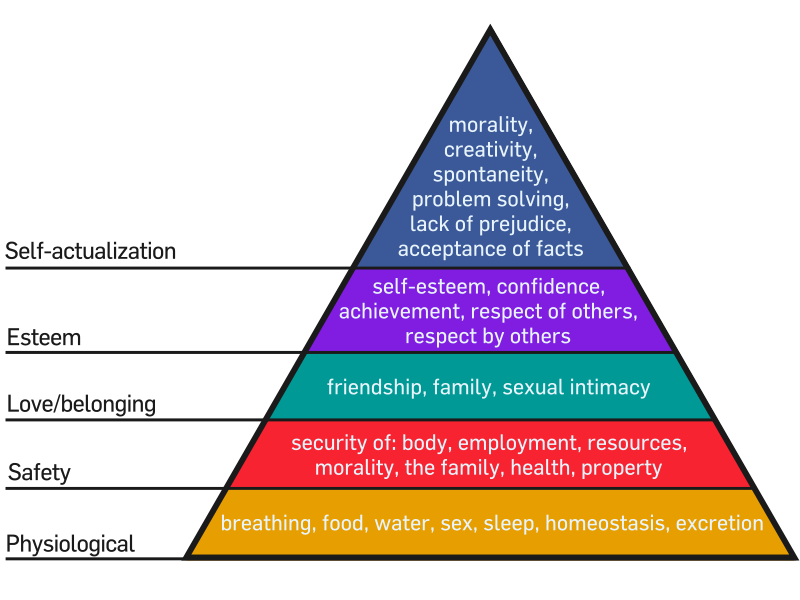
Have you seen this picture before?

If you have taken Psychology 101, or studied sociology, human development, or management, you have surely come across it. It is the popular representation of Maslow’s hierarchy of needs, a theory describing basic human needs/motivation.

In my opinion, the theory itself makes some sense. But, I have a huge problem with the popular representation of it as a pyramid. It is incorrect, and fosters dangerous thinking related to self-actualization and personal development.

Maslow’s hierarchy of needs.

Maslow’s hierarchy states that human needs can be divided into five distinct levels: physiological, safety, love/belonging, esteem, and self-actualization.

The first four needs are considered deficiency needs (d-needs). An easy way of thinking about these is that if you don’t have one of the needs, you may feel uneasy. These d-needs have ordering effect such that your physiological needs must be sufficiently met before your safety needs, and so on.

The fifth need is self-actualization, and is called a growth need (or b-need for being need). It is different than the d-needs as it represents human growth and potential.

The damn pyramid.

Maslow never drew these five needs into a pyramid.

Somewhere along the way, someone decided that it would be a good idea. It it has stuck! Just do a Google Image search for “Maslow’s hierarchy” and check out all the pyramids.

There are two problems here.

First, it combines the d-needs and b-need as if they are all similar. As you can tell in the simple description above, they aren’t. While the d-needs could be viewed as a layers in a pyramid, the b-need is different and should be represented in a different way.

Second, it places the b-need on top of the d-need. Not only does this imply that it is like the d-needs, it implies that it sits on top of all the needs; as if you needed to satisfy all of the needs before thinking about self-actualization.

You see the problem here?

The danger is that the pyramid seems so intuitive.

Of course, we need food and air before safety. And of course we need that before love. And, so we walk up the pyramid and just accept that it is true. You really only hit the problem at the top, but still, even at the top it is somewhat intuitive. Confidence comes before complete self-actualization, right?

Yet, the pyramid is wrong. And unfortunately, the part that it gets wrong is a critical part of our personal growth.

Self-actualization is not at the top of the pyramid. It isn’t enabled by satisfying the other needs. Quite the contrary: it is what enables you to satisfy many of the needs!

  • Do you need confidence to self-actualize? Or does self-actualization enable confidence?
  • Do you need sexual intimacy to self-actualize? Or does self-actualization enable you to find the proper partner, nurture a relationship, and experience sexual intimacy?
  • Do you need safety in employment to self-actualize? Or does self-actualization enable you to become a person of value that is worth employing?

Obviously, this doesn’t work across all of the needs. For example, you simply need food and air. But in general, self-actualization is the enabler that allows you to strengthen yourself within levels, and move up to the next level of Maslow’s d-needs.

We shouldn’t view self-actualization as the thing at the top. When it is at the top, it becomes something that we put off. It becomes that goal that we might get around to once we satisfy all of our other needs.

And guess what? We’ll never satisfy all of our other needs. Humans have this weird way of always coming up with more needs… especially, the ones who haven’t self-actualized.

We need to view self-actualization as number one. We begin with it, educate ourselves, learn who we are, discover who we can be, and figure out how to improve our lives.  In my opinion, this fundamental shift is the only way we can hope to move the entire world up Maslow’s hierarchy.

So let us begin by fixing that diagram. After that, we should switch our priorities within our communities and education systems. And just maybe, one day the world will become a better place 🙂

P.S. This is post number #28 in a 100 day blogging challenge. See you tomorrow!

Follow me on Twitter @alexshye.

Check out my current project Soulmix, your daily mix of food for the soul.

Personal development as social good

Hey there, Social Good. I’ve got a huge bone to pick with you.

No, I’m not talking about all that good stuff you do. I’m fully onboard with feeding the children, curing AIDS, fighting sexism and racism, campaigning for sustainable energy, etc.

I’m talking about a big part of the picture that:

  1. I happen to care a whole lot about, and
  2. you seem to forget about (or neglect).

Yes, personal development.

The individual within society.

Social Good, I know you concern yourself with big problems in society. You want to change the world, and I support you there.

But consider this: the fundamental unit of society is the individual human.

The only reason there is a society is because humans are inherently social. We could choose to be alone, but instead, we choose to connect with others. Through these connections, we self organize. We accomplish extraordinary things, build amazing cultures, and create self-perpetuating societies. We also destroy these things.

The caveat to this is that each of us has the ability to affect the world on a daily basis. This isn’t difficult to understand.

Imagine you are having a shitty day. This shit doesn’t just stay with you. If rubs off onto each person you come into contact with. It makes each of their days just a little bit worse. And then they rub their bit of shit onto others that they come into contact with.

Imagine you have a psychological problem and lash out at your child. You become your childs example in the world, and your psychological problem becomes ingrained within them. They naturally perpetuate this within the world.

It happens with every person every day. We come into contact with each other, and the core of our beings affects the world around us.

Personal development and social good.

Society is a construct we have created as social creatures. Social good is anything we do for the betterment of this social construct.

How do we better this social construct?

We could focus on the rules within the construct. We could focus on technology. We could raise awareness of important issues. Or, we could focus on how one group of humans helps can another group of humans. These are all great.

But you know what else we can do? Focus on the individual human!

This is precisely where personal development comes into the picture.

Personal development lies at the very core of social good. If the fundamental unit of society is the individual human, then a society is only as good as the people in it. Each of us becomes a limiting factor to the greatness of the whole.

So, Social Good. Why do you ignore personal development?

Almost all web sites, summits, conferences, etc. that spout your name don’t seem to touch much on personal development.

My theory is that it is because this isn’t a fun topic to think about.

Actually, it is the opposite of fun.

Why focus on your own problems when you can focus on someone else’s?

It is easier to toil away in a lab studying cancer, fly to Africa to feed the children, or research sustainable energy. We feel good about ourselves when we do these things.

It is far more difficult to sit there alone, peer into the depths of our souls, uncover the demons within own psyches, and then wrestle with these demons. This is scary. It isn’t easy to talk about, and may not feel good at all.

Yet, it is critical that each of us develop ourselves. Our society depends on it.

So, here is my memo to you, Social Good. You are a big idea, and have the ability to mobilize people across the globe. Get your shit together, and help out society by supporting and pushing personal development as a social good. Please.

(If you won’t listen to me, MJ said it pretty well also.)

P.S. This is post number #27 in a 100 day blogging challenge. See you tomorrow!

Follow me on Twitter @alexshye.

Check out my current project Soulmix, your daily mix of food for the soul. Request an invite now for free access to the public beta!