Online dating will always be broken, but it might be OK

In general, it is not smart to unilaterally count things out, or count things in. People change, technologies change, circumstances change, etc.

In light of that, I’m going be bold anyways.. at least with respect to online dating.

Online dating will always be broken.

Profiles are broken. It doesn’t matter what kind of profile it is. It is impossible to summarize a person and all of their subtleties with a set of questions or profile pictures or computer generated numbers.

The search is broken. Many sites provide instant searchable access to a whole pool of people. But because the profiles are broken, the search is also broken. It doesn’t matter if there are many fish in the sea, if I can’t trust their profiles to give me good information about them.

Messaging is broken. Guys need to play the numbers game and find a way to stand out. Girls receive hundreds of messages and wading through them becomes a pain in the ass. This asymmetric nature of many sites also results in girls having crappy profiles (why write it if they are going get tons of messages anyways?). This gives guys less to go on, and encourages spray and pray messaging tactics.

The dates are broken. Every date is a blind date. This must be the worst way to date. When I was single, I lined up a bunch of them and hated every one. In most real-world dates, you have at least interacted with the other person. Whether it is at a friends potluck or at a nightclub, you have talked, seen each other’s body language, and decided to trade information. That filter counts for a lot.

It is pretty easy to list the ways it is broken. Just ask anyone that has tried it. These are just my top few complaints.

Some of these can be improved, but you can’t fix them all.

Profiles will most likely always suck. Some sort of search must exist, whether you do it, or a computer does it and provides matches. Messaging is pretty much a fundamental action on the Internet. And no matter what, the first real-life date will probably always feel similar to a blind date.

Still, it might be OK.

Finding a significant other is a tough problem.

The timing needs to work out. You must both mentally and emotionally available to date. You need to be reasonably attracted to each other (however you define attraction). And the X factor needs to be there; the click, the spark, the chemistry, the excitement, whatever you want to call it.

The initial meet is just one part of it also. It is the string of dates where you really get to know the person. You see them in various situations, you meet their friends, etc.

When I was dating, each date seemed to be a toss up. It was totally random, with most of them not being very exciting. I ended up concluding that the best you could do is just meet a lot of people and hope that you click with some of them.. or at least one of them. In other words, play the numbers game.

And if that is the case, it is OK for online dating to be broken. As long as an online dating site facilitates a meet up, it has done its job.

My ideal online dating app.

Again, the main goal is to simply facilitate meet ups. Do the minimum possible, with the lowest amount of friction for both parties.

Externally, profiles would be minimal (as in what you show members on the site). You can’t expect to understand someone, so just give them a picture and few a lines to express themselves. Internally (or within the site), you can collect as much information as you’d like, and use it in a Pandora kind of way.

The interaction needs to be symmetric. Girls and guys should have a similar user experience. That means it doesn’t seem like a numbers game for guys to contact a single girl, and girls aren’t flooded with messages from guys.

Search is eliminated. You get one, or a few matches a day from guys/girls that are relatively close to you. The matches are selected with the Pandora-style algorithm. Either that, or matches are done locally in specific time frames. I want to hit a button when I walk across the street to the Starbucks, and if there is someone else on a coffee break who may be a date, I wouldn’t mind a quick intro for a 10 minute chat over coffees.

Messaging is moderated and anonymous (until you actually want to meet). You can’t just message anyone. Both people need to indicate interest. In addition, messages may be limited also. Wouldn’t it be cool if you only got 10 messages to set up a date? You can’t expect to learn much online anyways, so a meet in person would be much better.

That sounds good to me. Hmm.. seems like a mashup of Tinder plus Coffee Meets Bagel with a few extra things thrown in the mix. Someone build it!

P.S. This is post number #13 in a 100 day blogging challenge. See you tomorrow!

Follow me on Twitter @alexshye.

Check out my current project Soulmix, your daily mix of food for the soul. Request an invite now for free access to the private beta!

A typical Tuesday, killin’ it startup style

Have you heard what it’s like being a founder in the startup world?

It’s rough. It’s intense. We’re killin’ it.

We chug beers at hack-a-thon sprints, and create crazy shit out of nothing. We’ll pitch you so good you’ll be stuffing Benjamins down our pants. Then we’ll scrap that shit, pull a ridiculous pivot on your ass, and sprint for 72 hours to hack up some even crazier shit.

By sprint, I mean sit on our asses and code. No, we don’t run. We hack… nonstop.

We have youth, passion, drive, and stupidity, all rolled together in a perfect fucking combination.

We write blog posts that blow up the internet. We disrupt all your markets.

We build. We create.

And did I forget?

We change… the… world… every… single.. day.

* * *

To give you a better idea about things, let me walk you through this last Tuesday.

Beep, beep, beep… The alarms rings. I wake up, and look at the alarm.

It’s 6 in the morning! Shit, I need to wake up.

I’m cold, and sniveling, with some major phlegm going on. I blow my nose, and then hock a loogie into the sink. I’ve been under the weather for a few days, and not feeling awesome at all.

Still, my girlfriend has a hand surgery scheduled at 7:15. She broke her pinkie months ago, got some pins in it, did physical therapy for months, and it still isn’t proper. The doctors say she needs another surgery to scrape away the scar tissue inhibiting her finger’s movement.

So, we wake up, get ready, and make our way to the hospital.

We get to the hospital, she checks in, and we wait. All the while, I’m holding back my coughs. Don’t want to get anyone else sick, right?

Her Dad comes in to make sure she is OK. Now I’m really holding back my coughs.

She gets her finger cut open, while I schedule some tweets and send a few emails. An hour later, it is over. She is all woozy from anesthesia and Vicodin, so I drive us home. On the way, we pick up some prescription.

Both of use are exhausted. She obviously, feels worse than I do. So we take a nap.

A few hours later, my roommate comes in. It is his moving out day. I help out a bit, clean up the BBQ grill (it is a dirty mess), and move it into their van. They drive away.

My girlfriend is still passed out, but man, am I getting hungry.

I drive over to the store, get a sandwich, and go shopping for stuff to cook. Going to cook up some oxtail soup! That should be good for healing.

We spend the rest of the night cooking up the soup, resting, relaxing, watching Law and Order SVU, and eating, with a brief visit from a friend.

Occasionally, a timer goes off, and she needs to take her meds.

I pop a Tylenols, a Mucinex, and then sit down to write this post (because I have to).

Soon, it’ll be bedtime.

* * *

“Yo Alex, great story man. Doesn’t sound like you are killing it though.”

Sorry dude, reality is a different story.

Plus, health comes first. Got to take care of myself, and those I care about.

I hope things get better soon.

Then I’ll get back to killin’ it, and of course, changing the world.

P.S. This is post number #12 in a 100 day blogging challenge. See you tomorrow!

Follow me on Twitter @alexshye.

Check out my current project Soulmix, your daily mix of food for the soul. Request an invite now for free access to the private beta!

Surviving the startup roller coaster

roller_coaster

It has been almost 18 months for me as an entrepreneur in the startup world. This isn’t a tremendous amount of time, but it is enough to begin understanding the lifestyle.

They say entrepreneurship is a roller coaster. And man, are they right.

I have already had my share of emotional highs and lows. It is crazy. You can be on a high one day, and hit a low on the next day. In fact, it can switch multiple times within the same day. Aside from those days, many of the days are simply a grind. Over time, the grind wears away at you, and feels like a low. All in all, there have been more lows than highs; enough that the lows have thoroughly tested the limits of my natural optimism.

Fortunately, I think I have figured out how to survive, and even thrive in this lifestyle. The trick lies in your mind within that space between the stimulus and your response. We all experience the highs and lows. What makes the difference is how we respond to them.

Know which ride you are on.

Let us look at two riders on the proverbial roller coaster.

Rider A hops onto the roller coaster. Click, click, click.  As the ride takes her higher and higher, she begins to get nervous. And it keeps going up! If only it could go down so that the drop wouldn’t be as bad. All of a sudden there is a drop. Whooosh! She freaks out and shrieks. The coaster continues through twists and turns, shaking her and rattling her. By the time the ride of over, she breathes a sigh of relief, and is glad she survived.

Rider B hops onto the same roller coaster. Click, click, click. As the ride climbs up, she looks up, in awe of how high she is. The first big drop occurs, and she throws her hands up, and lets out a scream of happiness and excitement. She leans into the twists and turns, and relaxes her body when the ride gets shaky. When the ride is over, she is exhilarated, and wants to ride again.

See the difference?

Rider A, the novice entrepreneur, is passive and lets the massive dips get the best of her emotions. It is as if she doesn’t know which ride she is on, and is surprised at each twist and turn.

Rider B, the more enlightened entrepreneur, knows what’s up and knows what ride she is on. She didn’t choose the carousel, ferris wheel, or the spinning tea cups. She chose the big bad roller coaster, and expects it to be one hell of a ride.

The key to surviving the startup roller coaster is to set the right expectations and go in with the right mindset. There is nothing special or surprising about the highs and the lows. They just happen to be a part of the ride you are on.

Know that it is a long grind.

Now I know what you are thinking:

“Alex, that is a great story and all, but coming out of the roller coaster exhilarated? Yeah right!”.

I know, I know… like most analogies, it isn’t perfect.

Perhaps this is a better analogy: the startup lifestyle is more like continuously riding the big bad roller coaster for years, with no end in sight.

At first, it can be pretty damn exhilarating. Over time, it is just a grind. If you can’t handle it, your physical and mental health will probably deteriorate to the point where you have to get off the roller coaster.

18 months into my ride, I can assure you that is definitely what it feels like: long grind with many drops, twists, and turns. And that is only 18 months in! I can only imagine it being worse in a few years.

Still, the solution is similar. The trick is to manage your expectations and your mindset going into the whole thing.

If you expect every ride to be exciting, tough luck.

If you expect it to be a grind, and adjust your emotional response accordingly, you may just and survive the ordeal. You may even figure out how strong you are and learn to thrive on this roller coaster.

It is about desire, not passion.

I came across an article today  (which inspired me to write this post) with an amazing Thomas Keller quote. For those who don’t know, Thomas Keller is the master chef behind The French LaundryPer Se and Bouchon.

He describes how excellence is about desire, not passion:

“It’s not about passion. Passion is something that we tend to overemphasize, that we certainly place too much importance on. Passion ebbs and flows. To me, it’s about desire. If you have constant, unwavering desire to be a cook, then you’ll be a great cook. If it’s only about passion, sometimes you’ll be good and sometimes you won’t. You’ve got to come in every day with a strong desire. With passion, if you see the first asparagus of the springtime and you become passionate about it, so much the better, but three weeks later, when you’ve seen that asparagus every day now, passions have subsided. What’s going to make you treat the asparagus the same? It’s the desire.”

– Thomas Keller

It isn’t about the excitement or the passion.

It is about having the desire to create something of value in the world.

You hop onto the endless startup roller coaster because you must. It is the only way to satisfy this desire to create. And because you know what ride you are on, you know that there will be highs and lows. The dips, twists, and turns won’t stop. So, you lean into them, and you don’t let them shake you. You don’t intend to stop either. Your only expectation to grind it out, and move the needle forward, day by day.

P.S. This is post number #10 in a 100 day blogging challenge. See you tomorrow!

Follow me on Twitter @alexshye.

Check out my current project Soulmix, your daily mix of food for the soul. Request an invite now for free access to the private beta!

What being an entrepreneur means to me

Credit: Jeffrey Friedl

Credit: Jeffrey Friedl

About 18 months ago, I quit my research career and began my career as an entrepreneur.

Back then, I was a bit naive. I didn’t know exactly what I was looking for. I only knew that I wanted something different, and needed the time to figure it out.

I remember logging into my LinkedIn account to commemorate the career change. I quickly tapped the backspace key to remove the title ‘Senior Research Engineer’. Then I sat silent for a while, before slowly typing ‘Entrepreneur’.

I stared at the word ‘Entrepreneur’, and thought “what the heck does that mean?

I couldn’t really answer the question. I just felt like the right word to use.

Still, it sounded too serious, and I felt weird about it, so I tacked a bit more onto my title: ‘Entrepreneur (a.k.a. unemployed, but hopeful, bum)’.

That seemed passable. I opened up more tabs in my browser and proceeded to change my job title in all other social networks.

Since then, I’ve thought a great deal about what it means to be an entrepreneur.

And I think I have figured it out.

To me, being an entrepreneur means that I am making it my job to create value in the world.

The first part to understand is the “creating value” aspect of this.

It has nothing to do with:

  • my development skills;
  • who I am, or who I know;
  • whether I’m am employed or unemployed;
  • how much money I make;
  • whether I am working alone, inside a team, managing a team, or managing an organization.

All that matters is the act of creating some thing of value for the world.

Note that I mentioned it doesn’t matter how much money an entrepreneur makes. There are things of value that should be created, but are not particularly profitable.

However, it is fortunate for the entrepreneur that things of value can be usually be monetized in some shape or form. After all, money exists to be exchanged for things of value, right?

Being a successful entrepreneur can be quite lucrative. In fact, it can be lucrative enough that it distracts people. People see the money, power, and/or fame, and then aspire to be in this position.

A true entrepreneur is concerned with, and often obsessed with, the process of creating some thing of value. Money isn’t the goal. Money is the byproduct. It turns out to be a great byproduct because it can be reinvested to create more things of value.

The second part of this is that entrepreneurs create value “in the world”.

What good is a creation that never sees the light of day? It is the entrepreneur’s version of the proverbial tree in the woods.

Entrepreneurship is more than creation; it implies some form of accessibility or distribution.

An entrepreneur creates this thing of value, but doesn’t stop there. An entrepreneur ensures that this thing touches the world.

This is the value of the entrepreneur. This thing would not exist if the entrepreneur wasn’t there to create it. And because this thing has value to some people in the world, the entrepreneur has made the world a better place.

So there is it: my tentative definition of an entrepreneur, which at this point, seems to make perfect sense to me.

It makes me sure of myself, and clear about what I am doing.

I am an entrepreneur. I want to create a thing of value. And I want to see it touch the world.

P.S. This is lucky post number #7 in a 100 day blogging challenge. See you tomorrow!

Follow me on Twitter @alexshye

Check out my current project Soulmix, your daily mix of food for the soul. Request an invite now for free early access to the private beta!

The power of temporary social media

snapchat

A friend and I are enjoying a lunch together, when she cracks a raunchy joke.

As she nears the punchline, I see her exact facial expressions. I listen intently, and hear each and every word. A split second later, I bust out laughing. She sees my reaction and also begins laughing. We enjoy a shared moment, and then as the laughing subsides, we continue with our lunch.

Afterwards, I remember her facial expressions and her words, but only as a figment of my imagination. The joke may retold as a story. It may be recast as a rumor. Or it may be forgotten. Whatever happens, the exact scene and the exact words are gone forever.

This is how real human communication works.

Today, we are seeing a trend towards temporary social media. That is, shared media which disappears after a prescribed amount of time. Snapchat is leading the way, but there are other startups on the horizon, such as Frankly.

At first, temporary social media was misunderstood as a gimmick best used for sexting. But with the growing traction of Snapchat, it is clear that it is much more powerful than that.

In my humble opinion, the power of temporary social media is simple: it closely mimics real human communication. We see a message in its exact form, get a chance to savor it, and then it is gone, relegated only to our memories.

P.S. This is post 6/100 in a 100 day blogging challenge. See you tomorrow!

Follow me on Twitter @alexshye

Check out my current project Soulmix, your daily mix of food for the soul. Request an invite now for free early access to the private beta!

One metric to rule them all: what is yours?

measurement

Getting a startup off of the ground is a complicated task with many moving parts.

On any given day, you might be writing back-end code, designing the front-end, becoming your product’s power user, writing content, reaching out to users, writing emails, sharing on social networks, meeting people for coffee, etc.

However, at the end of the day, only one thing matters: are you making progress?

Answering this question involves measuring something. But what?

It is easy to come up with stuff to measure. And if you read startup blog posts on A/B testing, funnels, cohorts, etc., there is no doubt that you’ll come up with many more.

Pretty soon, you’ll find yourself drowning in numbers.

Measuring stuff is easy. Finding meaning in the numbers isn’t.

Using one simple metric.

The best way to manage complexity is to ruthlessly simplify.

Can you simplify everything down to one metric?

I believe that the answer may be “yes”. For the past few months on Soulmix, I have been keeping track of many numbers in a spreadsheet. As time goes by, I have found myself strongly leaning on one metric. It has become my make-it-or-break-it metric as the one thing to focus on.

My current single metric: Weekly Returning Uniques (WRU).

WRU = Weekly uniques - Weekly new visits

There are several benefits to using this metric:

  1. It is super simple to measure. Install Google Analytics and you are set!
  2. It drowns out noise. Web traffic is bursty, and many of these visits will be 1-time visits. You don’t want to count these as real visitors.
  3. It is a light-weight metric for engagement or retention.

The most important one of these is (3). Sure, there are better ways to measure specific types of engagement, but the fact that people are returning on a weekly basis is a prerequisite for engagement.

WRU is powerful on two levels: it encompasses product-market fit (PMF), and can be used as a measure of growth.

It encompasses PMF: If you have a stable WRU, it means that part of your market uses your product on a consistent basis. Doesn’t that sound like PFM?

Measure of growth: If you are growing your WRU, it means that you are finding ways to tap into your market, and keep them coming back on a weekly basis. At this point, it may be useful to start using the WRU rate of change is your primary metric.

What if you can’t keep a stable WRU at a meaningful number?  Either you aren’t tapping into the right market, or there is a problem with your product. Bad news.

Do whatever you can to get your WRU up to some value, and then keep it stable. When it is stable, start figuring out how to up it the value while keeping it stable. It may mean acquiring new users. It may mean engaging existing users. Do whatever it takes.

What is your single metric?

I’m not the first to notice this. KISSmetrics has a great blog post on using a single metric. So does the Lean Analytics blog.

I am aware that people use the terms daily/weekly/monthly active users (DAU/WAU/MAU) all over the place on the web. Unfortunately, I have no idea what an “active user” is. WRU is clear to me.

Nevertheless, it would be great to start a conversation and hear your experiences. Have you found a great single metric to use? Has it changed over time?

Learning complicated metrics are fun and all, but at the end of the day, what metrics do you live-or-die by?

I would love to hear your thoughts!

P.S. This today’s step as post 4/100 in a 100 day blogging challenge. See you tomorrow!

Follow me on Twitter @alexshye

Check out my current project Soulmix, your daily mix of food for the soul. Request an invite now for free early access to the private beta!

The two biggest differences between academia and entrepreneurship

midnight-clock

[Note: this is from my experiences in computer architecture and systems research. Your mileage may vary when applying this blog post to other fields.]

Earlier, I wrote about how my PhD unexpectedly provided a good foundation for entrepreneurship. It is almost a year later, and I still feel good about that blog post. Much of it remains true.

However, not everything carried over well from my PhD. As I’ve gotten further into entrepreneurship and the startup world, I’ve begun to realize two big differences that have been tough for me to adjust to.

(1) Time scales are much longer in entrepreneurship.

If you look at publication records these days, it is common for a great graduate student to publish 2+ top-tier conference papers per year. It is common for great professors to publish 5-10 or even more top-tier conference papers a year.

Think about this. Each paper requires a peer review, and top-tier conferences have fairly low acceptance rates (5-20%). Let’s assume a great student experiences a 50% accept rate. In order for a great grad student to publish 2+ top-tier papers a year, they are most likely working on 4+ papers a year, or at least one every 3 months.

A paper is a full production, requiring ideation, implementation, experimentation, and writing. Completing a full round in a few months is aggressive, but possible. I personally have done it, and know most of my friends with PhDs have.

This means that within academia, you are used to entire projects which turn around in just a few months. Once that one is done, it is on to the next! Things move quickly, and you get this awesome feeling of accomplishment each time you close the loop.

Startups and entrepreneurship work on a much, much larger time scale. You don’t get that feeling of accomplishment every few months. You may reach failure within a few months. But you will rarely reach success.

Finding product-market fit can take years. A great content marketing strategy can take years. Growing and scaling a product can take years.

A quick search easily confirms this. Pinterest was founded in 2009. Lyft was spun out of Zimride, which was founded in 2007. Snapchat was founded in 2011. It is now the end of 2013 and although these startups are fairly big, there is much room for growth.

Managing this difference requires managing your expectations. Understand that building a startup takes time. You better be in it for the long haul.

(2) Developing a new optimization function

Academia and entrepreneurship require completely different optimization functions.

In academia, you ask: what is novel and publishable?

In entrepreneurship, you ask: what do people want?

Being able to answer these questions requires a combination of knowledge and gut instinct (others may call it vision). Building the knowledge takes time. So does building a good gut instinct.

For an ex-academic, this difference is deadly. You spend years building your knowledge, and then years publishing. At the end of this, you believe you are smart! You think you know your stuff!

This is a huge trap. If you follow your academic instincts into entrepreneurship, you are most likely doomed for failure.

(Note: Stanford kids seem much better at this than most, and it must be because the culture is just different).

Managing this difference requires understanding this difference in optimization function. From my experience, it sounds easy in theory, but is very difficult in practice. Ignoring a trained gut instinct is tough. Developing a new optimization function is tough. Combine this with the first point, and realize it will just take time.

To you ex-academic entrepreneurs out there, good luck! I would love to hear how you are doing, and how you’ve managed the transition.

P.S. This today’s step as post 3/100 in a 100 day blogging challenge. See you tomorrow!

Follow me on Twitter @alexshye

Check out my current project Soulmix, your daily mix of food for the soul. Request an invite now for free early access to the private beta!

The unbundling of Craigslist and reddit

There are strong similarities between Craigslist and reddit.

Both sites drive incredible amounts of web traffic, and rank highly in the Alexa rankings. Both are horizontal in nature, using a single set of interactions across a wide range of verticals. Both support openness, allowing use cases that are both savory and unsavory. And although both are very functional, they are among the ugliest websites on the Internet.

The unbundling of Craigslist.

Craigslist has remained remarkably successful through the years. Arguably, there hasn’t been a strong competitor since its founding in the 90’s. If anything, competition comes from an unbundling trend, with 100s of startups that are competing to provide a better user experience for specific verticals of Craigslist.

Years ago, Andrew Parker put together a great picture of all the startups competing within verticals of Craigslist. More recently, Chris Dixon has echoed a similar sentiment.

Startups competing with verticals of Craigslist. (via Andrew Parker's blog)

Startups competing with verticals of Craigslist. (via Andrew Parker’s blog)

The same thing will happen to reddit.

Although it hasn’t been written about much, the unbundling trend is going to happen to reddit also. Actually, it has been happening for a while, and it will continue in the foreseeable future.

Here are a few examples:

What else? I would love to build out a more comprehensive list here.

What makes a vertical startup viable?

Each startup within a vertical must satisfy two constraints.

First, there must be a compelling value proposition. It may be the community, the user experience, or whatever. But it must be enough to make users of horizontal company switch products.

Second, the market must be large enough. It doesn’t need to be large enough at the outset, but it must be large enough within a reasonable number of years such that a business can be sustained.

Surely, there are many verticals in which viable startups can be built. But, most likely, there are also many verticals that don’t satisfy these constraints. The horizontal companies will probably always survive, if not only to serve the many verticals that cannot be viable stand-alone businesses.

How would horizontal businesses respond?

The horizontal approaches usually have larger scale, and therefore larger network effects. To squash startups in a particular vertical, they must be nimble enough to observe what works, and improve their user experience for the particular vertical. This is asking a lot from a large company.

If that doesn’t work, they can acquire the company, or hope another company acquires them (since it seems most acquisitions kill a companies product either explicitly, out of neglect, or through mismanagement).

An interesting comparison.

Recently, Tom Tunguz wrote about how the unbundling trend may be the biggest challenge for Facebook, Twitter, and LinkedIn. Unbundling certainly is a threat, but social networks such as Facebook, Twitter, and LinkedIn have appeared more willing to be nimble with their product features and their user experience.

Facebook has changed dramatically since the early days. It’s “move fast, and break things” adage helps out here. Twitter continually tries new experiments, including the recent Twitter music. LinkedIn is in the midst of a drastic change with a new social feed, and with influencer blogs.

On top of that, these social networks have been more aggressive with acquisitions of startups that begin to show success.

One last similarity between Craigslist and reddit.

This brings us to one last similarity between Craigslist and reddit. Both of them don’t seem to move very fast. From a design and functionality standpoint, their user experiences have not changed much over the years. In fact, they almost seem stubborn, refusing to change with the times. Also, they don’t seem to acquire many competitors.

Why is this the case? I don’t know. But, my guess is that this leaves both Craigslist and reddit more vulnerable to unbundling effect, and this is a good sign for startups building within their verticals.

Any thoughts? What other companies are verticals of reddit? What are properties or strategies for successful companies within these verticals? And why do the social networks behave differently when compared to Craigslist and reddit? I would love to hear some different perspectives here.

Follow me on Twitter here.

Check out my latest project Soulmix.

(P.S. I later wrote a post on the flip side of this argument)

The single founder dilemma

Wolfpack_2012

In the startup world, my current position isn’t particularly enviable.

I am a one man wolf pack. Yes, I am a single founder, a.k.a. a random guy hacking on stuff alone in his living room.

Being a lone wolf isn’t always a bad thing. Except for the fact that in startups, it kind of is.

Conventional wisdom is that you should have a cofounder when you start something. It is all over startup blogs and articles. Accelerators and VCs highly prefer founding teams. And not without good reason. Empirically, most successful companies start this way.

I assure you that I am not a one man wolf pack by choice. If I could choose, I would be part of an awesome team. Right now.

So, why aren’t I?

This has been one of the most difficult issues for me to handle in my time as an entrepreneur.

The single founder dilemma.

At any given moment, there are two things I can do:

  1. Look for a cofounder. This would be great, but it is a lot like dating. I have no idea how things will work out. I just need to keep putting myself out there. The problem is that each coffee meeting takes time. This time easily adds up, begging the question: is there a better way to use this time?
  2. I can also start getting shit done. I’m not short on ideas. And I am technical, so why not just start coding? Besides, each git commit feels like real tangible progress. The problem is that we all know that most startup ideas suck. So “getting shit done” can often be a colossal waste of time.

And herein lies the trap for the single founder.

It gets worse.

As I already mentioned, I am not short on ideas. I am also not short on confidence. Look, I didn’t quit my job because I didn’t believe I could make stuff happen.

But, I am not the only one like this.

So what happens? Most single founders choose choice (2) and start getting shit done. Sooner or later, we get pretty far along (at least in our minds). And by some point, we start to drink our own Kool aid. Shoot, this project just might become something!

By the time we meet another single founder, there are several questions:

  1. Do I drop my project?
  2. Do I get him or her to drop their project?
  3. Do we work on something together, requiring both of us to drop our projects?
  4. Or, do we hack on something part time?

Numbers (1) through (3) require people dropping work, and people are bad with the sunk costs problem.

In theory, alternative (4) seems like the best option to me. It allows people to try each other out, while making some progress. The problem is that it requires both people to set aside time. And each minute not working on your main project increases its likelihood for failure.

What I’m doing

So what to do? I haven’t completely figured it out yet.

The only reasonable answer seems to do both at the same time, and leave space open for alternative (4).

There is one thing that I do know, and I learned it from dating: if you never date, you won’t  meet people. Simple as that. Meeting people is necessary. And the upshot is that even if you don’t meet a cofounder, you will slowly build out your network.

At the same time, I am never really short on ideas. I just can’t guarantee they are any good. In the meantime, I’m going to keep building stuff.

Who knows that will happen. Maybe I’ll meet someone awesome tomorrow. Or maybe my next project, Soulmix, will gain traction. If I had to bet on it, I think it will be a long process of building products and building relationships. At some point, it will probably seem natural to work with a friend on an idea that we are both excited about.

Are you a single founder? Have you been a single founder? How have you handled this dilemma? I would love to hear your thoughts!

Follow me on Twitter here!

Check out my current project Soulmix, your daily mix of food for the soul. Request an invite now for free early access to the private beta!

My first year as an entrepreneur: a retrospective

i-guess-i-have-many-things-to-ponder

Whew! Just like that, one year has flown by.

Last April, I quit a perfectly good job and entered the world of entrepreneurship. A few months in, I wrote an update on my first 15 weeks. And then I went silent.. at least with public updates on this blog.

It has been just over a year now, so here is one HUGE update on how things have gone. Really. This is a long post. You have been warned.

My blogging dilemma

First, I’d like to tell you why I have been away.

There is nothing like that first few months after you quit your job. Everything is fun and new! I started this blog to capture my whole journey. And at first, it was great. I could write about quitting my job, and about how exciting things were.

Then, reality set in.

I was in way over my head… for a number of reasons:

  • Technical proficiency: I quit my job without ever creating a real web product. I had a personal website but that doesn’t count. Web programming is a mix of all kinds of libraries, frameworks, languages, etc. And I had to pick it all up quickly.
  • Startup knowledge: I used to subscribe to Harvard Business Review and read business books for fun. The articles on leadership, management, and running a company fascinated me. I always imagined that the reading would help me if I ever wanted to do my own thing. Unfortunately, it didn’t. Before there is a business, there is nothing. Startups are about getting from nothing to something, and that experience isn’t well described in much of the popular business literature.
  • Web background: I was a researcher in computer architecture. I had no appreciation for products such as Facebook, Twitter, Pinterest, etc. It turns out that if you want to build a web/mobile startup, it is good to understand what these things are, and why they matter. It is a prerequisite.
  • No network: Again, I was a researcher in low-level hardware/software. If you want to contact professors or researchers in architecture, I could probably help out. But my network in the web/startup game? Zero.

I was struggling, and I had no idea what I was doing.

This left me with two choices.

  1. Continue writing about the struggle, and everything I am confused about. Or,
  2. Forget about writing, and just move full speed ahead learning and trying stuff.

A few months into entrepreneurship, I chose the second option. It isn’t necessarily the best choice, but it is what happened.

I have learned that is easy to let my “urgent” work take precedence over blogging. It is also occasionally keeps me from working out. It isn’t a good thing.

Writing often helps me clear my mind and organize my thoughts. It also helps me connect with others on there on the web. So I’m back.. at least for now.

And I’ve been trying to exercise more too, but that is another story.

A summary of the last year.

So what have I been up to? Here is a high level overview:

  • April 20, 2012: Quit my job, and take a week off for vacation.
  • May – early August 2012: Learn web programming. Blog a little. Learn about the web. Wrote my own web todo list app. Scrapped it.
  • August – Nov 2012: Build my first “real” app called Thrive.
  • Mid Nov 2012: Met a few folks from YC Startup School and one of them became a potential cofounder. We re-thought Thrive and began building something codenamed Project Awesome.
  • Dec 2012 – Feb 2013: Hacked on Project Awesome with my cofounder while being affiliated with StartX.
  • March 2013: My cofounder decided to stop working on Project Awesome. I was back to being a single founder. At the end of March, I stopped working on Project Awesome also.
  • April-now: I spent a few weeks trying to figure out what to do. Find a new cofounder? Work on something new? Tough times. I’ll finish up this post with what is going on now.

And now, for the details.

Hope you stick around, because its going to be long.

Meaning and purpose.

One of the biggest reasons I quit my job was that I wanted to (1) create something of my own for the world, and (2) create meaning somewhere in the personal development space.

Meaning and purpose matter to me. I work pretty hard. We all do. When all is said and done, I want my work to add up to something I care about. At my job, I had intellectually interesting work. But it had no meaning to me at a deeper level.

I am big into personal development. In the bookstore, you will find me all over the self-help aisle, as well as the business section. To me, they are the same thing. Self-help is marketed towards people with their lives and relationships. Business is marketed towards people and their careers.

I knew I wanted to pursue something at the intersection of tech and personal development.

Why? Because people matter.

I believe that one of the biggest inefficiencies in the world is people.

If people (1) defined their dreams, (2) kept their dreams in the back of their minds, and (3) earnestly worked towards their dreams, the world would be a better place in many ways.

It is easy to fall short of our potential at each stage. Many people don’t even know what they want. If they do, it can be easy to forget in the day-to-day grind. And even if they start working towards it, it requires time and perseverance to see anything meaningful through.

I wanted to (and would still love to) play a role in making this happen.

I had a plan. Sort of.

Self-help and personal development are pretty low tech. Much of it is stuff for people to consume: blogs, books, workshops, TV shows, etc. There had to be something great to build online for people to interact with. The beauty of web/mobile products is that they integrate with our daily lives. If some kind of self-help tool could be built that people used during their daily lives, it could be so much more powerful than reading books and going to workshops.

I wanted to build this thing.

Vague right? Well, it is a starting point.

My first “real” site: Thrive.

As I riffed on ideas, one of them solidified into something that I felt would be cool. I called it Thrive.

Here is the concept. Most people don’t have a good way of explicitly viewing their lives, both looking forward and backwards.

  • Looking forward, it is important to define what matters to us. We need a set of values and goals, and make sure we stick to them.
  • Looking backwards, it is important to get some sort of explicit feedback about how life is going. Does it match what we want? Are we living lives we are proud of?

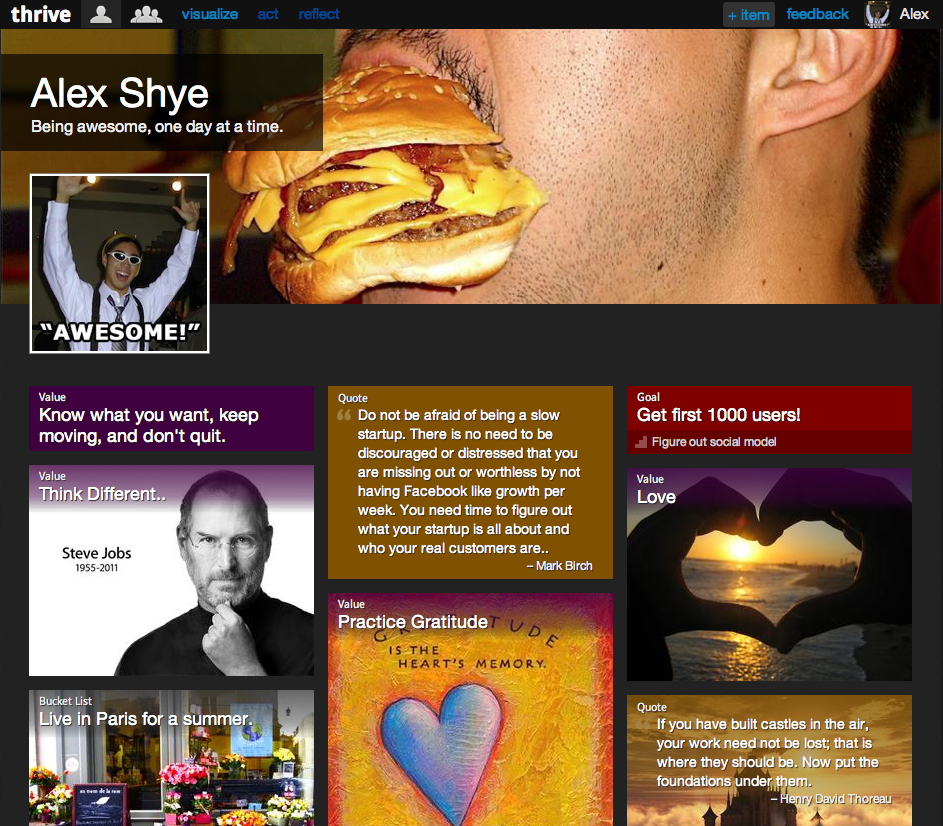
Thrive consists of two boards. The first is a forward-looking vision board representing what we want in our lives. You could add your values, goals, bucket list items, and favorite quotes. The second is a reflection board, which contains the things that we have done. The boards are connected via action steps. Each item on the vision board can be broken down into action steps. As you check off the steps, and then check off the items on the vision board, they move over to the reflection board. I believed that over a lifetime, it would be a useful tool for people to keep track of the stuff that matters in life.

And so I built it. The site is down now, but here are a screen shot:
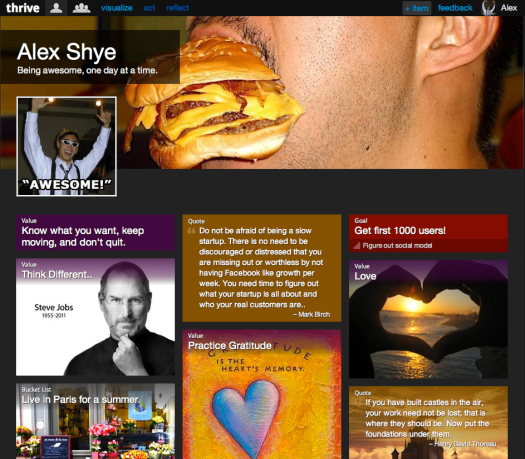
My Thrive vision board

My Thrive vision board

Since this was my first larger website, the development took me a few months. At the end of development, I got a little under 200 people on the site and started using it myself.

The verdict? I didn’t like it. Beyond the first few days, I didn’t use the site myself.

Why?

First, I don’t like todo lists. On a particular day, I have one or two most important things, and I do them. I rarely need action steps to do stuff.

Second, the list items were so far in the future that action steps didn’t feel meaningful to me on a daily basis. For example, I have a bucket list item of living in NYC one day. How do I take steps towards it? What is meaningful on a daily basis? I tried adding steps, but they never seemed to make sense to me.

Beyond that, almost none of the visitors did anything. Some of them really liked building up their vision board, but then they just left it, and never came back. Almost no one created action steps. Shoot, I barely created any action steps myself.

At this point, I began to believe that an action-based web app like this would be very difficult to build. I couldn’t make the actions meaningful enough to myself, and I didn’t want to do them on a daily basis. Even if I did, I didn’t feel like checking them off.

This was bad news.

 A cofounder, and Project Awesome.

As things tapered off with Thrive, I met a potential cofounder at Startup School.

He had liked the idea of Thrive, but wanted to simplify it to just a single board. This seemed like a good idea. If you go to Pinterest and search for ‘vision board’, you will see tons of them. Clearly, there was a vertical here to go after!

I had started to believe that an action-based vision board wouldn’t work. But what about making it more social? It I didn’t want to create and check off steps, I might like sharing and socializing about my dreams and goals. We converged on building a new product that was a single board, with social components such as Like buttons and comments.

And thus, Project Awesome was born (the site is up for now, but only gets the single free Heroku instance and may be taken down fairly soon). Project Awesome was always meant to be a code name. It started as our git repo name, but eventually it sort of just stuck.

My cofounder was affiliated with StartX, so we went along with one of the sessions. During the session, we built a site that was basically a subset of Pinterest, and then released it to about 100 people.

What happened?

I liked it slightly better than Thrive. The user base did also. People built up some boards, and some social action took place. It turns out that adding any social component to a site seems to make it much more engaging. I liked occasionally chatting with strangers about what matters in life.

However, after a few weeks, I had a hard time continuing to use it. I tried all kinds of things. I used it for a workout journal. I used it as a gratitude journal. But it became boring to use!

One of the design decisions was to limit the vision board to 20 items. Focus matters in life. We wanted to differentiate from Pinterest by forcing focus. From a theoretical standpoint, it sounds good. Practically, the focus eventually becomes boring.

After a few weeks of using it, my cofounder decided to pursue something else. I couldn’t blame him. The product wasn’t that good, and on top of that, we had some troubles with different working styles.

A few weeks after my cofounder left, I decided to stop working on Project Awesome also.

It isn’t all rainbows and flowers.

You know how everyone says entrepreneurship is a huge emotional roller coaster?

When I quit my job last year, I thought that was BS. You see.. I am one of the most optimistic people I know. I barely ever get down.

But, now I know. It is certainly true. Entrepreneurship is one hell of an emotional rollercoaster. Seriously. This shit is tough. Really really tough.

It had been close to a year and I had nothing real to show for it. I had now built out two products (or two versions of one product depending on how you see it) that I didn’t like. I also had a cofounder that didn’t work out. I had also applied to YC twice, as well as a few other accelerators, and been rejected. The rejections made sense though. I was a single founder that hadn’t figured out much yet.

What followed was pretty much a few weeks of nothingness. I didn’t know what to do. I didn’t know what to build. I was struggling, lost, and totally confused. And because I didn’t share it with anyone for a week or two, I was alone in this nothingness.

From an emotional standpoint, if there is one thing I have learned, it is that when shit gets difficult, share it with someone! A week or two later, I started telling people that I was down. I told them that I felt lost and had no idea what I was doing. The funny thing was that just sharing it made me feel way better.

My great epiphany.

Soon after, I had a great epiphany.

I was building things to try to get people to do stuff.

That is the wrong way to think!

I needed to build things to help people do what they want to do!

I had heard this from people several times: “Alex, you are on a noble, but difficult mission”. And it was true! I wanted to help change people. But from a business perspective, it makes things difficult.

Here is another way to put it.

Lets say we know two things. The first is something people do. The second is something that people don’t naturally do, but you want them to do. Which of these things would you stake a business on? If I were a betting man, it would be obvious: the first thing!

So for the time being, I am hopping on board with the first option. It seems like the smart thing to do. I want to build something that helps people do things they want to do.

What now?

Currently, I am struggling with a question.

Do I make finding a cofounder first priority? Or do I just start with something?

I don’t know the answer, so I am doing both. I can’t guarantee when I will find a cofounder, but I can guarantee real progress if I start on something (unless the idea is bad again!).

A few weeks ago, I came up with something new to build. I like the idea a lot so far.

I want to build an aggregator and community for content related to living a good life. Personal development can be hard, but one thing people do is that they consume content. A lot of it. I want to build something that helps people find, share, and connect over the best content.

There are only two rules:

  1. Anything related to living a good life in on topic.
  2. No assholes.

There is good life related content fragmented all over the web, across blogs, web sites, videos, etc. I look for it, but it can be hard to find the good stuff. And often, the good stuff is fragmented. A particular blog may have one or two good posts, but to drive page views, they need a ton of other watered-down posts.

This is something that I want to use. And, I think others would like it too.

I’m about 2-3 weeks into building it and it is almost ready. So far, it is something like a love child between reddit/Hacker News, imgfave, and svbtle.  I’ll share it in the near future 🙂

Lessons learned

On one hand, I have almost nothing real to show from this last year.

On the other hand, I have grown and learned so much about myself and about entrepreneurship that it is crazy.

Here are a few of the things I have learned:

  • Help people do what they want to do. My big epiphany. You can either try to change people, or help them do what they want. You’ll always be better off helping them do what they want to do.
  • Entrepreneurship is great job. Yes, it is tough as shit. And yes, it can be a huge roller coaster. But I wouldn’t trade it for any other job in the world. It is difficult because things really matter. Entrepreneurs try to create real value for the world. Creating real, scalable value isn’t a cakewalk. But it is worth working for.
  • Cofounders can be awesome, except for when they aren’t. I have worked with and without a cofounder now. It was great having a cofounder, but when there are problems, things can slow way down. There is value to having a team, but make sure it is a good team that works together and is aligned with similar goals and visions.
  • Keep good company. I have 3-4 other friends who are single founders. We meet once every few weeks and trade thoughts and stories. They have kept me sane and given me a sounding board whenever I have needed it.
  • Share your experiences and feelings! As I said before, there are definitely down times. We like to project success and happiness, but if you are having a tough time, make sure you have people to be honest with.
  • At some point, be honest with yourself. This is with regards to your startup idea. Try your own product. If you don’t like it, that’s not good news. If others don’t like it, it needs work. Either learn from them and change the product, or do something else. Most ideas suck. Yours probably does too. That is OK, as long as you recognize it.
  • Tighten the loop if possible. I worked on both Thrive and Project Awesome for a few months. Waiting a few months for user feedback is not good. I’m trying to figure out how I can tighten this loop, and make better use of my time.
  • Getting users is hard. Either you don’t know how to reach them, or your product sucks. Or both. As a tech guy, it is easy to just keep building. My toughest battles are to stop building stuff, and to actually make sure I’m building something worth building.
  • Entrepreneurs are awesome. The entrepreneur culture is amazing. I think it is because we all know how hard this job is. We are all in the deep end just trying to stay afloat, helping each other is the right thing to do. I’ve met some amazing people so far, and everyone has been very supportive and helpful.
  • Keep going. Think long term. You will have lots of setbacks. But, over time you learn a lot. Things get better. And faster. For example, Thrive took about 3 months of coding. Project Awesome took about 1.5 months. This new thing is 2-3 weeks old, and pretty much done. But beyond that, each product is just one thing. The real product is YOU. Every hour of work makes you better, so just keep going.

Now, last but not least, here is the most important lesson:

No matter what, you will make your own mistakes.

Check this out. None of this advise is new. Look at most startup blogs, and they say the same thing. But you will make many mistakes, and learn the same things anyways.

Here is an awesome example.

My biggest epiphany so far is that I need to create something to help people do what they want to do.

What does this sound like?

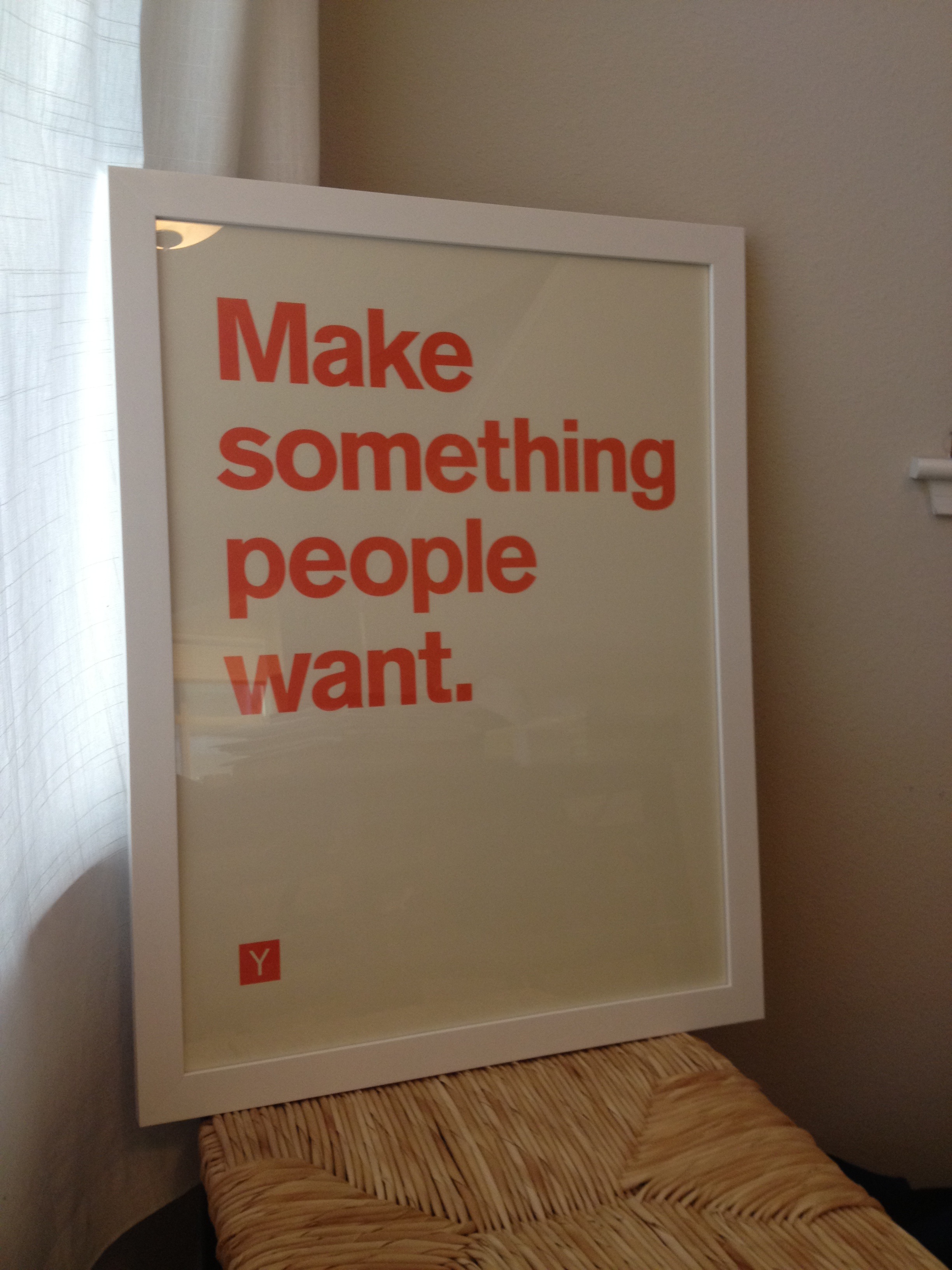
YC’s number one rule is: make something that people want.

This is probably the first bit of startup advice I read after I quit my job. And somehow I found myself re-learning it almost a year later!

You can read stuff and it makes sense in theory. But doing things right in practice?

Good luck.
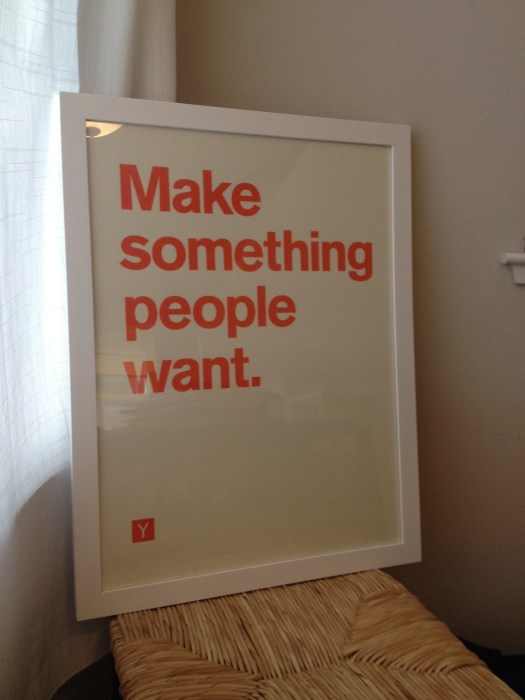
During my big epiphany, Alvy Brooks was selling these posters for donations to Watsi. I snapped one up and it is now by my desk as a reminder every single day.


During my big epiphany, Alvy Brooks was selling these posters for donations to Watsi. I snapped one up and it is now by my desk as a reminder every single day.