Music and social media

Music is a wonderful thing. It can immediately evoke strong emotions, such as excitiement or feelings of nostalgia. Whatever you are doing, great music can significantly improve your experience.

I love music. The funny thing is, it has never been part of my social media experience. I have shared status updates, location, images, and videos, but I have rarely had a reason to share something with music. That is, until this week.

Recently, I’ve been coming across short videos made by the Mindie iOS app. This week, I’m on vacation on Oahu, and gave it a try myself. For those that haven’t seen them, Mindie allows a user to choose a song from the iTunes store, and then use their phone’s video camera to put together video clips totaling up to 7 seconds. 7 seconds of your chosen song plays in the background.

Mindie sounds like a simple app, but it is the first music-related social media experience that I have ever been excited about. It allows you to stitch together parts of your life, and then use the music of your choice to strengthen the moment. The addition of music is powerful. It improves the video, as well as attaches itself to your experiences within your mind. I’m sure that when I recall the experiences in the future, the songs will be part of my memory.

Want an example? Here’s an Mindie from today 🙂

Awesome, huh?

The 7 second limit is a huge design decision here. It allows the video to be short and fun, but is long enough include a significant number of shots. More importantly, the constraint forces users to use their creativity to maximize the 7 seconds of video. It essentially turns everyone into the executive producer of a short music video reflecting their lives. The result is an exciting video that you don’t mind looping over and over. And because they are only 7 seconds, you don’t mind watching other people’s Mindies also.

I’ve already made 10+ Mindies these past few days, and they have been a lot of fun. It is very exciting. The most exciting part of this, is that I believe Mindie has unlocked the key to adding music into social media. This is great for music lovers and me.. and I’m sure many others in the world.

IMHO, Mindie is the first compelling social app that makes music a core part of the experience. I don’t think it will be the last, and am excited to see what other app developers come up with.

P.S. This is post number #85 in a 100 day blogging challenge. See you tomorrow!

Follow me on Twitter @alexshye.

Or, check out my current project Soulmix.

Be good (the startup version)

Yesterday, I wrote on a big lesson that consistently pops up in my life: be good. The lesson is simple: if you want something, the only thing that matters is to be good.

Most recently, I have been learning this lesson with respect to startups.

When I quit my job in April 2012, I had no idea what I was doing. I only knew that I wanted to create an impact in the world, and that I probably had to figure it out on my own.

The first thing I did was consume everything I could find on the web and in the bookstore. I devoured books and blog posts. I watched as many videos as I could find from founders I respected. I browsed Hacker News daily, reading a good fraction of all the posts on the front page. At the same time, I started doing a lot. I picked up web programming. I started blogging. I continually networked as best I could, taking coffee meeting after coffee meeting.

In the first year, I met a lot of people, and learned a great deal about the VC and tech world. However, I hadn’t built anything worth anything. I had built and scrapped three prototype products. So where was my startup? At ground zero.

After I scrapped my third code base, I remembered that lesson that I always seem to come back to: be good.

Since then, I’ve browsed Hacker News a lot less. I’ve drastically cut back on coffee meetings. Instead, I spend almost all of my time building and iterating on product.

Why?

A startup is defined by it’s product. Build a great product, and you’ve built the beginnings of a great startup. Fail to build a great product, and there is no startup.

You can have the greatest network in the world, but without a good product, you are just simply good at schmoozing and connecting with people.

You can figure out a way to raise millions of dollars, but without a good product, you aren’t a startup. You are just a bank account.

You can churn out thousands of lines of code, but if it doesn’t turn into a good product, those lines of code are going to be thrown away.

You can build your Twitter and blog following, but without a good product, you are a talking head.

You can read all of Hacker News, Techcrunch, etc. but without a good product, you are just a listener.. most likely listening to a bunch of talking heads.

You can learn all you want about growth hacking, but without a good product, you have nothing to grow.

Only one thing matters in building a startup: being good at building product.

And how do you build a great product?

I wish I could answer that one. I only know that the start of that answer again is to be good. I don’t think there are any tricks. Great products don’t just pop out of thin air. They are created by people who are good at building product that people want.*

Knowing this, there is only one thing to do: focus on understanding great consumer web/mobile products. I’m not good yet, but hopefully if I keep focusing and working, I’ll get there one day.

* One may say there is some luck involved, and I would agree. But it isn’t all luck, and the best way to maximize your luck is to be good, and be persistent.

* You may ask why I am blogging. First, I am rounding out this 100-day challenge. Second, and more importantly, I have learned that blogging everyday forces me to reflect and think about the big picture on a regular basis. This forcing function has actually been great. So even if I write horribly with typos and grammatical errors all over the place, the writing is really good for me. I’m not sure what I’ll do when the blogging challenge is over, but I may keep writing everyday.

P.S. This is post number #82 in a 100 day blogging challenge. See you tomorrow!

Follow me on Twitter @alexshye.

Or, check out my current project Soulmix.
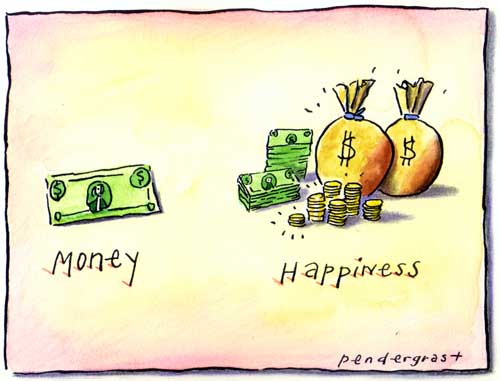
Startups, money, and happiness

money-happiness

A commonly cited Princeton study on money and happiness claims that money correlates to happiness until you reach a 75K/year salary. Past that, money doesn’t make you much happier.

You can argue about locations, standards of living, etc. but I think it is easy to agree that money provides decreasing marginal utility. That is, the amount of happiness you gain per dollar decreases as you make make more money.

People often think about the marginal utility of money with respect to an annual salary, but there is another interesting way to look at it: the marginal utility of money earned in a lifetime. This becomes particularly interesting for people making the decision between their tech job, and their desire to give the entrepreneur/startup thing a try.

Let us use an example of Jeff, a fictional dude that has 30 years of work in him. He has the choice to either work at a company for 30 years, or to give up 5 years of salary to give a startup a try. If we assume Jeff makes the same amount each year (which obviously isn’t true, but please just go along with it for now), Jeff gives up 16.67% of his lifetime income if he goes the startup route.

Is this a good tradeoff?

I’m going to argue that going the startup route is the right decision (granted that deep down, he really wants to try it).

Jeff only needs a certain amount of money in his lifetime before reaching of point of diminishing returns with respect to happiness. At that point, the only way to significantly increase happiness is to significantly increase the total money earned.

If Jeff’s cushy tech job pays anywhere near 6 figures (as many in tech jobs do), he is way above the 75K/year number in the Princeton study. If he gives the startup thing a try, he doesn’t stand to lose much lifetime happiness when reducing his lifetime income by 16.67%.

However, by trying a startup, Jeff gains the chance to significantly increase his happiness in two ways.

First, he gets the chance to chase a dream. The impact to happiness here is hard to measure, but it can be significant. In the short term, there are benefits to having purpose and hope while chasing your dream. In the long term, there are also big benefits. Whether he succeeds or fails, when Jeff is on his death bed, he will be proud that he gave the startup thing a try.

Second, should the startup actually make it big, he has the chance to significantly increase his lifetime earnings. By “significant”, I mean 2x, 5x, 10x , or possibly more. At these multiples, the increase of lifetime earnings can significantly impact your life happiness, and change your life style.

Yes, this example is rough, but it should be enough to get the picture. I believe that for a knowledgable and skilled person who wants to try a startup and optimize for life happiness, the rational decision is to take the plunge and go for it.

Obviously, I would say this because I’ve done it. What do you think? Does it make sense?

P.S. This is post number #80 in a 100 day blogging challenge. See you tomorrow!

Follow me on Twitter @alexshye.

Or, check out my current project Soulmix.

The problem with righteous entrepreneurship

Recently, there have been a lot of press on the troubles of VC firm Kleiner Perkins. They were once legendary in their pick of tech companies, as early investors in Amazon, AOL, EA, Google, Intuit, Netscape, Sun Microsystems, Tandem, etc. More recently, they went all-in with cleantech, and did not come out smelling so great.

Linked to the article from Gigaom is another good article this, and on the problem with righteous investing. VCs play a large role in innovation by picking and choosing the right startups to fund. However, this choice is critical. VCs can’t just pick a lofty mission, and dump money into it. As I’ve been learning (and wrote about in a prior post), the market always wins. Lofty visions are great, but there must be a market, and the market must want your product.

However, VCs are only one side of the story. The other side is the entrepreneurs. And the same law applies: lofty visions are awesome, but at some point the vision meets reality, and the reality of the market wins.

This is critical for entrepreneurs to think about. Passion matters in entrepreneurship. Most people don’t leave perfectly good jobs (with perfectly good paychecks) unless they have a passion for something. The most passionate are often driven by the largest missions, and there are many great missions out there: world peace, feeding the poor, educating the world, etc. Clean tech may be one of these (although I’d bet that timing was the real issue). These missions sound great, but can be huge traps. Maybe they would be great as a non-profit, but as a startup? Tread lightly.

This has been one of my biggest lessons so far in my time as an entrepreneur. Look at yourself and make sure you aren’t being a righteous entrepreneur. Passion is great, but the market always wins.

P.S. This is post number #79 in a 100 day blogging challenge. See you tomorrow!

Follow me on Twitter @alexshye.

Or, check out my current project Soulmix.
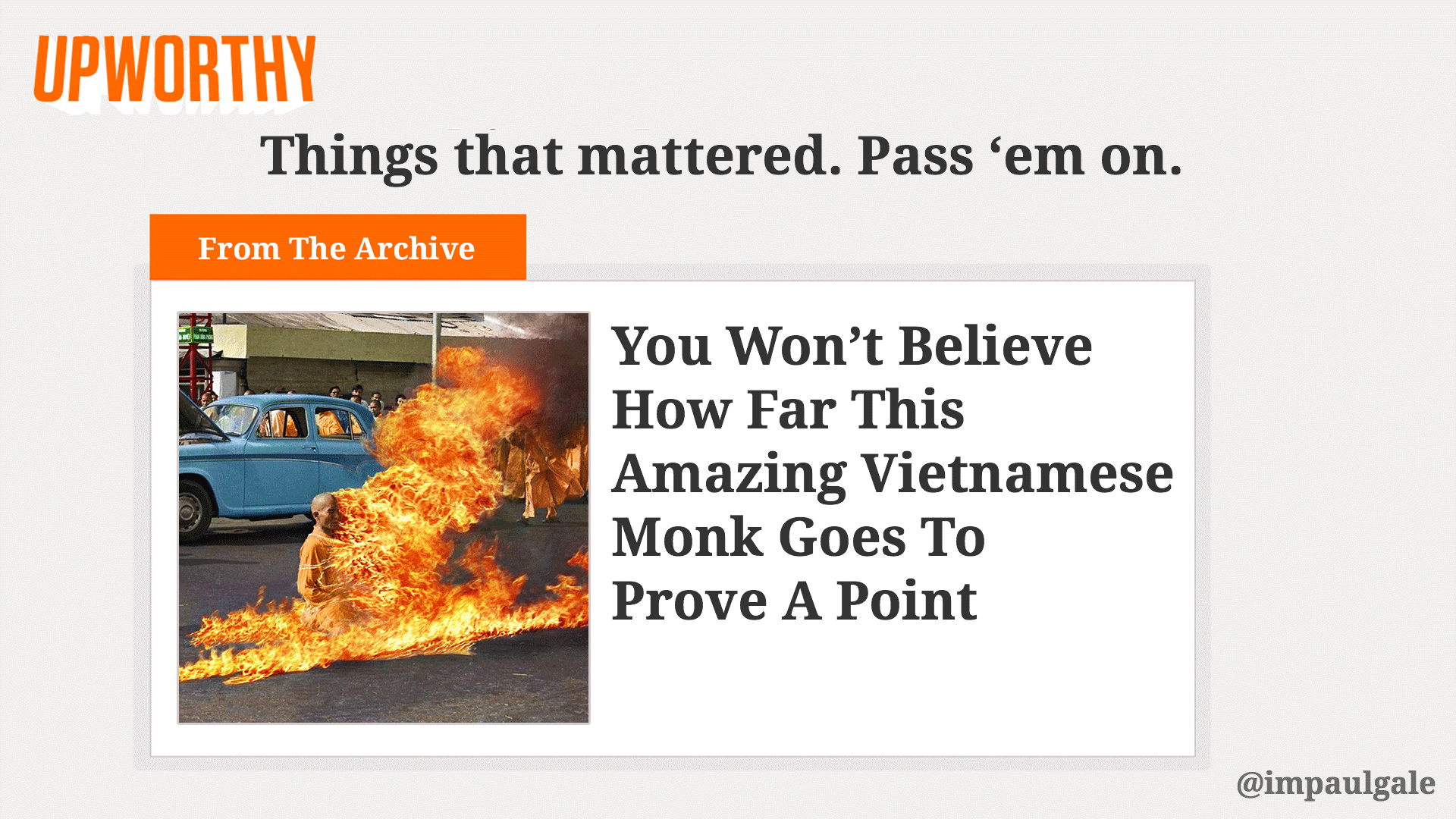
The startup of headlines

The power of headlines has been known for quite a while in the publishing world. No matter how great a piece is, it doesn’t matter if the headline is bad. If a headline is good, you can easily 10x your page views. None of this is new.

Here is what’s new. Headlines may be much more powerful than we ever thought. As it turns out, headlines alone are enough to power a startup.

The best example here is Upworthy. If you use Facebook, I am certain you have come across Upworthy. They are the posts with super-clickable titles like “At first I was only  interested, but two minutes later, my mind was blown”. Have you seen any like those? And then clicked? I sure have.

Upworthy has a fairly simple business. It (1) chooses great shareable  content, and then (2) slaps a great headline on the content, and (3) shares it out on Facebook. A great headline compels the user to view the content, and great content compels the reader to share. That is all you need for massive growth. I have also come across Viralnova, which seems to be doing the same thing.

Isn’t that amazing? These are full VC-investable startups that are built on choosing great content, and writing great headlines. Yes, choosing great content is a value add. But it isn’t like they are creating the content. It is all out there. If you hire enough people, you can easily find great content, and then slap a new headline on them.

Can you write great headlines? You may want to consider a startup 🙂

P.S. This is post number #78 in a 100 day blogging challenge. See you tomorrow!

Follow me on Twitter @alexshye.

Or, check out my current project Soulmix.

Are startup valuations and payouts too high?

Since I have jumped into the startup game, I’ve consistently heard people comment on the high startup valuations/acquisitions and the high payouts that successful founders and early employees get in liquidity events.

These comments/complaints sound something like:

  • Snapchat just turned down 3 billion. Is it really worth that?
  • Pinterest and Dropbox have valuations of 4+ billions. That’s crazy!
  • Twitter just raised close to 2 billion on a 14 billion valuation.. built on top of a table storing 140 character tweets!
  • Tumblr? 1 billion? Damn, that is a lot of money.

There are also similar comments about the money people end up with:

  • Snapchat just turned down 3 billion? Even with modest founder equity percentages, the founders would have banked. Is it fair that they make so much?
  • Instagram had twelve people and sold for a billion? That is a boatload of money for 10+ people.
  • etc., etc., etc.

People seem to have a hard time with these kinds of numbers. Are these high numbers alright? And are the high payouts for founders and early employees fair?

I believe that for the most part, the high valuations and payouts and 100% warranted. I’m no economist, finance wizard, or even that good with numbers, but I don’t think it is difficult to come to this conclusion.

High startup valuations.

As a quick exercise, check out the market caps of the Fortune 500 companies (and these are for 2012). You see that? Apple is at 568 billion! Microsoft is at 269 billion. Those are some big big numbers.

People squawk about startups valued at a few billion. Seriously? They don’t believe that a startup could speculatively be valued at 1% of Apple? At some point, the breakout unicorn startups will be surely be worth a few percent of Apple. And possibly more in the future if they do a great job.

Individual don’t usually deal with huge numbers in their bank accounts, but businesses do. You shouldn’t be stunned with you see billions in the business world. It is a regular thing for the real large successful companies out there.

 High founder and early employee payouts.

The real insight here is this: a person’s pay should be related to the value they bring to the market.

It can be easy for employees of large corporations to lose sight of this. Why? Because they go to work everyday, and collect a nice paycheck regardless of the value they bring to the market. The employee doesn’t directly bring value to the market. Instead, the business does. The business is a money making machine, and it pays employees to keep this money making machine sustainable.

Founders and early employees have a different job than employees. Their job is to figure out how to create value for the market, and then turn this value into a money making machine. Their job is to create the beast which, if successful, may one day have a market cap in the 10’s or 100’s of billions!

When you think this way, it surprising that founders and early employees of successful companies are well compensated? Not really.

A common dialogue.

I have many friends in the tech industry, and I have already repeated this conversation several times. In turns out, I have many friends in research, so it makes this conversation even easier. It goes something like this:

Friend: Dude, Snapchat just turned down 3 billion cash! The founders could have easily walked away with 100’s of millions cash, if not more. Isn’t that crazy?

Me: Well, it really isn’t that crazy. You’re a good software developer at Google/Facebook/etc. I bet your yearly compensation is somewhere between 150K and 200K right? Possibly more?

Friend: Yes.. that is in the right ball park.

Me: And I bet your boss makes more right? As does you’re boss’s boss. They must make 200K-1M a year depending on how big they are right?

Friend: Yes… probably.

Me: OK, well tell me: what happened to your project this last year or two?

Friend: Well we’ve been working on something, but the project just got cancelled and we’ve been put on something else. (Again, having friends in research makes this argument really easy.)

Me: Hmm.. OK. So you and your bosses are banking a cool fraction of a million per year without creating value in the world. Do you know what the Snapchat kids did? They have 30+ million active users and are sending 400+ million messages a day. It is quite a feat. That is real value, and it is real world impact. Are you telling me that they don’t deserve a payout that is orders of magnitude more than you and your boss?

Friend: Ummm….

Me: Oh yeah, and if you want another way to think about it, Paul Graham has this really good essay on how to make wealth. You should check it out.

P.S. This is post number #75 in a 100 day blogging challenge. See you tomorrow!

Follow me on Twitter @alexshye.

Or, check out my current project Soulmix.

The importance of the market when building a startup

This 100-day blogging challenge is getting difficult. Now, one or two days a week, I hit a writer’s block and just can’t come up with a topic to write about. This is a big reason why I have begun publishing notes on other content. I figure if I share notes on some of the best content I have found, it may be useful to others.

Well today I’m having writers block again. I’ve been thinking about the importance of the market in building a startup, but frankly, I don’t have anything original or interesting to add to prior blog posts that I have read.

So, I’ll just leave you with the best blog post I have ever come across on this topic by Marc Andreeson of Andreeson Horowitz. Some of the best parts paraphrase Andy Rachleff, formerly of Benchmark Capital.

When discussing startups, people tend to argue about the relative importance of the team, product, and market. Marc makes a strong case that the most important factor is the market. He then describes product-market fit (PMF), which is arguably the most important step a startup can take on the road to success.

IMHO, the most important bit is here:

The #1 company-killer is lack of market.

Andy puts it this way:


– When a great team meets a lousy market, market wins

– When a lousy team meets a great market, market wins.

– When a great team meets a great market, something special happens.


You can obviously screw up a great market — and that has been done, and not infrequently — but assuming the team is baseline competent and the product is fundamentally acceptable, a great market will tend to equal success and a poor market will tend to equal failure. Market matters most.

And neither a stellar team nor a fantastic product will redeem a bad market.

And here:

The only thing that matters is getting to product/market fit.

Product/market fit means being in a good market with a product that can satisfy that market.


You can always feel when product/market fit isn’t happening. The customers aren’t quite getting value out of the product, word of mouth isn’t spreading, usage isn’t growing that fast, press reviews are kind of “blah”, the sales cycle takes too long, and lots of deals never close.


And you can always feel product/market fit when it’s happening. The customers are buying the product just as fast as you can make it — or usage is growing just as fast as you can add more servers. Money from customers is piling up in your company checking account. You’re hiring sales and customer support staff as fast as you can. Reporters are calling because they’ve heard about your hot new thing and they want to talk to you about it. You start getting entrepreneur of the year awards from Harvard Business School. Investment bankers are staking out your house. You could eat free for a year at Buck’s.

Again, you can find the entire article here, and I highly recommend it. If you have even more time, the Pmarchive contain a bunch of old posts from Marc Andreeson. They are some of the best reading you can find on building startups.

P.S. This is post number #73 in a 100 day blogging challenge. See you tomorrow!

Follow me on Twitter @alexshye.

Or, check out my current project Soulmix.

Notes from the PandoMonthly with Mark Suster

For the past few weeks, I have been burning through PandoMonthly fireside chats and keeping notes on them. Since the talks are so long, I hope the notes will be useful in helping you determine if you want to watch the full interview.

marksuster5

Today I’ll be writing on the PandoMonthly with Mark Suster, a prior entrepreneur, a VC at Upfront Ventures, and a blogger at Both Sides of the Table. The interview is a bit under 2.5 hours, and has a ton of great advice in it.

Here are some paraphrased notes of my favorites points during the interview.

  • CEO as chief psychologist: You have sales working with marketing working with engineers, and they have different viewpoints. Everyone ends up fighting with everyone else. CEO’s job is to handle this. If the CEO wants everyone to love them, you can’t make the right decisions, and handle these problems correctly.
  • Deflationary economics: Almost every great success story on Internet is built on massively deflationary prices. Drive costs down, drive margins down, create large overall market doing so, and it is impossible for the big incumbents to beat you.
  • Finds it a shame he sold company: There were many currently successful companies built on the ideas that his company was working on. He was tired, employees were tired, etc. They ended up selling the company, and didn’t see it through, but could have had a great future.
  • Why big VC blogs in NY, Boulder, LA:  Necessity of mother of all invention. Fred Wilson (NYC), Brad Felt (Boulder), and Mark Suster (LA) weren’t plugged into Silicon Valley ecosystem. They needed to work harder to get out there. It ended up being a great investment.
  • Commercializing academic work is tough. Very difficult, especially in California. The UC system has a unified policy is they want 2% royalties on sales. That makes most of their startups untenable. If a professor is involved, it makes it worse. The tip is to not touch university resources or professors. Universities should embrace equity like Stanford.
  • Internet of everything.  Mark isn’t a big fan of wearable. He is a big fan of things talking to each other: objects all talking to each other, broadcasting, and communicating. This will be powerful for logistics, manufacturing, transportation, etc..
  • Consumer vs. enterprise. Marc Andreeson recently said that Andreeson-Horowitz generally wants to do enterprise A round, and consumer B round. Consumer is hard. Enterprise and unsexy stuff has less competition, you know users, and monetization more clear. In enterprise, you can listen to consumers. With consumer, you can’t because its always angry consumer that is loudest.
  • Keep communication simple about startup and vision. Be more like George Bush, less like Al Gore. Al Gore speaks too intelligently. Keep message simple so that everyone will easily understand it.

If you’ve got the time, check out the full interview here:

P.S. This is post number #71 in a 100 day blogging challenge. See you tomorrow!

Follow me on Twitter @alexshye.

Or, check out my current project Soulmix.

Living online documents

pages

I haven’t been treating this blog as an “actual” blog.

As a reader, I view blogs as a place for regularly published posts which are read and then immediately forgotten. As a writer, I view blogs as a place to publish a piece of writing and then move on to the next piece.

I can’t think of my blog this way.

Instead, I think of each post as an unfinished piece of work that acts a stake in the ground for an idea that may be worth thinking about. In the future, I may come back to fix up typos, grammatical errors, add/remove sentences, or even add/remove entire ideas.

This means that each post is a living online document. I wish that there was some way for the public to view it as such. Instead, people just see the new posts within their email or RSS readers. To my subscribers, I’m sorry about this. It is unfortunate because all of the ideas are half-baked and may contain some horrible typos/errors. I hope you still find the ideas interesting, and perhaps find your way back to some of the posts in the future (after the 100-day challenge when I can revisit posts).

This points to an interesting thought about online publishing. Most content online does not change. News articles don’t change. Most people don’t change their blog posts. Facebook and Twitter posts don’t change. And at the same time, content is growing at and exponential rate. The Internet is becoming a firehose of half-baked articles that could be better, but never will be.

The current Internet rewards quantity. Yet, over time, it is the evergreen quality posts that really matter. One could expect writers to publish fully formed evergreen content, but this is very difficult. What makes sense is to revisit ideas, iterate on them, and then iterate on the writing.

Is there some way to support and encourage living online documents? If someone could figure how to make living documents engaging, IMHO, the Internet would become a much better place.

P.S. This is post number #70 in a 100 day blogging challenge. See you tomorrow!

Follow me on Twitter @alexshye.

Or, check out my current project Soulmix.

Will we see more successful startups with single founders?

cofounders

Historically, most tech startups have multiple founders, especially the ones that have made it big. Think Steve & Woz, Larry & Sergey, Bill & Paul, Hewlett & Packard, Brian & Joe & Nathan (AirBnb), Drew & Arash (Dropbox), Jack & Noah & Ev & Biz (Twitter), Ben & Evan & Paul (Pinterest), etc.

It has become so ingrained in Silicon Valley wisdom that life as a single founder is very difficult. Because of this, it people seem to take founding teams more seriously. As an example, it seems that accelerators highly prefer cofounding teams. The partners of accelerators often say so. And from experience, I know teams of smart people with no product that have gotten YC/500/Techstars/etc. interviews (or into the programs), but very very few single founders that have gotten interviews in the same position.

To some degree, it makes sense. A startup is hard enough that it is extremely difficult for one person to get something off of the ground. And even if a single person gets something off the ground, can they build a team while growing and scaling?

Things may be tough for a single founder, but times are changing quickly.

  • Services such as  AWS, Heroku, MixPanel, MailChimp, etc. make development simple. More and more startups are popping up to improve the toolchain and sell shovels to the startup folks. It is never been easier to get a product up and running.
  • The world is becoming increasingly connected with the growing social and interest graphs. This means that for many consumer apps, distribution has never been easier.
  • Crowdfunding is starting to gain traction, as well as Angellist. It has never been easier to contact investors, as well as close a round (from what I’ve heard).
  • Accelerators are picking up and learning how to improve the chances for startup success. At the same time, founders/investors are becoming increasingly open with advice on blog posts, Hacker News, USV.com, etc. It has never been easier to gain a basic education in startups, marketing, positioning, distribution, etc.

All of these trends are continuing, and they may even be accelerating. This means that as time goes by, the amount of work necessary to build a startup decreases quickly.

It would go against common wisdom, but if the trends continue, it intuitively makes sense that we should see more single founders build large successful startups.

What do you think? As I am working alone at the moment, I surely hope this is the case.

P.S. This is post number #69 in a 100 day blogging challenge. See you tomorrow!

Follow me on Twitter @alexshye.

Or, check out my current project Soulmix.