
What time frame do you optimize for?

Infinity-Time1

To optimize productivity for today, I would probably continue working on exactly what I was working on yesterday.

To optimize productivity for the next few years, I would probably continue working in exactly the same area I’ve been working on for the last few years.

To optimize productivity for 10+ years, things change. I may be better off leaving my current area of expertise, and building expertise somewhere else.

To optimize for play today, I would forget about productivity and have as much fun as possible.

To optimize for play in the next few years, I would probably work in my area of expertise to maximize my pay/hour, and use that money to buy awesome life experiences.

To optimize for play in the next 10+ years, I’m not sure what I would do. My guess is that purely playing for the sake of playing would get old. I would want some sense of purpose.

To optimize my life for the now, I would probably optimize for fun.

To optimize my life in the next few years, I would probably do a mix fun, family, and purpose.

To optimize my life for 10+ years, I would probably emphasize family and purpose.

What is interesting is that as the time period changes, my actions to optimize anything also changes. It means that for any given area in life, it is important to know what time frame you are optimizing for. If your actions match the time frame you are optimizing for, you are probably in decent shape. At the very least, you are living the life you intend to life at the moment. If your actions don’t match the time frame you would like to optimize for, then something is off, and it is worth considering whether your actions or the time frame you are optimizing for is off.

I find myself performing this thought experiment from time to time and it has significantly impacted how I view my actions. Personally, I shoot to optimize for the short-term (today) a small fraction of the time (let’s say 20%), and I shoot to optimize for the long-long-term (10+ or 20+ years) most of the time. Optimizing for the now allows me to do some crazy awesome stuff and enjoy the moment. Optimizing for the long-long-term allows me to view my life as a whole, and do what I feel is right for an entire life. I’m not convinced it is worth optimizing for the medium time frames.

Have you done this thought experiment? What time frames do you optimize for, and what have you found to work best for you?

P.S. This is post number #98 in a 100 day blogging challenge. See you tomorrow!

Follow me on Twitter @alexshye.

Or, check out my current project Soulmix.
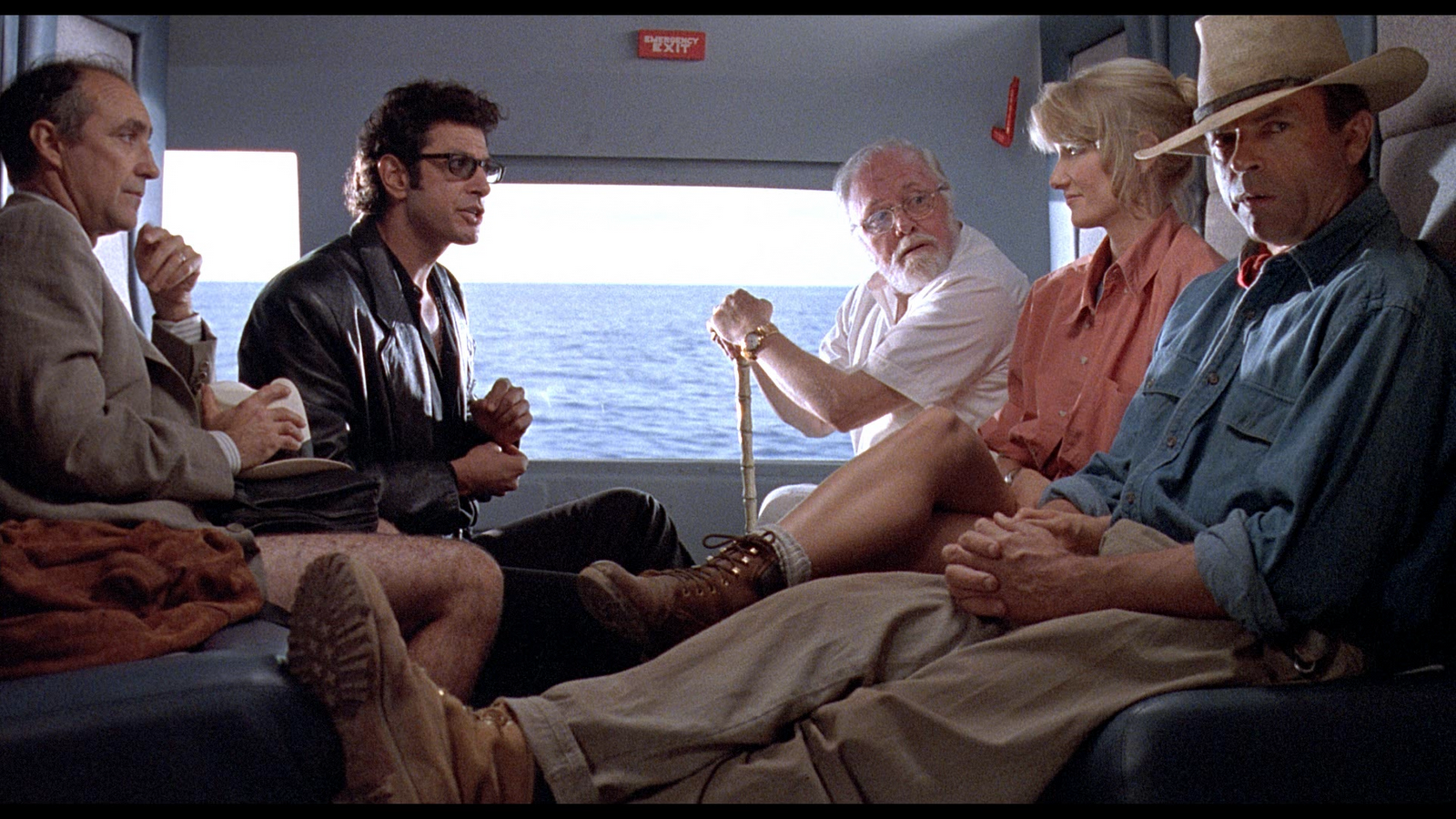
 

Jurassic Awesome

jurassic-park-helicopter-ride

I strongly believe in the importance of the old. Much of my favorite music is from the 70’s. Many of the best blog posts I’ve read on the web are old blog posts. Old stuff can be great. It shouldn’t just sit around occupying the dark corners of bookshelves (or of the web).

Because of this, I am always happy when something awesome from the past pops up.

Last week in Hawaii, some friends and I visited a valley used as scenery in Jurassic Park. The day before, we watched the movie. Released nearly 20 years ago, the movie is still brilliant. It seems dated, but not 20-years dated. And the soundtrack is still as beautiful as I remember it 20 years ago. I fell in love with the theme song back when it was released, and just this past week, I have fallen in love with it again.

Since then, I’ve bee playing the theme song non-stop. It is old, but damn, it is better than 99% of the stuff I could be listening to. I think I’ll keep it going for a little while longer, and then put it aside. I just hope that I will re-discover it again the near future, and fall in love with it all over again.

For those looking for a bit of nostalgia plus and extra does of ridiculous-ness, I have stumbled across 10 hours of the Jurassic Park Theme, embedded below for your aural pleasure 🙂

http://www.youtube.com/watch?v=cIWLIUwe1tE

P.S. This is post number #97 in a 100 day blogging challenge. See you tomorrow!

Follow me on Twitter @alexshye.

Or, check out my current project Soulmix.

Looking back on 2014

looking-back

Today is January 1st, 2014, the perfect time for New Year’s resolutions.

Personally, I’m not a plan of resolutions.

A resolution is something that you don’t do, but would like to talk about doing. That is why you hear everyone talk about them (and maybe even stick to them) for a few weeks, and then they fall off of the wagon.

A big problem with resolutions is that they look forward. Looking forward is difficult. The future is cloudy and fraught with uncertainties. How can we guarantee anything? In the face of uncertainty, at the very least, we can make a wish and hope that things pan out. That is how resolutions are. Resolutions are like making a wish.

It is always easier to look back. Once we have reached a point, we can simply turn around and see the path we took to reach that point. There is no uncertainty. There is just cause and effect.

We can use this observation to improve our resolutions. Instead of looking forward, let us take a look back on 2014.

If you were to look back on 2014, what would it be like? What would you like to be proud of in 2014? What would your personal life be like? What about career, or social life? How will you have grown in 2014?

Once you know the answers to these questions, there aren’t any more uncertainties. You can look back and figure out what you need to do.

If you need to pick up something new, do it.

If you need to quit something, do it.

If you need to stay on the same path, do it.

Sound good?

P.S. This is post number #96 in a 100 day blogging challenge. See you tomorrow!

Follow me on Twitter @alexshye.

Or, check out my current project Soulmix.

Critics and creators

gladiators

To me, being an entrepreneur means being a creator. Along the way, an entrepreneur is bound to come into contact with critics. Some critics are friendly and constructive. They may be stern or cutting in their criticisms, but they have your best interests in mind. Other critics aren’t as friendly. They will find reasons to call you and your work stupid, and criticize you when you fail.

No matter the type of critic, it is important for entrepreneurs not to be fazed. The world is made by the creators. Critics will always be there with their words, but the creators make the world to ’round.

I believe that Theodore Roosevelt said it best, so will just leave the rest of the post to his classic quote:

It is not the critic who counts; not the man who points out how the strong man stumbles, or where the doer of deeds could have done them better. The credit belongs to the man who is actually in the arena, whose face is marred by dust and sweat and blood, who strives valiantly; who errs and comes short again and again; because there is not effort without error and shortcomings; but who does actually strive to do the deed; who knows the great enthusiasm, the great devotion, who spends himself in a worthy cause, who at the best knows in the end the triumph of high achievement and who at the worst, if he fails, at least he fails while daring greatly. So that his place shall never be with those cold and timid souls who know neither victory nor defeat.

– Theodore Roosevelt, “Man in the Arena”, April 23, 1910

P.S. This is post number #93 in a 100 day blogging challenge. See you tomorrow!

Follow me on Twitter @alexshye.

Or, check out my current project Soulmix.

The fragility of life

wirdig

The older I get, the more I respect life.

Have you gotten sick? A little virus or bacterial infection can wreak havoc on our bodies. I happen to be sick today. I don’t know what it is, but it is probably just a little bit of stuff in my system that has caused a days worth of nausea, headaches, fever, and vomiting. Crazy.

Have you gotten drunk? Have you ever gotten high? We pass so much stuff through our systems on a daily basis, yet a little amount of alcohol or drugs (relative to our entire body), can change everything. It changes our mindset. It changes our reality and our actions.

Have you noticed your body aging? I used to be able to hit the basketball courts, and immediately begin sprinting and jumping all over the place. Now, I’ve put some mileage on my body. The muscles are still there, and I can still get on the court and move, but the little changes from the wear and tear are very noticeable. I require stretching. I can’t run as fast. I can’t jump as high. And I get hurt more.

Life is an awesome thing. We get this one opportunity to experience all that this world has to offer. However, I’m beginning to realize that this is but a brief opportunity. Our body is a complex system and it is amazing that it functions as well as it does for as long as it does. It only requires little changes here and there for life to be different.. perhaps even end.

Again, as I get older, the more I respect life. The only takeaway I know of is that we need to seize the opportunity, and make sure to get what we can out of the life that we have. It sounds pithy, but it really the most important thing to understand in life.

P.S. This is post number #92 in a 100 day blogging challenge. See you tomorrow!

Follow me on Twitter @alexshye.

Or, check out my current project Soulmix.
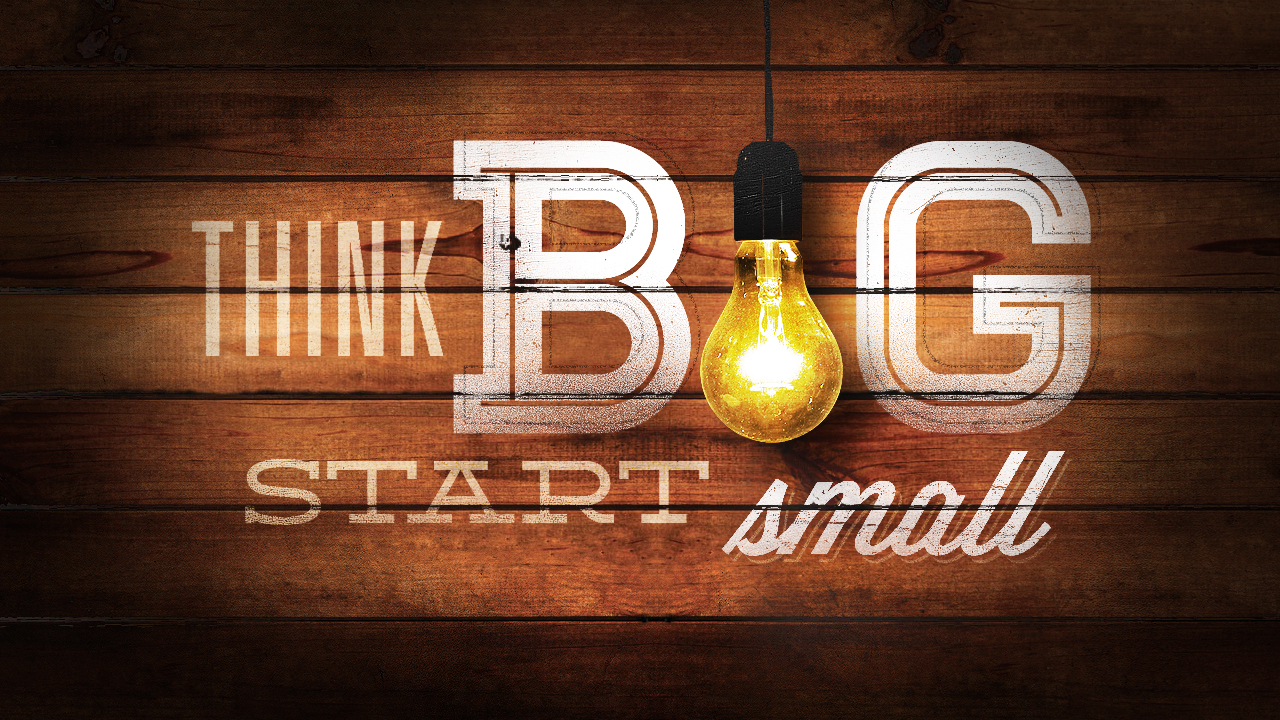
Thinking big and small

think-big_start-small

I came across this post today by Gabriel Weinberg on thinking big in startups, and it struck a chord with one of the biggest lessons I have learned in my startup career thus far.

As far as I can tell, it is critical for an entrepreneur to be able to think both big and small.

Thinking big gives you a clear understanding of how you intent to change the world. It gives you your mission, which drives you through the entire startup rollercoaster (which is damn tough!). Thinking big ensures that you are tackling a large market. The big vision is essentially what your startup could look like once it hits traction and scales out.

However, thinking big has a major problem. You begin a startup with nothing. Zero traction. Zero scale. No code. No users. No data. Nothing. You don’t magically take over the world overnight. You have to begin with a few small steps.

Here is where thinking small is critical.

You must take your big picture, and distill it down to that first step. The first step is your entry point into the large picture. It is best if this entry point (1) can be tested in a small amount of time, (2) requires relatively little resources, and (3) is something that a market needs right now. Some people may call this an minimum viable product (MVP), but I like to call it my entry point. If selected properly, the entry point should be simple, but powerful. It is enough to begin gaining traction, and sets you on your way towards your larger vision.

What order do you go in? Big first? Or small first?

From what I can tell, Amazon seems to have gone big first. I would bet that Jeff Bezos understood where he was going, and began with an online bookstore. On the contrary, Mark Zuckerberg seems to have gone small first. He built a small thing for his university that gained traction. Afterwards, he developed the large vision and mapped out the steps for accomplishing it.

It appears you can go either way, but at some point, you must be able to think both big and small.

P.S. This is post number #91 in a 100 day blogging challenge. See you tomorrow!

Follow me on Twitter @alexshye.

Or, check out my current project Soulmix.

Relationships and social networks

I find the intersection of technology and human interaction fascinating. Specifically, I am interested in how technology can be used to mimic and augment existing human interactions. I’ve written a bit about Snapchat and how temporary social media is brilliant at mimicking real life experiences. Similarly, the telephone, Skype, and Facetime all use technology to mimic/enable real life conversations.

One area technology hasn’t mimicked well is the formation of human relationships.

What happens when we meet a stranger in real life? We look at them. We observe their dress and body language. We make some small talk to break the ice, and collection enough information to create a first impression. As time goes by, we dig deeper into the relationship, delving into our personal history, our values, our hopes and dreams. We share our lives. And in doing so, we build rapport and trust.

What is the online equivalent? There really isn’t any.

We connect on Facebook and instantly access a stranger’s timeline and photo albums. We look at a person’s Twitter or Pinterest and can instantly view all of their public interests and tweets. There is nothing realistic about this. We don’t gradually get to know someone. Instead, we instantly have access to someone’s information.

This instant access may be OK is some situations, but can be harmful in other situations such as in dating. In real life, after a first date, I only know a little about my date. However, if we connect on Facebook, I can see all of my dates photos, timeline shares, and ex-relationships. IMHO, it breaks the dating process, and doesn’t allow me to slowly learn about a date. That is why the last time I was single, I consciously did not connect with any of my dates on Facebook.

There has to be something better here. Is there some way to create an user experience where people gradually get to know one another? I don’t know exactly what it would look like, but would be glad to see something like this exist.

P.S. This is post number #90 in a 100 day blogging challenge. See you tomorrow!

Follow me on Twitter @alexshye.

Or, check out my current project Soulmix.
Your problem isn’t new

We all live our own lives starting from scratch. As we go through the different stages of life, we invariably hit challenges. As a child, it may be arguing with your parents, figuring out how to ask that girl out, or dealing with the school bully. As we grow up, it may be choosing a career, learning to achieve our goals, finding a person to marry, handling rebel children, etc. The challenges are all different, but because we start without knowing anything, each challenge seems like the biggest challenge in the world.

What often comforts me is knowing that my problem most likely isn’t a new problem. There have been generations of people that have come before me, and many (if not all) have hit the exact same challenges. Furthermore, many of them have figured out how to overcome the challenges.

What does this mean? First, most of my challenges are solvable. Second, there is much to learn from the people who have hit the challenge before I have.

People pass on lessons in various ways. They tell stories or pass on folk lore. They write books or articles on their experiences. Today, we have an even better option: publish to the Internet. Once a story is published, it is out there for all future generations, and can be immediately retrieved via a URL. This is extremely powerful, and one of the big reasons that I care so much about retrieving old content on the web. It isn’t simply accessing old content; it means helping people tap into the collective knowledge of the world when solving their life problems.

P.S. This is post number #90 in a 100 day blogging challenge. See you tomorrow!

Follow me on Twitter @alexshye.

Or, check out my current project Soulmix.

Motivation for 2014

The end of the year is always a great time for contemplation. We reflect on the past year, think about our lives, and then put together a set of goals and priorities for the next year.

As this year comes to a close, I’d like to share a motivational video that I greatly enjoyed today. My favorite quote is:

The wealthiest place on the planet is the graveyard because in the graveyard we will find inventions that we never ever exposed to; ideas, dreams that never became reality; hopes and aspirations that we were never acted upon.

The video is below. I hope you enjoy it, and look forward to an awesome 2014.

Merry Christmas!

P.S. This is post number #89 in a 100 day blogging challenge. See you tomorrow!

Follow me on Twitter @alexshye.

Or, check out my current project Soulmix.

Decoupling dissatisfaction from self worth

I came across this great quote from Alan Kay’s today, from ‘The Early History of Smalltalk‘, that strongly resonated with me:

A twentieth century problem is that technology has become too “easy”. When it was hard to do anything whether good or bad, enough time was taken so that the result was usually good. Now we can make things almost trivially, especially in software, but most of the designs are trivial as well. This is inverse vandalism: the making of things because you can. Couple this to even less sophisticated buyers and you have generated an exploitation marketplace similar to that set up for teenagers. A counter to this is to generate enormous disatisfaction with one’s designs using the entire history of human art as a standard and goal. Then the trick is to decouple the disatisfaction from self worth–otherwise it is either too depressing or one stops too soon with trivial results.

The crazy thing is that Alan Kay wrote this in 1993. Fast forward 20 years to today, and this quote has never been more true. It has never been easier to build software, yet it is difficult to make something of real value. The trick still seems to have the ability to decouple one’s dissatisfaction of their current work with their self worth. And then, of course, to keep working and honing one’s craft.

P.S. This is post number #88 in a 100 day blogging challenge. See you tomorrow!

Follow me on Twitter @alexshye.

Or, check out my current project Soulmix.