What being an entrepreneur means to me

Credit: Jeffrey Friedl

Credit: Jeffrey Friedl

About 18 months ago, I quit my research career and began my career as an entrepreneur.

Back then, I was a bit naive. I didn’t know exactly what I was looking for. I only knew that I wanted something different, and needed the time to figure it out.

I remember logging into my LinkedIn account to commemorate the career change. I quickly tapped the backspace key to remove the title ‘Senior Research Engineer’. Then I sat silent for a while, before slowly typing ‘Entrepreneur’.

I stared at the word ‘Entrepreneur’, and thought “what the heck does that mean?

I couldn’t really answer the question. I just felt like the right word to use.

Still, it sounded too serious, and I felt weird about it, so I tacked a bit more onto my title: ‘Entrepreneur (a.k.a. unemployed, but hopeful, bum)’.

That seemed passable. I opened up more tabs in my browser and proceeded to change my job title in all other social networks.

Since then, I’ve thought a great deal about what it means to be an entrepreneur.

And I think I have figured it out.

To me, being an entrepreneur means that I am making it my job to create value in the world.

The first part to understand is the “creating value” aspect of this.

It has nothing to do with:

  • my development skills;
  • who I am, or who I know;
  • whether I’m am employed or unemployed;
  • how much money I make;
  • whether I am working alone, inside a team, managing a team, or managing an organization.

All that matters is the act of creating some thing of value for the world.

Note that I mentioned it doesn’t matter how much money an entrepreneur makes. There are things of value that should be created, but are not particularly profitable.

However, it is fortunate for the entrepreneur that things of value can be usually be monetized in some shape or form. After all, money exists to be exchanged for things of value, right?

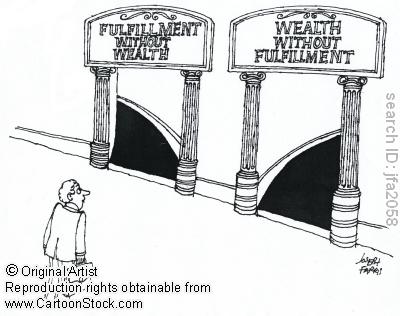
Being a successful entrepreneur can be quite lucrative. In fact, it can be lucrative enough that it distracts people. People see the money, power, and/or fame, and then aspire to be in this position.

A true entrepreneur is concerned with, and often obsessed with, the process of creating some thing of value. Money isn’t the goal. Money is the byproduct. It turns out to be a great byproduct because it can be reinvested to create more things of value.

The second part of this is that entrepreneurs create value “in the world”.

What good is a creation that never sees the light of day? It is the entrepreneur’s version of the proverbial tree in the woods.

Entrepreneurship is more than creation; it implies some form of accessibility or distribution.

An entrepreneur creates this thing of value, but doesn’t stop there. An entrepreneur ensures that this thing touches the world.

This is the value of the entrepreneur. This thing would not exist if the entrepreneur wasn’t there to create it. And because this thing has value to some people in the world, the entrepreneur has made the world a better place.

So there is it: my tentative definition of an entrepreneur, which at this point, seems to make perfect sense to me.

It makes me sure of myself, and clear about what I am doing.

I am an entrepreneur. I want to create a thing of value. And I want to see it touch the world.

P.S. This is lucky post number #7 in a 100 day blogging challenge. See you tomorrow!

Follow me on Twitter @alexshye

Check out my current project Soulmix, your daily mix of food for the soul. Request an invite now for free early access to the private beta!


Internal and external mirrors

Credit:  Quasimondo (Flickr)

Credit: Quasimondo (Flickr)

What do you see when you look at yourself internally?

You see your self as you are. You see your self changing. You see your self as your actions. And, you see the self that you would like to be.

All of these these dimensions, many of which contradict each other, and many of which are fluid in nature, make up the self you see within your internal mirror.

What do others see when they look at you?

You would like them to see you as your are. But that is complicated.

Our brains naturally categorize the external world, simplifying concepts and placing them into nice little boxes within our minds. You are either smart or not. A hard worker or a slacker. Responsible or flakey. Shy or outgoing. Childish or mature.

Others will categorize us, and their words and actions act as an external mirror.

The external mirrors do not reflect who we are. At best, they reflect an accurate slice of our personality. At worst, they are disastrously incorrect.

And herein lies the danger.

The external mirrors become the world you see, and the world you interact with. If you are unaware, you will look at them, believe the reflection to be true, and become the image that you see.

Be aware. You become what you see.

Are you focusing on your internal or external mirrors?

P.S. This is post 5/100 in a 100 day blogging challenge. See you tomorrow!

Follow me on Twitter: @alexshye

Check out my current project Soulmix, your daily mix of food for the soul. Request an invite now for free access to the private beta!

The first step

TOSHIBA Exif JPEG

They say the first step is the hardest.

The first step is daunting. You start with nothing. No history. No momentum.

But, the first step is critical. You have big dreams, and you want to live a life you are proud of.  You can’t make that happen without the first step.

And so you take it. Now what?

You have a bit of momentum. You have a bit of history. But not much. You are only a single step into it all, and it feels like you have just begun because, well, you have.

The next step may as well just be that first step.

But you need to take it, and so you do

What now? Again, the next step feels the same.

The journey of a thousand miles begins with a single step.

I love this saying. But it doesn’t tell the whole story… at least not in an obvious way.

Here is how I like to think of it:

The journey of 1000 miles begins with the first mile.

The journey of 999 miles begins with the first mile.

The journey of 998 miles begins with the first mile.

Got it?

At some point, you may build up momentum. That is great, but you can’t count on it. Because even if you have traveled 500 miles, you will wake up to a new day and see what you have another 500 miles to go.

It is always that first mile. It is always that first step.

Theory versus practice.

In theory, it is always that “first step”.

In practice, the only thing that matters is whether you make it “today’s step”. And whether you take it every single day.

P.S. This today’s step as post 2/100 in a 100 day blogging challenge. See you tomorrow!

Follow me on Twitter @alexshye

Check out my current project Soulmix, your daily mix of food for the soul. Request an invite now for free early access to the private beta!

I’m writing 100 posts in 100 days

Power of Words

Yesterday I came across a blog post by David Spinks on writing 100 posts in 100 days.

My first thought was, “Wow, that is a great idea. I wish I could do that.

Then I remembered the most important lesson I ever learned: just do it.

So now I’m doing it 🙂

Why 100 in 100?

I’ve always enjoyed writing.

One reason for this is that I grew up with a speech impediment. I used to stutter a lot as a child, and still do when I get nervous. Although I can’t always communicate clearly through speech, I can write as whatever I want.

Another reason is that writing just feels good. There is something cathartic about sitting down with your thoughts, distilling them, and putting them down to paper (or virtual paper). It is an exercise in self expression, and must be why artists love their craft.

That said, I not a good writer. And I am definitely a slow writer.

There is a reason that I rarely blog. It usually takes me a few days (sometimes up to a week) to get any post to the point where it feels publishable. And even then, I’ll make a pass after publishing and find all kinds of typos and mistakes that should be fixed.

I want to get better at writing, and this an awesome way to do it.

Embracing the suckitude.

I promise one post a day. That is it.

Some posts will be really short. Some will be wrong. Some will be pointless. And some will just plain suck.

But it is all good.

If there is one thing I fully believe in, it is the power of ritual and habit. I’ve already seen it in various areas within my life.

  • Try running everyday, and see how fast you get.
  • Try lifting everyday and see how strong you get.
  • Try coding everyday, and see how good you get.
  • Try partying everyday and see how much your alcohol tolerance increases 😉

I’ve never tried blogging everyday, but am sure it will be worth it.

Let’s see where this goes!

Here we are: post 1 of 100, complete.

See you tomorrow!

Follow me on Twitter @alexshye

Check out my current project Soulmix, your daily mix of food for the soul. Request an invite for free early access!

Beware of false dichotomies: Goals vs Love

There is a whole industry around goal setting. There are tons of books and articles about goals. They tell you about the importance of goals, how to set them, how to achieve them, etc.

There is also the other side. They say to forget about goals. They say to do what you love, and it all works out.

Guess what? Both sides are right.

It is good to have goals. Goals are like dreams. They can be amazingly inspirational. Lofty goals can inspire and mobilize nations. JFK set the goal of reaching the moon. And, we did. That was good. MLK dreamt of equality. We are getting there. That is a good goal. Years ago, I set a goal of running a marathon. I trained, ran the Chicago marathon, and was happy about it.

It is also good to focus on what you love. Who doesn’t want to do that? It sounds obvious, but can be hard to accept. Recently, I quit my job because I didn’t love what I was doing enough.

Both sides can also be wrong.

If someone has the wrong priorities, or is not ambitious enough, they can set goals that limit themselves. Similarly, if someone loves the wrong things, doing what they love can be detrimental.

What is interesting is to see how these sides interact.

The goal-setting side tends to be more positive and inspirational. They will sometimes talk about love for your work, and sometimes they won’t.

The other side tends to be more negative. They look down on the corny self-help stuff, and proclaim their love for their work. A good example of this is the recent article titled ‘Forget Self-Improvement’. It is completely ridiculous and sets up a false dichotomy between having goals and doing what you love.

In reality, the world needs both sides of the story. It needs people with goals and dreams, and it needs people doing what they love.

But if I were to wish anything for myself, I want both: to have good goals in what I love. It doesn’t matter which comes first, the goals or the love. I’m fairly sure it is possible both ways.

Working at home and loving it

It is well-known that working at home can be both awesome and horrible. As a first-time, near-broke, entrepreneur, this is pretty much the only option I have. If I had money, a co-working space may work out. If I had even more money (funding), maybe an office. But, as of now, those aren’t possible.

This is how I learned to love working at home.

Customize your working space.

This is one of the best parts of working at home. You can set up your workspace any way you want: take advantage of it!

First, I highly suggest getting a standing desk. One of the problems with working on computers too much is that we sit way too much. Not only is all the sitting bad, but many of us have bad posture. We hunch our shoulders forward, stick our necks out, and lean forward towards the monitor. After hours, it wreaks havoc on your body. And over the years, it is no good. Standing promotes more movement, and if set up correctly, allows you to work upright.

I bought the UTBY underframe, a table top, and the FRANKLIN high chair at IKEA. The table was a bit low, so I went to Home Depot, and got them to cut some 4×4 blocks that I bolted to the bottom of the underframe.

The FRANKLIN high chair is perfect. It allows you to take breaks from standing a occasionally sit. You can also sit on it like you would a bar stool, partially on the seat, and partially standing on one leg. More importantly, it is not a comfortable chair. This forces you to constantly shift your position as you work, and not sit for too long.

Here is a picture of my work space and my standing desk.

My home work setup.

Besides the standing desk, you might notice a few things:

  • Speakers: I love music. One of the perks of being at home is that you can listen to whatever music you want as loud as you want.
  • Tennis ball: If you’ve worked as long as I have at the computer, you get knots in your back, neck, shoulders, etc. Take an occasional break and work them out! Tennis balls are perfect for self massage.
  • Foam roller: Another approach to working out knots is to use a foam roller. I keep one next to my desk, and use it along with the tennis ball.
  • Basketball: My fingers occasionally get tired from typing. Some people use the little balls that you squeeze. I like to pick up my basketball, and squeeze it with my fingers as you would with palming the basketball.

Having a custom workspace makes it much easier to be happy work at home. Everything you need is there exactly how you want it.

Separate working space.

Make sure your work space is separate from your regular living area, especially your bed room. You want to separation between work and living, and this is the best way to do it.

At first I set up a regular desk in my bed room, and a standing desk in an unused part of the living room. My thought was that I could switch between areas and get a change of pace. Very quickly, I stopped using the desk in the bed room. First, having a bed to lay on makes it easy to take a nap (and who doesn’t love naps when you have all day for a nap?). Second, you get used to thinking about work in your bed room, and it make it hard to separate from work when you actually want to sleep at night.

You will do yourself a huge favor my moving out of your bed room. Even better is to go somewhere you don’t normally go. I put my standing desk in an area of the living room behind the couches for watching TV. It is an area that I never used to spend much time before, so my mind treats it as a new area of the apartment.

Have daily rituals that makes you happy.

The days at home can get monotonous. And there are ups and downs to working on your own stuff. It is good to put together a routine, preferably a morning routine, that makes you happy. It helps to start the day with something you really like.

I love coffee. I love making fresh coffee. I love the smell of coffee

First thing I do when I wake up, is start boiling water. It forces me to walk out of my bed room, down the stairs, into the kitchen, and then back up the stairs. By then, I’m a lot more awake, and am anticipating the coffee.

I get ready for the day as the water boils. When it is done, I grind up some freshly roasted beans, put it in the french press, wait 15 minutes, and voila.. awesome coffee!

I’m a simple man. This makes me happy every day.

Other rituals are good too. One thing I have started doing is taking frequent walking breaks. I go outside, look around, appreciate everything around me (to be fair, its much easier with the great California weather), and then go on a walk to clear my mind.

Pick whatever makes you happy. Just make sure that there are a few things you do each day that truly make you happy.

Make yourself happy beyond rituals.

Beyond rituals, make sure you consistently take breaks and do things that make you happy.

I love food. So, treating myself with good food every-so-often works well. As a near-broke entrepreneur, it is so easy to fall into the trap of trying to live as cheaply as possible. I started eating ramen or black beans and rice all the time. Don’t!!

It isn’t hard to do things that are nice, but don’t cost much money. They just take a bit of effort to make happen. For example, get out to your Farmer’s Market, buy some fresh food, and make something that puts a smile on your face!

Lunch today: fresh bread, mozzarella, heirloom tomato, olive spread, and basil. Sure beats ramen!

Get out!

I believe humans are wired to be social. We need some form of human interaction. No matter how good your work setup is, nothing replaces a real person. So get out and work with people!

I have gone out to work with friends in their co-working space, or just met up with people to hack together (or just trade stories) at a coffee house. Even better, if you are an entrepreneur, use this as a opportunity to meet new people and expand your network.

It’s now been 15.5 weeks for me working at home, and things have been pretty awesome. If you make sure to take advantage of your freedom, do things to make yourself happy, and occasionally connect with others during your week, I believe it is possible to work from home indefinitely. That said, one day I wouldn’t mind some funding and a great office space to customize :).

Step out of your box. And show some respect.

I like to view the world as a place of endless opportunity. There are new things to learn, ways to think, places to visit, and people to meet. Life is simply a span of time that we are given to experience the world.

This is great in theory, but in practice, things are often very different. Although most people have a great deal of freedom, many don’t exercise it as much as they should.. or could.

When studying myself and the world around me, it seems there are two strong human tendencies that contribute to this. I find both to be unfortunate. They tend to stagnate lives, and generally make the world a worse place to live in.

Credit: Benjamin Arthur

1) We are limited by our background.

It is easy to become limited by our previous life experiences. And many of those life experiences were not fully under our control. We can’t control who our parents are, how they chose to raise us, the country we were raised in, the part of the country we were raised in, the family financial situation, the teachers we had at school, etc. But nevertheless, our past has a strong hold on our present, and often our future.

Here are a few examples:

Career. Many people follow a linear career path. They pick area of interest early on, get schooling, get a job, and then climb the ladder in that area. The early choice of an area to study greatly impacted the next few decades of life. What if they had picked something else? What if they had been exposed to more? Would they do something different? Should they have done something different?

Academia. University is supposed to be the land of free thought. Tenure means freedom. Why is it that everyone sticks to their field of training? And typically, it isn’t just a field: it is a subfield of a subfield of the field. They get a PhD in dynamic compilers, get tenure researching dynamic compilers, and then continue to work in dynamic compilers. Why is this? There is so much to explore. Things change quickly.

Religion. I was not raised with a religion. Besides my one year of Christianity, I have stayed non-religious. Many of my friends were raised Christian. Today, they are Christian. Some were raised Buddhist. And today, they are Buddhist. There is a pattern here.

Location. The world is a big place with various types of people, cultures, food, etc. Many people don’t take advantage of this. Growing up in Bay Area, I know many people who have barely left California. Some have barely left the Bay Area! It is like this almost everywhere. Small town folks tend to stay in their small towns. Many big city folk love their big city.

2) We are prejudiced against that which is different.

Our background puts us into a box. What about what is outside of that box? When encountering something new, we almost always get defensive and negative by default.

Again, a few examples:

Career. Engineers think that business folk are stupid douchebags. Business folk think that engineers are dorky code monkeys that exist to build out their ideas. Academics value their ivory tower and often look down on  industry jobs. Industry people think academics are in one large delusional circle jerk with their heads stuck up their butts.

Academia. I lied. Industry folk think academics are in several large circle jerks, not just one. At least in computer engineering and science, there are several “hot” fields at any given time. It is easier to publish in an established “hot” field. It is also easier to get funding from what I understand. Outside of these “hot” circle jerks? Not so easy. (To be fair, you can publish weird stuff. I did in my PhD).

Academics in a hot subfield.

Religion: Those who are religious often believe they are right, and the others are wrong. Those without religion think all of them are wrong. This isn’t necessarily that bad, except for the animosity that can come from it. What kind of animosity? Wars.. lots of wars.

Location. Californians are liberal, hippy, tree-huggers. New Yorkers are asshole investment bankers. Everyone in Miami and LA is shallow. Small town folk have narrow minds. What else? Feel free to insert your favorite location-based stereotype here.

And the list goes on. Historically, white people had a difficult time with those of color in the US. Today straight people have a difficult time with gay people. We tend to not like that which is different.. and that is very unfortunate.

What to do.

Be aware of these tendencies. Help others be aware of them too.

Don’t let our past take a hold of us. Choose what your own personal future should be, and make it happen.

If you find yourself thinking or talking negatively about something different, stop yourself for a second. Do you really understand what you are talking about? Probably not.

So here is my memo to the world:

The world is your oyster. Recognize that box you are in. Step out of it. And show some respect. Thanks!

The most important lesson I ever learned

I recently read an article by Steven Pressfield titled “The most important writing lesson I ever learned”.  In short, the lesson is this: no one wants to read your shit.  I’ve just begun writing, but hopefully over time people won’t mind reading my shit. In any case, here’s some more shit.

This got me thinking more broadly about the most important lesson I ever learned. The lesson is quite simple, and may sound familiar:

Just do it.

Simple right? I would like to think so too, but it took me 23 years to properly apply it outside of just having fun.

The backstory.

I’ve never been good at doing what I’m “supposed” to do.

I was never the model Asian child. I talked back to my parents. I listened to 2pac during class at Chinese school. I cut summer school classes to bike around and explore. This exploring had a few negative consequences: I was caught for stealing a few times*, and put on probation for 2 years after accidentally setting a brush fire.

Despite having a PhD, I was never the model student. I didn’t do homework if it was boring. In college, I stopped copying homework because it took too much time (even with a good friend often offering to give me the answers). I skipped labs to play basketball. It wasn’t long until I brought home my first B, and then my first C, and then D.**

How I felt about doing what I was supposed to do as a kid. I don’t suppose much has changed.

Now this is all fine and dandy, except for when there is something you actually want to do! When you have bad grades, you look like crap on paper. When you look like crap on paper, people don’t take you seriously. It turns out there are tons of people that don’t look like crap on paper, and many that look awesome on paper. And when people don’t take you seriously, it can be hard to get started on whatever you want to do.

The lesson.

At the end of my junior year, I found something I wanted to do. I took a course on computer architecture and found it fascinating. I decided that I wanted to do research in computer architecture.

When I arrived at the M.S. program at the University of Colorado, I was very excited. It was time to start doing research! There was just one problem. I didn’t have an advisor. My friends that looked awesome on paper (and who actually are awesome) started with an advisor funding them. Unfortunately, I started without an advisor and without funding.

I began bugging professors to be my advisor. I went door-to-door, introduced myself, talked with them about their research, and asked if there was something I could help with. All of the professors rejected me in some form. I continued bugging a few professors every week. Each time, I was rejected. This continued for months, and I began to feel hopeless about the situation.

One night, over a few Jack+Cokes, I told one of my good friends about my problem. I told him about the professors I was bugging. I told him about the months of rejection. I told him about how hopeless I felt.

And then I heard perhaps the best advice I will hear in my lifetime:

“What are you doing? Why don’t you just start doing research?”

This blew my mind. I thought I needed an advisor. I thought I needed guidance to begin research. But all of that was wrong. The only person stopping me from doing research was myself.

I began going into a research lab every day. Without a summer internship, I went through the summer. I set my own research agenda. I learned, coded, and collected preliminary data all summer. I also connected with one of the senior students in that lab and he began mentoring me. By the end of summer, I showed a professor the preliminary data, and soon became a funded graduate student. Years later, I completed a PhD in computer architecture, and landed a great industry research job in computer architecture (which I recently quit, but that is a different story).

Lesson learned.

We all have goals. We all have things that we want. No one is going to hand you what you want on a silver platter. The flip side to it is that no one is there to stop you from getting started. So just do it!  Whether you reach the goal or not is irrelevant. Most likely you will gain a lot along the journey.

I’ve found this lesson broadly applicable. If you want to learn anything, just do it. No one will stop you. If you want to do anything, just do it. Just make sure you can live with the consequences. If you see a cute girl/guy and want to talk to them, just do it. You may get rejected, but no one is stopping you from trying. It applies to just about everything.

I’m not saying I’ve always followed this lesson. But, when I have, it has paid off. And, when I haven’t, I have often regretted it.

There is a reason Nike is so iconic: they have a damn good company mantra.

* I haven’t stolen in years. When you get caught as a minor (and if you do it enough, it is inevitable), you only get slapped on the wrist with a phone call to your parents. As an adult, it’s a stupid way to seriously mess up your life.

** I never got an F in my life. It is actually pretty hard to get an F. With a little bit of work, a D- is very attainable. And, I’m still a horrible student. My PhD advisor once told me, “you are bad at school, but could be a good researcher.”

Something new…

Last Friday was a big day for me.  I started the day employed as a researcher in the mobile industry.  I ended the day as a first-time entrepreneur (a.k.a. unemployed, but hopeful, bum).

When I joined Qualcomm Research Silicon Valley (QRSV) 19 months ago, the job seemed like a perfect fit.  QRSV was an up-and-coming lab in my research area.  The pay was a huge step up from grad school.  The people were awesome.  The project was intellectually challenging, with the potential for large industry impact.  It was just about everything a fresh PhD could ask for.

That’s great.  So, why leave?

About one year into the job, something started to nag at me.  I couldn’t place it, but something felt wrong.  At first, I convinced myself that I was uncomfortable with industry. Coming from grad school, industry felt like a huge culture shock.  I told myself to stick with it, and hoped that the feeling would pass.

Except, the feeling didn’t pass.  With each day, the feeling grew stronger.  I wish I could say that I understood myself, and quickly figured things out.  Unfortunately, that was not the case.  Initially, days passed, followed by weeks.  Over time, work became less exciting, and I began to dread going to work each morning.

As the feeling grew stronger, it eventually manifested itself as a faint voice in the back of my head:

“This is wrong.  What are you doing with your life?”

What was once a vague feeling, was now a voice with a clear message.  The message itself isn’t anything unique or special.  If I had to bet, a good majority of the human population has heard the same message at some point.  It is the stuff that great mid-life crises are built on.

In any case, it was time to honest with myself.

What am I doing with my life?

I was doing what I was trained for.  I spent many years in school along the same streamlined career path, accumulating B.S., M.S., and Ph.D. degrees in Computer Engineering.  This job was the next logical step.

I was doing something that I could be good at.  I’ve learned over the years that as long as I work hard, I can excel at what I’m working on.  I believe that I did reasonably well.  If you measure by publications in top-tier conferences, I made a meaningful impact through several papers.  If you measure by real-world impact, it remains to be seen.

I was doing something that could be fun.  Research is fun.  Working with brilliant folks at the top of your field is fun.  Writing code, debugging it, and integrating it into a larger project is fun.

As I mentioned above, this is a really good set up, and there really aren’t any complaints. Most people would be happy with the situation.  In fact, I continue to refer my friends to Qualcomm Research because I believe it is a great place to work.

So, what’s wrong with this picture?  It took me a while to answer this, but in hindsight, it’s quite simple.

We only have one life.  We are only young once (and at 32, I’m not that young).  We have a limited time on this Earth, and we better make good use of this time.  Therefore, the most important decisions we make in our lives are related to how we allocate our time.

Furthermore, we spend a majority of our young adult waking lives working.  To some degree, this is a sad realization.  The average work day is supposed to be 8 hours.  Most of the people I know work far more than that.  Thus, on an average work day, people spend more time at work than with their families.  If the most important decisions we make are related to how we allocate our time, and we spend a majority of our young lives working, the choice of what to work on is pretty damn important.

The result from this thinking is straightforward.  Doing what I can is not good enough. Doing what I could be good at is not good enough.  And doing what may be fun is not good enough.  Given the opportunity to work on anything, I need to find what I want to do.

What’s next?

This brings us to the present.  I quit my job to figure out what what I want to do.  There are several ways I could approach this.  One approach could be to find a position within a large company that gives me freedom to explore.  Another approach could be to join a startup that has goal that I vibe with.  Both of these may work, but I am afraid of being constrained by the direction or politics of the organization.  For now, I intend to strike it out on my own, and give myself absolute freedom to find what I want to work on.

Although the future is hazy, I do have a general idea of where I am going.

I have always been interested in the human condition.  If you see me in a book store, you will not find me in the computer aisle.  Instead, you will find me rummaging through books on psychology, self-help, business, and personal development.  I am interested in what makes people tick, and how people live their lives.  I like thinking about how to make my life more awesome.  I like thinking about how to help others live the best lives that they can.

I want to combine my fascination with the human condition, and my interest in computing technology.  How do we design products that change lives?  How can technology help make us better people?  How can technology help create a better society?

I have some thoughts marinating in my head, but they are vague and need a lot of massaging.  I hope that in the near future, they will solidify into something to start building. And then, who knows?  Entrepreneurs love to talk about pivoting, and I’m sure I will do my fair share of that.

The first few days.

After quitting my job, I took the weekend off and explored Point Reyes National Seashore in Marin County.  The hikes are good.  Some of the views are gorgeous.  The oysters grown in Tomales Bay are abolutely delicious.  If you haven’t been, I would suggest spending an afternoon there shucking oysters and washing them down with some good beer or white wine.

Yesterday, I woke up with an amazing sense of freedom.  It feels surreal.  Aside from monetary concerns, there are no limitations.  I don’t use my alarm clock anymore.  I can go for a run anytime I want.  I can spend all day thinking about whatever I want.  I can build whatever I want.

I know it’s only the beginning, and there will be many ups and downs in the near future, but for now, everything is fun and exciting.

Stay tuned.  I will keep you posted with random thoughts on life, and chronicles of my adventures as a first-time entrepreneur.