Luke Wroblewski: Mobile to the future (Google tech talk)

I came across a great talk about mobile from the AVC blog from Luke Wroblewski on mobile product design.

Luke makes an insightful point that mobile isn’t just a smaller desktop. Similar to the text, music recordings, radio, TV, and the Internet, mobile is actually a new form of mass media. And as a new form of mass media, it is transformative. We shouldn’t be designing for mobile as if it was a smaller computer. We need to treat it as an entirely new things.

He notes how Facebook has become a mobile company, and how more and more companies will hit a point where mobile traffic outpaces desktop traffic.

The bulk of this talk goes through one example of rethinking login design for mobile. All in all, a great talk for those thinking about mobile trends and mobile design.

Derek Sivers: How to start a movement

People often make the analogy between starting a movement and getting a startup off of the ground. People also tend to glorify the leaders/founders for getting the movement going.

Derek Sivers has a really interesting take on this, and observes the importance of early followers. This is a short video, and I won’t spoil it anymore than that. If you haven’t seen it, it is definitely worth a view.

http://www.youtube.com/watch?v=SsvYQKcX_GY

Securing investment from others

An important part of building large scalable startups is securing investment money. The cash infusion is important because it allows you to grow much faster than you would normally be able to grow. In winner-take-all markets, this can be the difference between success and failure.

Securing investment isn’t just for startups.

When you get hired for a job, it essentially means that your job is making an investment in you. Your boss has decided to place a certain amount of money in your direction, with the expectation that the cash investment will pay off in the future.

You could make a loose analogy with relationships also. They say time is money right? Time can often be more valuable than money, since you can never get time back. When someone decided to spend time with you, they are investing their time with you. The expectation is that the time is well spent, and that there is some type of reward/benefit for them. Relationships don’t always work this way, but I would argue that a great two-way relationship does: both people invest their time in each other, and both people help each other grow.

Securing outside investment can be a scary thing. It isn’t your decision. Someone else makes the decision to invest in you.

In order for someone to invest in you, you much either (1) be a good investment, or (2) seem like a good investment.

Both strategies will work, except that (1) will produce long-term benefits for the investor, and (2) will most likely will never produce any type of benefit. What follows seems clear. You should shoot to be (1). Be a good investment. With (2), you are just duping people, and it will never work out for you in the long run.

How do you become a good investment?

You can hope for friends and family to invest because they care about you, but at the beginning, the only person to who can definitely invest in you is YOU. You may not have money, but you have your own time. And, with that time, you can choose where you place your attention, what you learn, and what you do.

When you have developed yourself enough (emotionally, physically, mentally, tactically, etc.), you will simply BE a good investment. And when you are a good investment, you just be yourself, tell the truth, and it should’t be hard to get outside investment.

What are you after? VC money? The job? That awesome girl or guy?

Become a good investment, and you will get what you deserve.


What content people want

Paul Graham of Y Combinator has a motto: “make something people want”.

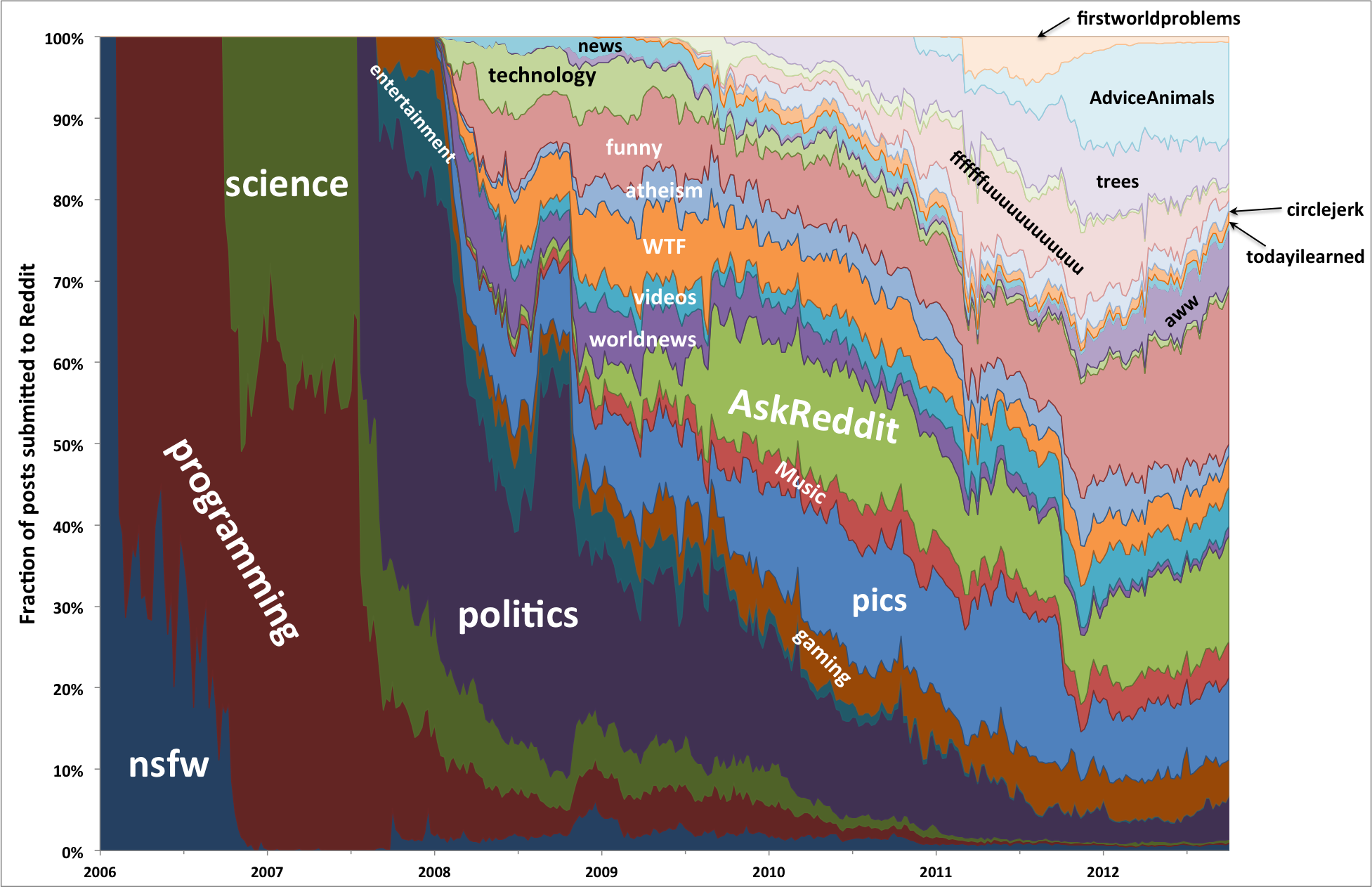
If you believe in the motto (which makes a lot of sense), and you are working on a content-related startup, Randal Olson has recently posted a gift for you. In a blog post, he shows the number of posts on Reddit across different subreddits.

A picture of the large timeline is below:

Credit: Randal Olson

Credit: Randal Olson

In this graph, you can see that Reddit gained traction within a particular niche which was most programming related (apparently this niche loves NSFW content also). In the first year or two, it covered other topics that programmers/hackers may find interesting, such as politics and science. In 2008, Reddit went mainstream, allowing users to create whatever subreddits they liked. And as a result, Reddit as a whole changed dramatically. Today’s Reddit is dominated by images, memes, videos, advice, and funnies.

Some look at it and cry out “Reddit has gone mainstream!”, or even worse, “Reddit has gone downhill with stupid memes and garbage”. That is one way to look at it. Another way to see this is to understand that the users have spoken. This is the Reddit they want. More specifically, this is the content they want.

If you are building a content-related startup, this information is gold.

If you are building a general content-related startup, you better allow users to share some combination of images, memes, videos, advice, and/or funnies.

If you are building a niche content-related startup, make sure to take a good look at this graph. The right side of this graph is what users want. If you are going to target it niche, it shows you which niches you might want to start thinking about.

P.S. On a related note, last year, I wrote a blog post on the unbundling of Reddit. It is still continuing today, and if you are building a startup that unbundles a niche of Reddit, this tells you where the big niches are.


Fred Wilson’s litmus test for startups

I just wanted to quickly share an image that I found on Quora today.

Semil Shah describes using Fred Wilson’s litmus test for looking examining startups. I’m a huge fan of simple concepts that get to the core of a problem, and will probably use this framework for thinking about my own startup as well as other startups.

Fred-Wilson-startup-testSimple equation: Person/team + idea + product + timing + market = Great.


Curation as the third frontier of the web

One of my recent big interests has been related to our relationship with content on the web. I’ve written a few posts on this about the importance of old content, and on finding the best content on the web. I’ve been beginning to believe that curation will play a huge role in our relationship with content.

Today I stumbled across a great blog post that helped me crystallize more of my thinking on this topic by Patrice Lamothe (founder of Pearltrees) called The Web’s Third Frontier.

The most interesting part to me was a section on the founding principles of the world wide web:

The founding principles

These principles are simply the initial objectives that Tim Berners-Lee and Robert Caillau stated for their project. Eliminating technical jargon, these objectives can be broken down into three general, universally applicable propositions:

1-    Allow anyone to access any type of document

2-    Allow everyone to disseminate their own documents

3-    Allow everyone to organize the entire collection of documents

When I came across this, things began to make sense.

  1. Information access: The Internet allows anyone immediate access any type of document via a URL.
  2. Information dissemination: Blogs enabled simple creation of content, and timely dissemination has been enabled via mailing lists and RSS readers.
  3. Information organization: This is where we are stuck with limited options.

This is a huge insight. Access and dissemination have been solved. Organization hasn’t been solved, and it could be a game changer on the Internet.

As far as organization goes, we are limited to (1) the time-based nature of blogs and news sites, or (2) the retrieval process from automated search.

Curation provides a much-needed third option, and it sounds good in theory, but has been difficult to implement in practice. Outside of Pinterest, which is mainly about images, there hasn’t been another huge winner in this space (and many have tried!).

What will to take to crack the curation space? I can’t say I have an answer, but am starting to come up with some interesting thoughts. If you have any thoughts or opinions on current and/or future curation solutions, I would love to hear from you!

P.S. This is post number #99 in a 100 day blogging challenge. See you tomorrow!

Follow me on Twitter @alexshye.

Or, check out my current project Soulmix.

Critics and creators

gladiators

To me, being an entrepreneur means being a creator. Along the way, an entrepreneur is bound to come into contact with critics. Some critics are friendly and constructive. They may be stern or cutting in their criticisms, but they have your best interests in mind. Other critics aren’t as friendly. They will find reasons to call you and your work stupid, and criticize you when you fail.

No matter the type of critic, it is important for entrepreneurs not to be fazed. The world is made by the creators. Critics will always be there with their words, but the creators make the world to ’round.

I believe that Theodore Roosevelt said it best, so will just leave the rest of the post to his classic quote:

It is not the critic who counts; not the man who points out how the strong man stumbles, or where the doer of deeds could have done them better. The credit belongs to the man who is actually in the arena, whose face is marred by dust and sweat and blood, who strives valiantly; who errs and comes short again and again; because there is not effort without error and shortcomings; but who does actually strive to do the deed; who knows the great enthusiasm, the great devotion, who spends himself in a worthy cause, who at the best knows in the end the triumph of high achievement and who at the worst, if he fails, at least he fails while daring greatly. So that his place shall never be with those cold and timid souls who know neither victory nor defeat.

– Theodore Roosevelt, “Man in the Arena”, April 23, 1910

P.S. This is post number #93 in a 100 day blogging challenge. See you tomorrow!

Follow me on Twitter @alexshye.

Or, check out my current project Soulmix.

Thinking big and small

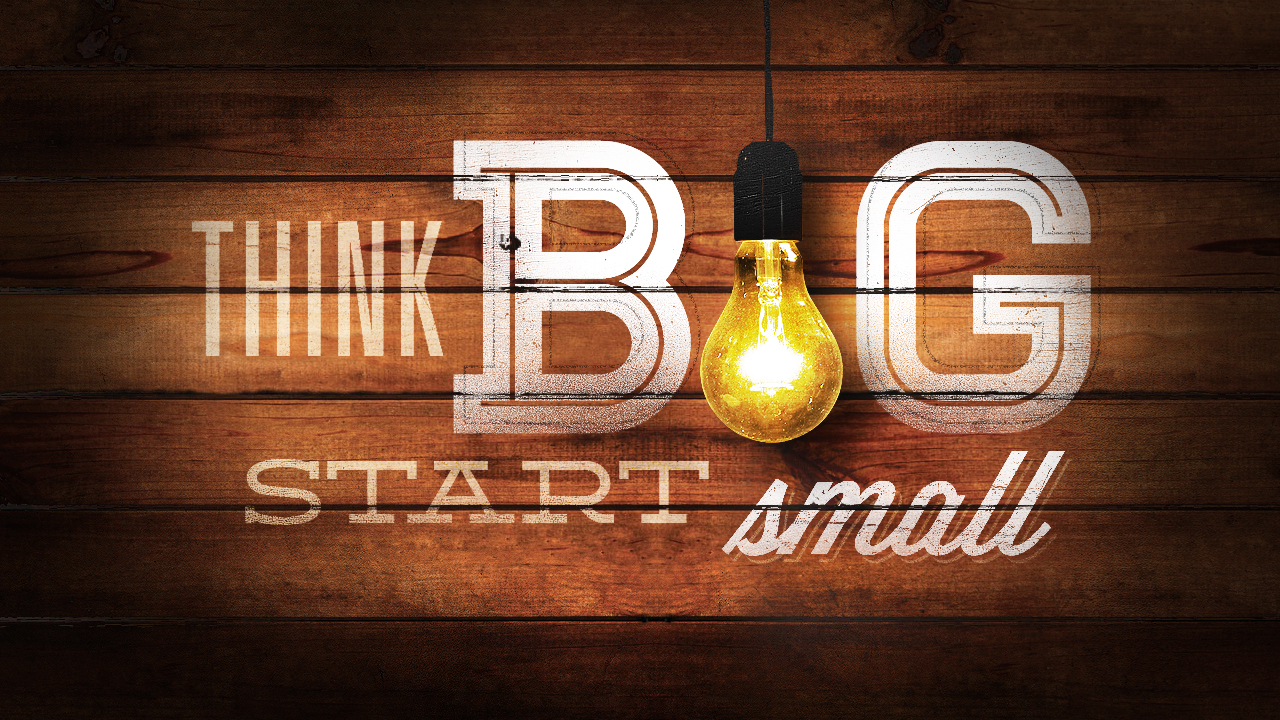
think-big_start-small

I came across this post today by Gabriel Weinberg on thinking big in startups, and it struck a chord with one of the biggest lessons I have learned in my startup career thus far.

As far as I can tell, it is critical for an entrepreneur to be able to think both big and small.

Thinking big gives you a clear understanding of how you intent to change the world. It gives you your mission, which drives you through the entire startup rollercoaster (which is damn tough!). Thinking big ensures that you are tackling a large market. The big vision is essentially what your startup could look like once it hits traction and scales out.

However, thinking big has a major problem. You begin a startup with nothing. Zero traction. Zero scale. No code. No users. No data. Nothing. You don’t magically take over the world overnight. You have to begin with a few small steps.

Here is where thinking small is critical.

You must take your big picture, and distill it down to that first step. The first step is your entry point into the large picture. It is best if this entry point (1) can be tested in a small amount of time, (2) requires relatively little resources, and (3) is something that a market needs right now. Some people may call this an minimum viable product (MVP), but I like to call it my entry point. If selected properly, the entry point should be simple, but powerful. It is enough to begin gaining traction, and sets you on your way towards your larger vision.

What order do you go in? Big first? Or small first?

From what I can tell, Amazon seems to have gone big first. I would bet that Jeff Bezos understood where he was going, and began with an online bookstore. On the contrary, Mark Zuckerberg seems to have gone small first. He built a small thing for his university that gained traction. Afterwards, he developed the large vision and mapped out the steps for accomplishing it.

It appears you can go either way, but at some point, you must be able to think both big and small.

P.S. This is post number #91 in a 100 day blogging challenge. See you tomorrow!

Follow me on Twitter @alexshye.

Or, check out my current project Soulmix.

Relationships and social networks

I find the intersection of technology and human interaction fascinating. Specifically, I am interested in how technology can be used to mimic and augment existing human interactions. I’ve written a bit about Snapchat and how temporary social media is brilliant at mimicking real life experiences. Similarly, the telephone, Skype, and Facetime all use technology to mimic/enable real life conversations.

One area technology hasn’t mimicked well is the formation of human relationships.

What happens when we meet a stranger in real life? We look at them. We observe their dress and body language. We make some small talk to break the ice, and collection enough information to create a first impression. As time goes by, we dig deeper into the relationship, delving into our personal history, our values, our hopes and dreams. We share our lives. And in doing so, we build rapport and trust.

What is the online equivalent? There really isn’t any.

We connect on Facebook and instantly access a stranger’s timeline and photo albums. We look at a person’s Twitter or Pinterest and can instantly view all of their public interests and tweets. There is nothing realistic about this. We don’t gradually get to know someone. Instead, we instantly have access to someone’s information.

This instant access may be OK is some situations, but can be harmful in other situations such as in dating. In real life, after a first date, I only know a little about my date. However, if we connect on Facebook, I can see all of my dates photos, timeline shares, and ex-relationships. IMHO, it breaks the dating process, and doesn’t allow me to slowly learn about a date. That is why the last time I was single, I consciously did not connect with any of my dates on Facebook.

There has to be something better here. Is there some way to create an user experience where people gradually get to know one another? I don’t know exactly what it would look like, but would be glad to see something like this exist.

P.S. This is post number #90 in a 100 day blogging challenge. See you tomorrow!

Follow me on Twitter @alexshye.

Or, check out my current project Soulmix.

Decoupling dissatisfaction from self worth

I came across this great quote from Alan Kay’s today, from ‘The Early History of Smalltalk‘, that strongly resonated with me:

A twentieth century problem is that technology has become too “easy”. When it was hard to do anything whether good or bad, enough time was taken so that the result was usually good. Now we can make things almost trivially, especially in software, but most of the designs are trivial as well. This is inverse vandalism: the making of things because you can. Couple this to even less sophisticated buyers and you have generated an exploitation marketplace similar to that set up for teenagers. A counter to this is to generate enormous disatisfaction with one’s designs using the entire history of human art as a standard and goal. Then the trick is to decouple the disatisfaction from self worth–otherwise it is either too depressing or one stops too soon with trivial results.

The crazy thing is that Alan Kay wrote this in 1993. Fast forward 20 years to today, and this quote has never been more true. It has never been easier to build software, yet it is difficult to make something of real value. The trick still seems to have the ability to decouple one’s dissatisfaction of their current work with their self worth. And then, of course, to keep working and honing one’s craft.

P.S. This is post number #88 in a 100 day blogging challenge. See you tomorrow!

Follow me on Twitter @alexshye.

Or, check out my current project Soulmix.